LongCat Open Sources VitaBench 2.0: A Pioneering Benchmark for Long-Term Dynamic User Modeling in AI Agents
The Meituan technical team has officially open-sourced VitaBench 2.0, a groundbreaking benchmark developed under the LongCat project. This new framework is the first of its kind to focus on long-term dynamic user modeling within real-life scenarios. VitaBench 2.0 is designed to systematically evaluate the capabilities of Large Language Models (LLMs) in maintaining personalization and demonstrating proactivity throughout extended, evolving interactions. By shifting the focus from static, short-term tasks to complex, real-world user relationships, VitaBench 2.0 sets a new standard for the industry. It provides a rigorous methodology for assessing how AI agents adapt to user needs over time, ensuring that the next generation of AI is not only reactive but also deeply personalized and capable of taking initiative in dynamic environments.
Key Takeaways
- First-of-its-Kind Framework: VitaBench 2.0 is the inaugural benchmark dedicated to long-term dynamic user modeling in authentic, real-life scenarios.
- Focus on Personalization: The benchmark systematically measures how well Large Language Models (LLMs) can tailor their behavior based on long-term user data and history.
- Evaluation of Proactivity: A core metric of VitaBench 2.0 is the assessment of an agent's ability to take initiative rather than merely responding to prompts.
- Open-Source Contribution: Developed by the LongCat and Meituan technical teams, the benchmark is now open to the global AI community to drive standardization in agent evaluation.
In-Depth Analysis
The Evolution Toward Long-Term Dynamic User Modeling
The release of VitaBench 2.0 represents a significant milestone in the evaluation of artificial intelligence. For years, the AI industry has relied on benchmarks that test "snapshot" capabilities—how a model performs on a specific logic puzzle, a coding task, or a single-turn conversation. However, real-world utility often depends on an agent's ability to function over days, weeks, or months. VitaBench 2.0 addresses this gap by focusing on "long-term dynamic user modeling."
In this context, "long-term" refers to the model's ability to maintain a consistent understanding of a user across multiple sessions and evolving contexts. "Dynamic" implies that the user's needs, preferences, and environment are not static; they change over time, and the AI must adapt accordingly. By utilizing "real-life scenarios," VitaBench 2.0 moves away from synthetic tests and toward environments that mimic the complexity of human daily life. This shift forces LLMs to move beyond simple pattern matching and toward a more sophisticated form of persistent memory and contextual awareness.
Systematic Evaluation of Personalization and Proactivity
VitaBench 2.0 introduces a structured approach to measuring two of the most elusive qualities in AI agents: personalization and proactivity. These are not just features but are essential components of what makes an AI feel like a "companion" or a "partner" rather than a simple software tool.
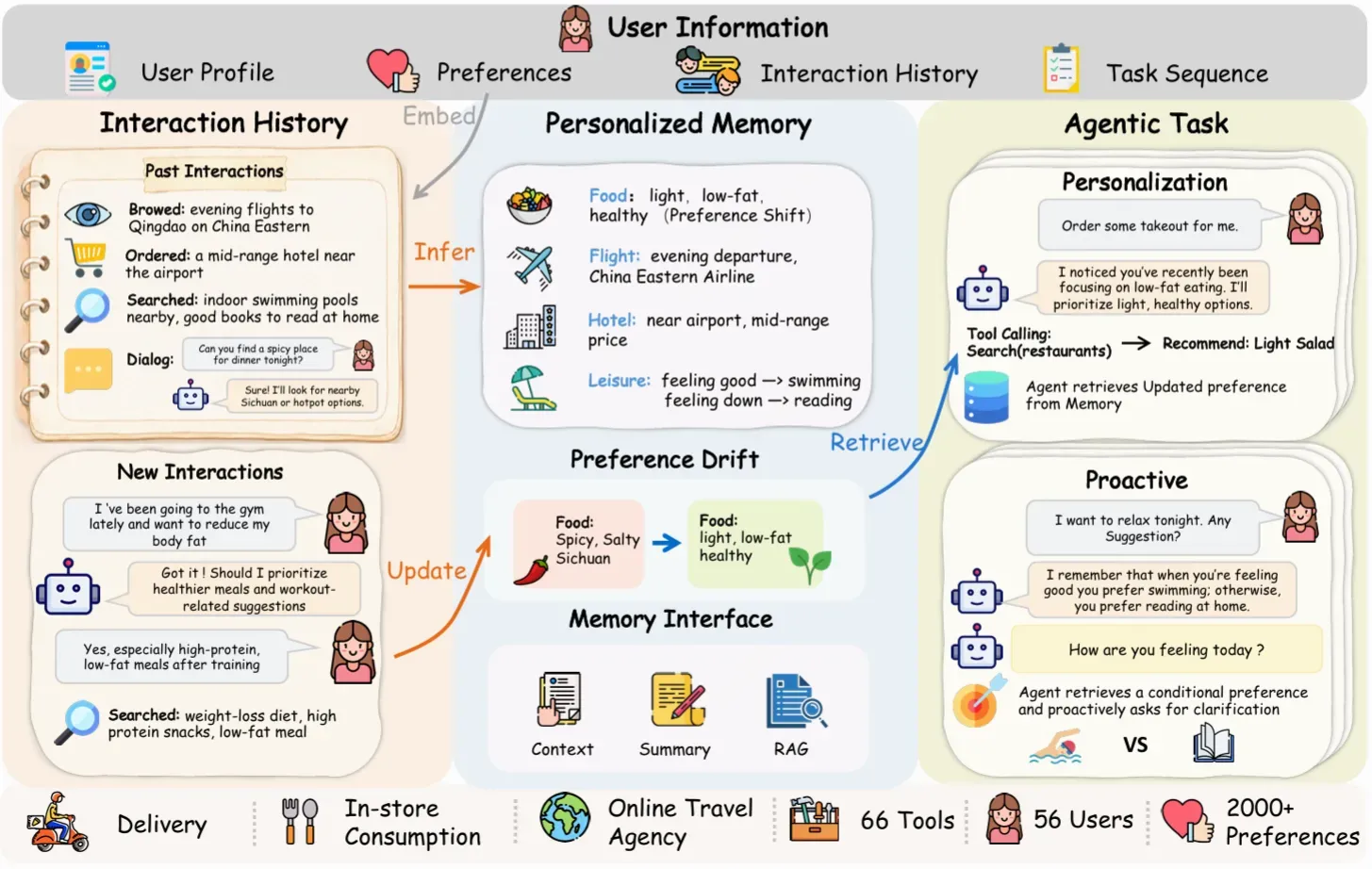
Personalization in VitaBench 2.0 is evaluated through the model's capacity to build a unique profile of the user based on long-term interactions. The benchmark tests whether the model can leverage past information to make current interactions more relevant and efficient. This goes beyond basic memory; it involves understanding the nuances of a user's specific style, goals, and constraints within a dynamic setting.
Proactivity is perhaps the most challenging aspect of the benchmark. In traditional LLM interactions, the user provides a prompt, and the AI responds. VitaBench 2.0 evaluates the model's ability to break this reactive cycle. It measures whether an agent can identify opportunities to assist the user without being explicitly asked, based on its long-term modeling of the user's situation. This systematic evaluation of proactivity is crucial for developing agents that can manage complex workflows or provide timely assistance in real-world applications.
Bridging the Gap Between Research and Real-Life Application
By focusing on "real-life scenarios," VitaBench 2.0 serves as a bridge between theoretical AI research and practical application. Many models that perform exceptionally well on academic benchmarks struggle when deployed in the real world because they cannot handle the noise, duration, and shifting priorities of human life. VitaBench 2.0 provides a sandbox that reflects these challenges, allowing developers to identify where their models fail in long-term engagement.
The systematic nature of the benchmark ensures that these evaluations are not anecdotal. By providing a standardized set of metrics for personalization and proactivity, LongCat enables a comparative analysis across different models and architectures. This transparency is vital for the industry to understand which techniques—such as RAG (Retrieval-Augmented Generation), long-context windows, or specialized fine-tuning—are most effective for long-term user modeling.
Industry Impact
The introduction of VitaBench 2.0 is likely to catalyze a shift in the AI development lifecycle. As developers begin to optimize for the metrics defined by this benchmark, we can expect to see a move away from "stateless" chatbots toward "stateful" persistent agents. This has profound implications for industries such as digital health, personal productivity, and customer service, where the value of an AI is directly tied to its understanding of the user's history and its ability to anticipate future needs.
Furthermore, as an open-source project from the Meituan technical team, VitaBench 2.0 encourages a collaborative approach to solving the "long-term memory" problem in AI. It provides a common language for researchers to discuss agentic behavior and sets a high bar for what constitutes a truly "intelligent" assistant. This benchmark will likely become a key reference point for any organization looking to deploy AI agents in complex, user-centric environments.
Frequently Asked Questions
What is the primary goal of VitaBench 2.0?
The primary goal of VitaBench 2.0 is to provide a systematic and realistic evaluation of how Large Language Models handle long-term, dynamic interactions with users. It specifically focuses on measuring personalization and proactivity in real-life scenarios, which are often missing from traditional AI benchmarks.
Why is "proactivity" a key metric in this benchmark?
Proactivity is a key metric because it represents a transition from reactive AI to agentic AI. A proactive agent can anticipate user needs and take initiative based on long-term modeling, which is essential for creating AI assistants that are truly helpful in dynamic, real-world situations.
Who can use VitaBench 2.0?
VitaBench 2.0 has been open-sourced by the LongCat and Meituan technical teams, meaning it is available to the entire AI research community, developers, and organizations looking to test and improve the long-term user modeling capabilities of their AI models.