LARYBench: Redefining Embodied Action Representation Through Large-Scale Human Video Learning
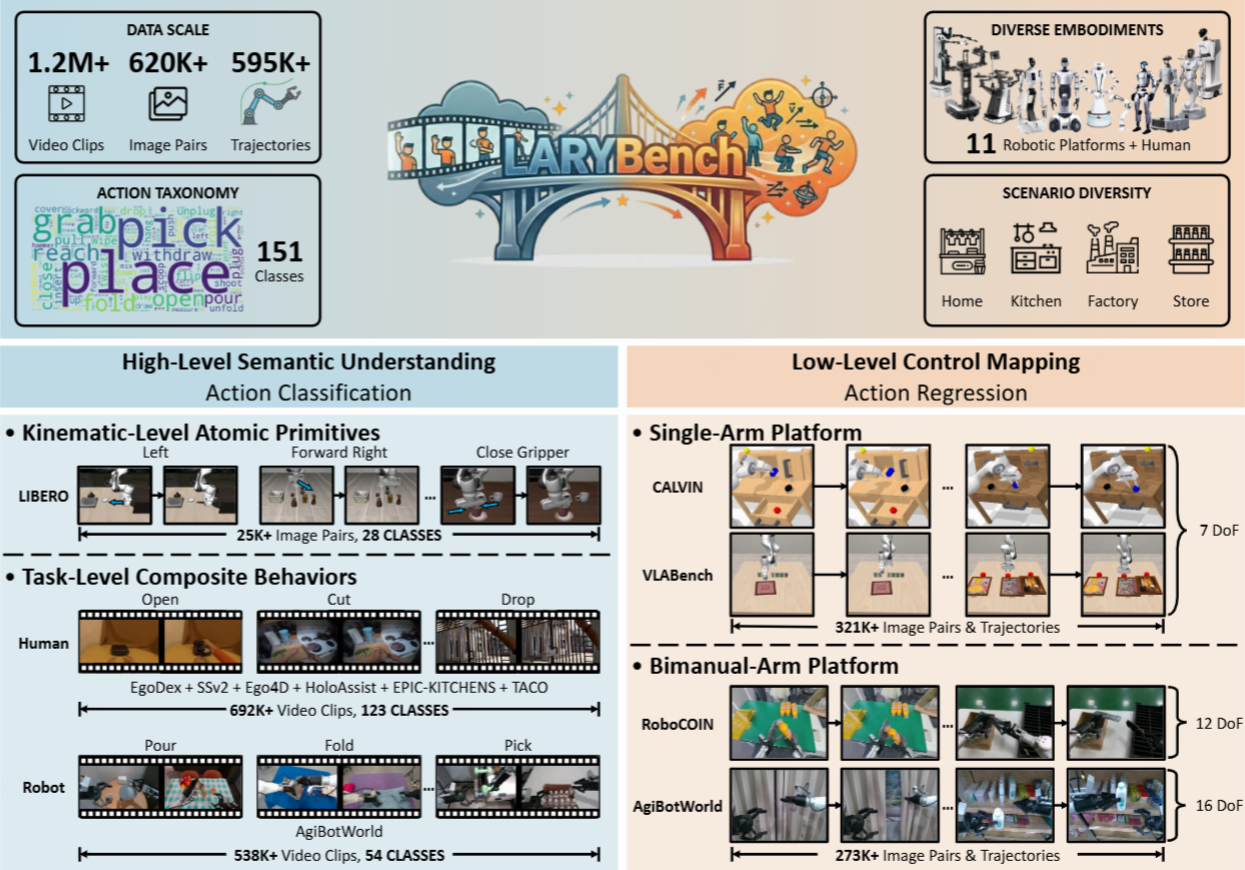
The Meituan Technical Team has introduced LARYBench (Latent Action Representation Yielding Benchmark), a systematic evaluation framework designed to guide the development of general latent action representations from massive visual datasets. This benchmark serves as a critical milestone, often compared to an 'ImageNet' for embodied actions. The research findings reveal a significant shift in AI development: general-purpose vision models demonstrate superior performance in action generalization and control precision when compared to specialized embodied AI expert models. Most notably, the study confirms that embodied action representations can naturally emerge from large-scale human video data, suggesting that the vast library of human motion can be a primary source for training sophisticated robotic control systems without the need for exclusive robotic telemetry.
Key Takeaways
- Introduction of LARYBench: A systematic benchmark created to evaluate and guide the learning of general latent action representations from large-scale visual data.
- Superiority of General Models: Experimental results indicate that general vision models significantly outperform specialized embodied AI expert models in both action generalization and control precision.
- Emergence from Human Videos: The research proves that embodied action representations can emerge from observing large-scale human video data, rather than relying solely on specialized robotic datasets.
- Standardizing Embodied AI: LARYBench aims to provide the industry with a standardized metric for measuring how well models translate visual information into physical action.
In-Depth Analysis
Establishing the 'ImageNet' for Embodied Action
The launch of LARYBench (Latent Action Representation Yielding Benchmark) by the Meituan Technical Team represents a foundational shift in how the industry approaches embodied AI. Historically, the field has lacked a unified, systematic benchmark to measure how effectively an AI model can understand and represent physical actions. By positioning LARYBench as a guide for learning latent action representations, the researchers are providing a standardized 'yardstick'—much like ImageNet did for object recognition. This benchmark allows for the rigorous evaluation of how models process visual data to yield 'latent actions,' which are the underlying mathematical representations of movement that an agent must master to interact with the physical world.
The Performance Gap: General Vision vs. Specialized Experts
One of the most provocative findings presented in the LARYBench report is the performance disparity between general vision models and specialized embodied AI expert models. For years, the prevailing logic in robotics was that specialized models, trained specifically on robotic control data, would naturally be more precise and capable in physical tasks. However, LARYBench's experimental results challenge this assumption. General vision models—those trained on broad, diverse visual datasets—showed a marked superiority in action generalization. This means they are better at applying learned movements to new, unseen environments. Furthermore, these general models achieved higher control precision, suggesting that the rich, diverse features learned from general visual tasks provide a more effective foundation for physical interaction than the narrow focus of specialized expert models.
The Emergence of Action from Human Video Data
The research highlights a breakthrough in data utilization: the emergence of embodied action representations from large-scale human video data. This finding suggests that the path to advanced robotics does not necessarily require the difficult and expensive collection of massive robotic-specific datasets. Instead, by analyzing the vast amounts of human motion captured in standard video formats, AI models can 'learn' the latent rules of physical action. This 'emergence' indicates that the fundamental principles of movement, coordination, and interaction are embedded within human-centric visual data. LARYBench provides the first systematic measurement of this phenomenon, proving that general-purpose models can internalize these representations to a degree that surpasses models designed specifically for embodied tasks.
Industry Impact
Shifting Training Paradigms
The revelation that general vision models outperform specialized ones is likely to trigger a shift in how AI companies allocate resources. Instead of focusing solely on niche robotic datasets, there will likely be an increased emphasis on leveraging massive, diverse visual datasets to build 'foundation models' for action. This could significantly lower the cost and complexity of developing robots capable of performing a wide variety of tasks in unpredictable environments.
Accelerating Robotic Generalization
By providing a systematic way to measure action generalization, LARYBench will accelerate the development of robots that can 'plug and play' in different scenarios. The ability to measure and improve how a model generalizes from human videos to robotic execution is a key step toward creating truly versatile autonomous systems. This benchmark provides the necessary framework for researchers to iterate faster and more accurately on the problem of cross-domain action transfer.
Frequently Asked Questions
Question: What exactly is LARYBench?
LARYBench stands for Latent Action Representation Yielding Benchmark. It is a systematic evaluation system designed to measure how well AI models learn general action representations from large-scale visual data, serving as a standard for the embodied AI industry.
Question: Why are general vision models better at robotic control than specialized models?
According to the LARYBench findings, general vision models possess better generalization capabilities and higher control precision. This is likely because the diverse data they are trained on allows them to develop more robust and flexible representations of action compared to models that are limited to specialized, narrow datasets.
Question: Can human videos replace robotic training data?
The research indicates that embodied action representations can emerge from large-scale human video data. While it may not entirely replace robotic data, it suggests that human videos are a powerful and underutilized resource that can provide the foundational 'latent' understanding of action required for high-precision robotic control.