Meituan LongCat Team Unveils WBench: The First Systematic Multi-Round Benchmark for Interactive Video World Models
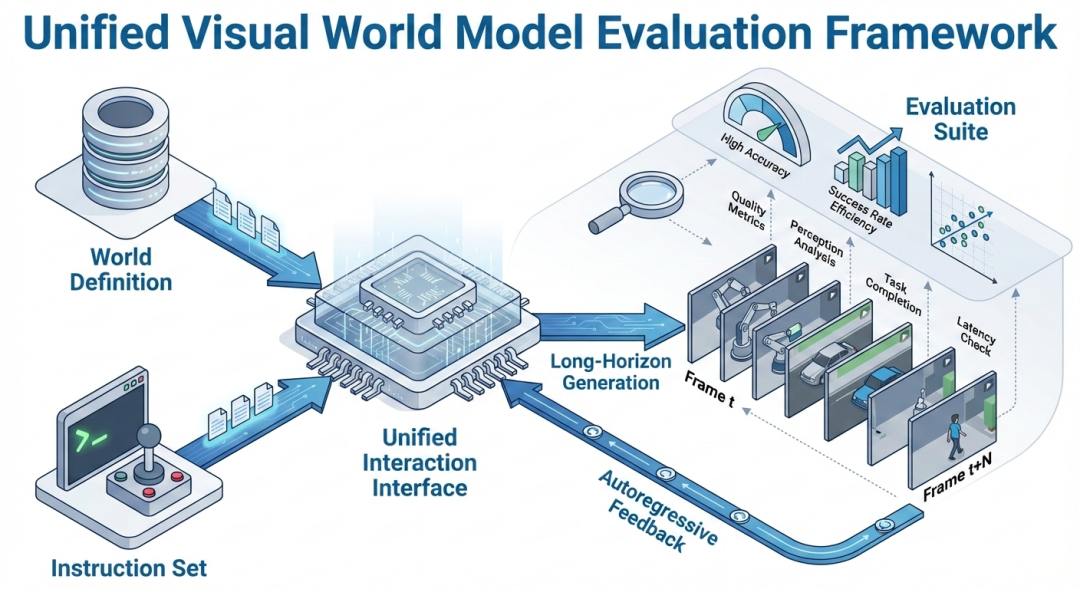
The Meituan LongCat team has officially introduced and open-sourced WBench, a pioneering evaluation benchmark designed to measure the capabilities of interactive video world models. As the first systematic framework for multi-round interaction assessment, WBench serves as a diagnostic tool—likened to a 'CT scanner'—to identify the specific technical hurdles AI models face when transitioning from passive observation to active, multi-stage interaction. By testing models across diverse scenarios ranging from lunar environments to futuristic urban settings, WBench establishes a new standard for defining the boundaries of world models. This release marks a significant step in providing the AI research community with the tools necessary to pinpoint and resolve the bottlenecks currently limiting the development of truly interactive artificial intelligence.
Key Takeaways
- Introduction of WBench: Meituan's LongCat team has developed and open-sourced WBench, the first systematic multi-round evaluation benchmark specifically for interactive video world models.
- Diagnostic Capability: The benchmark acts as a 'CT scanner' for AI, providing precise diagnostics to identify where models fail during the transition from passive viewing to active interaction.
- Focus on Interaction: Unlike traditional benchmarks, WBench emphasizes multi-round interactivity, testing how models maintain consistency and logic over successive stages of engagement.
- Open-Source Contribution: By making WBench open-source, Meituan provides the global AI community with a standardized tool to measure and push the boundaries of world model development.
In-Depth Analysis
Defining the Boundaries of World Models
The emergence of world models represents a significant leap in artificial intelligence, aiming to create systems that understand and simulate the physical and logical rules of our reality. However, a primary challenge has been the distinction between 'passive' and 'active' intelligence. The Meituan LongCat team’s release of WBench addresses this specific gap. According to the team, current world models often excel at generating or 'watching' video content but struggle when required to interact with that environment in a meaningful, multi-stage process.
WBench is designed to explore these boundaries by simulating complex environments, such as 'moonwalks' and 'cyber cities.' These scenarios are not merely visual backdrops but are intended to test the model's ability to sustain a coherent world state across multiple rounds of interaction. By systematically measuring these boundaries, WBench provides a clear picture of the current state of the art, highlighting the distance between simple video generation and the creation of a fully interactive, responsive world model.
The 'CT Scanner' for AI Interaction
One of the most compelling aspects of WBench is its role as a diagnostic instrument. The LongCat team describes the benchmark as a 'CT scanner' for world models. This metaphor suggests a level of precision that goes beyond simple pass/fail metrics. In the context of AI development, a 'CT scanner' approach means the benchmark can look 'inside' the model's performance to see exactly where the logic breaks down during interaction.
When a model moves from 'passive viewing'—where it simply predicts the next frame or observes a sequence—to 'active interaction'—where it must respond to inputs and maintain environmental consistency—new types of errors emerge. These can include spatial inconsistencies, loss of object permanence, or logical failures in multi-round sequences. WBench is structured to pinpoint these specific 'blockages,' allowing developers to understand whether a model's failure is due to a lack of temporal coherence, a misunderstanding of physical laws, or an inability to process complex, multi-turn instructions. This level of granular feedback is essential for iterative improvement in AI research.
Industry Impact
The introduction of WBench by Meituan's LongCat team carries significant implications for the broader AI industry. First, it establishes a much-needed standard for 'interactive' evaluation. As the industry moves toward more sophisticated applications like autonomous agents and advanced simulations, the ability to measure multi-round interaction becomes critical. WBench fills a void in the current evaluation landscape, which has historically focused more on static or single-turn tasks.
Furthermore, by open-sourcing the benchmark, Meituan is fostering a collaborative environment where researchers can compare results on a level playing field. This transparency is likely to accelerate the development of world models by identifying common bottlenecks across different architectures. As models are tested against the 'moonwalk' and 'cyber city' scenarios provided by WBench, the industry will gain a clearer understanding of what is required to move from generative video to truly interactive digital twins and world simulators.
Frequently Asked Questions
Question: What makes WBench different from existing AI benchmarks?
WBench is unique because it is the first systematic benchmark specifically designed for multi-round evaluation of interactive video world models. While other benchmarks might focus on image quality or single-frame prediction, WBench evaluates how well a model handles continuous, active interaction over multiple stages, identifying exactly where the model's understanding of the 'world' fails.
Question: Why does the LongCat team refer to WBench as a 'CT scanner'?
The 'CT scanner' metaphor is used to describe the benchmark's ability to provide a deep, precise diagnosis of a model's performance. Just as a medical CT scanner identifies internal issues in a patient, WBench identifies the specific technical 'blockages' that prevent a world model from successfully transitioning from a passive observer to an active participant in an interactive environment.
Question: What kind of scenarios does WBench use for testing?
Based on the announcement, WBench utilizes a variety of complex scenarios to test the limits of world models. These include diverse and imaginative settings such as 'moonwalks' (simulating low-gravity or extraterrestrial environments) and 'cyber cities' (simulating complex, high-density urban environments), which challenge the model's ability to maintain consistency across different physical and thematic rules.