Meituan LongCat Team Unveils LongCat-AudioDiT: Redefining Zero-Shot Voice Cloning via Waveform Latent Space
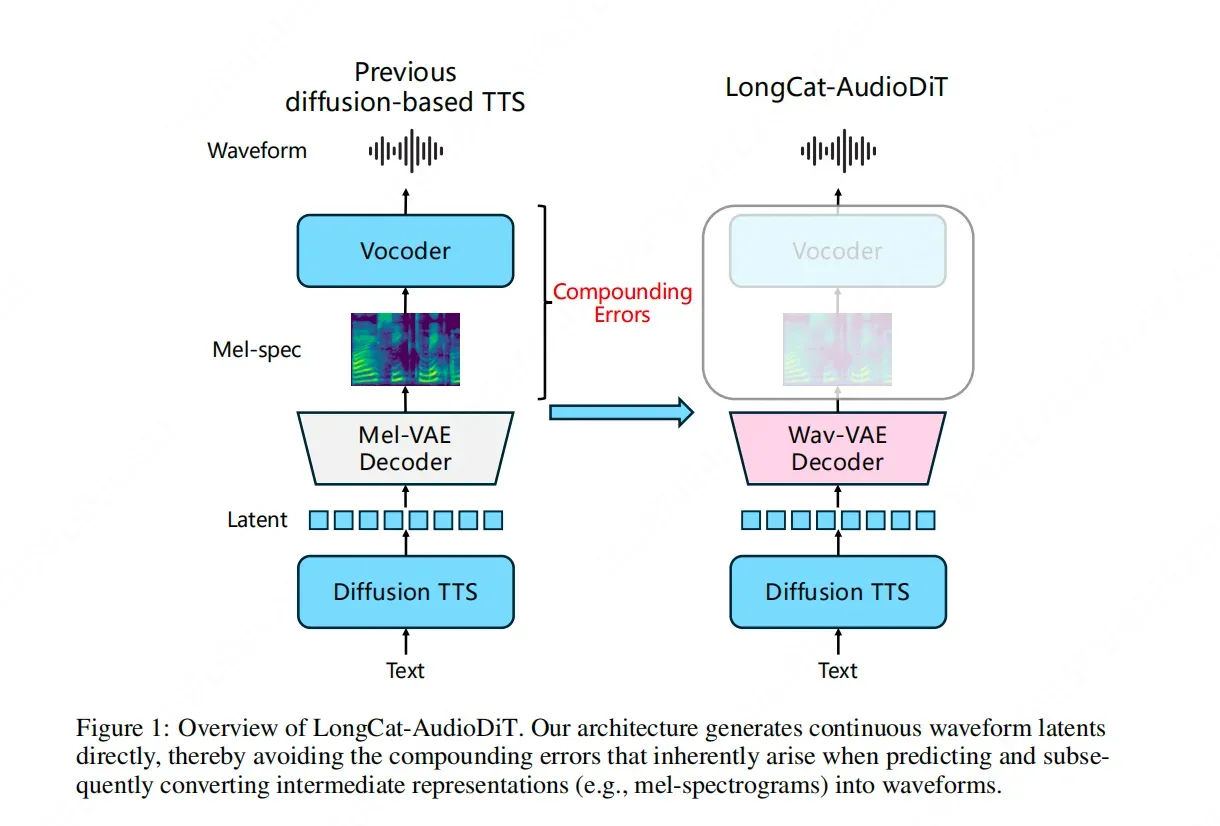
Meituan's LongCat team has announced a significant advancement in speech synthesis with the release of LongCat-AudioDiT. This new model aims to overcome the limitations of traditional zero-shot Text-to-Speech (TTS) systems by eliminating intermediate representations like Mel-spectrograms. Instead, it utilizes a diffusion-based approach operating directly within the waveform latent space. This method is designed to prevent the accumulation of cascade errors that often occur during multi-stage data conversion. By allowing the AI to learn the inherent patterns of sound directly, LongCat-AudioDiT pushes the boundaries of high-fidelity voice cloning and streamlined audio generation, marking a technical shift in how AI models interpret and replicate human vocal characteristics.
Key Takeaways
- Direct Waveform Processing: LongCat-AudioDiT abandons traditional intermediate representations like Mel-spectrograms, operating directly in the waveform latent space.
- Diffusion-Based Architecture: The model utilizes a diffusion-based Text-to-Speech (TTS) framework to synthesize audio.
- Error Reduction: By removing intermediate stages, the system aims to eliminate cascade errors caused by data conversion processes.
- Zero-Shot Breakthrough: The technology is specifically designed to push the upper limits of zero-shot voice cloning capabilities.
- Native Sound Learning: The approach focuses on letting AI learn the inherent laws of sound directly from the source.
In-Depth Analysis
Eliminating Intermediate Representations: The Shift from Mel-Spectrograms
In the traditional landscape of Text-to-Speech (TTS) and voice cloning, the industry has long relied on intermediate representations, most notably Mel-spectrograms. These representations act as a bridge between textual data and the final acoustic waveform. However, this multi-stage process often introduces a technical bottleneck. Meituan's LongCat team identifies these intermediate steps as a source of "cascade errors"—where inaccuracies in the conversion from text to spectrogram, and subsequently from spectrogram to waveform (via a vocoder), accumulate and degrade the final audio quality.
LongCat-AudioDiT represents a fundamental departure from this paradigm. By completely discarding Mel-spectrograms, the model seeks to bridge the gap between text and sound more directly. This architectural decision is rooted in the philosophy of allowing the AI to "directly learn the laws of sound itself." By operating in the waveform latent space, the model bypasses the lossy compression and artifacts often associated with frequency-domain transformations, potentially preserving more of the nuanced textures and timbres essential for high-fidelity voice cloning.
Direct Waveform Latent Space Processing via Diffusion
The core of the LongCat-AudioDiT innovation lies in its use of a diffusion model—specifically a Diffusion Transformer (DiT) architecture—applied within the waveform latent space. Diffusion models have gained prominence for their ability to generate high-quality data by iteratively refining noise into a structured output. Applying this to the waveform latent space allows the model to capture the complex, non-linear patterns of human speech without the constraints of traditional acoustic modeling.
This approach is particularly significant for zero-shot voice cloning. In a zero-shot scenario, the model must replicate a target voice using only a very brief sample of audio it has never encountered during training. By operating directly on the latent characteristics of the waveform, LongCat-AudioDiT can theoretically extract and apply vocal features more efficiently than models that must first translate those features into a spectrogram format. This direct mapping from text to the latent representation of the final sound wave is intended to maximize the accuracy of the cloned voice's identity and prosody.
Mitigating Cascade Errors in Synthetic Speech
The technical bottleneck of "cascade errors" has been a persistent challenge in the development of end-to-end TTS systems. In a typical pipeline, the first model generates a Mel-spectrogram from text, and a second model (the vocoder) generates the audio. If the first model produces a slightly flawed spectrogram, the vocoder amplifies those flaws, leading to robotic or distorted speech.
LongCat-AudioDiT addresses this by simplifying the pipeline. By performing the diffusion process directly in the waveform latent space, the model effectively merges the acoustic modeling and vocoding stages into a more cohesive framework. This "root-level" intervention blocks the accumulation of errors at the source. The result is a more robust synthesis process that maintains the integrity of the original vocal patterns, which is critical for achieving the "upper limit" of zero-shot cloning performance mentioned by the LongCat team.
Industry Impact
The introduction of LongCat-AudioDiT signals a potential shift in the AI audio industry toward more integrated, direct-to-waveform architectures. By proving the viability of bypassing Mel-spectrograms, Meituan's research could lead to a new generation of TTS models that are not only more accurate in their voice cloning capabilities but also more efficient in their data processing.
For the broader AI field, this highlights the growing importance of Diffusion Transformers (DiT) in audio synthesis, mirroring their success in image and video generation. As zero-shot voice cloning becomes more sophisticated, the applications for personalized AI assistants, high-quality content creation, and localized media dubbing are likely to expand, provided that the technical barriers of fidelity and error accumulation continue to be addressed by innovations like the waveform latent space approach.
Frequently Asked Questions
Question: What makes LongCat-AudioDiT different from traditional TTS models?
Traditional TTS models usually convert text into an intermediate visual representation of sound called a Mel-spectrogram before turning it into audio. LongCat-AudioDiT skips this intermediate step and works directly within the waveform latent space using a diffusion model, which helps reduce errors and improve sound quality.
Question: Why is the elimination of "cascade errors" important for voice cloning?
Cascade errors occur when mistakes from one stage of a multi-step process carry over and worsen in the next stage. In voice cloning, this often results in a loss of vocal detail or unnatural-sounding speech. By simplifying the process into a more direct path, LongCat-AudioDiT minimizes these errors, leading to more accurate and lifelike voice replication.
Question: What is "zero-shot" voice cloning in the context of this model?
Zero-shot voice cloning refers to the ability of an AI to mimic a specific person's voice after hearing only a short, previously unknown sample of that voice. LongCat-AudioDiT aims to push the performance limits of this technology, making it possible to clone voices more effectively with minimal data.