LARYBench Released: Defining the ImageNet for Embodied Action Representations via Large-Scale Human Video Learning
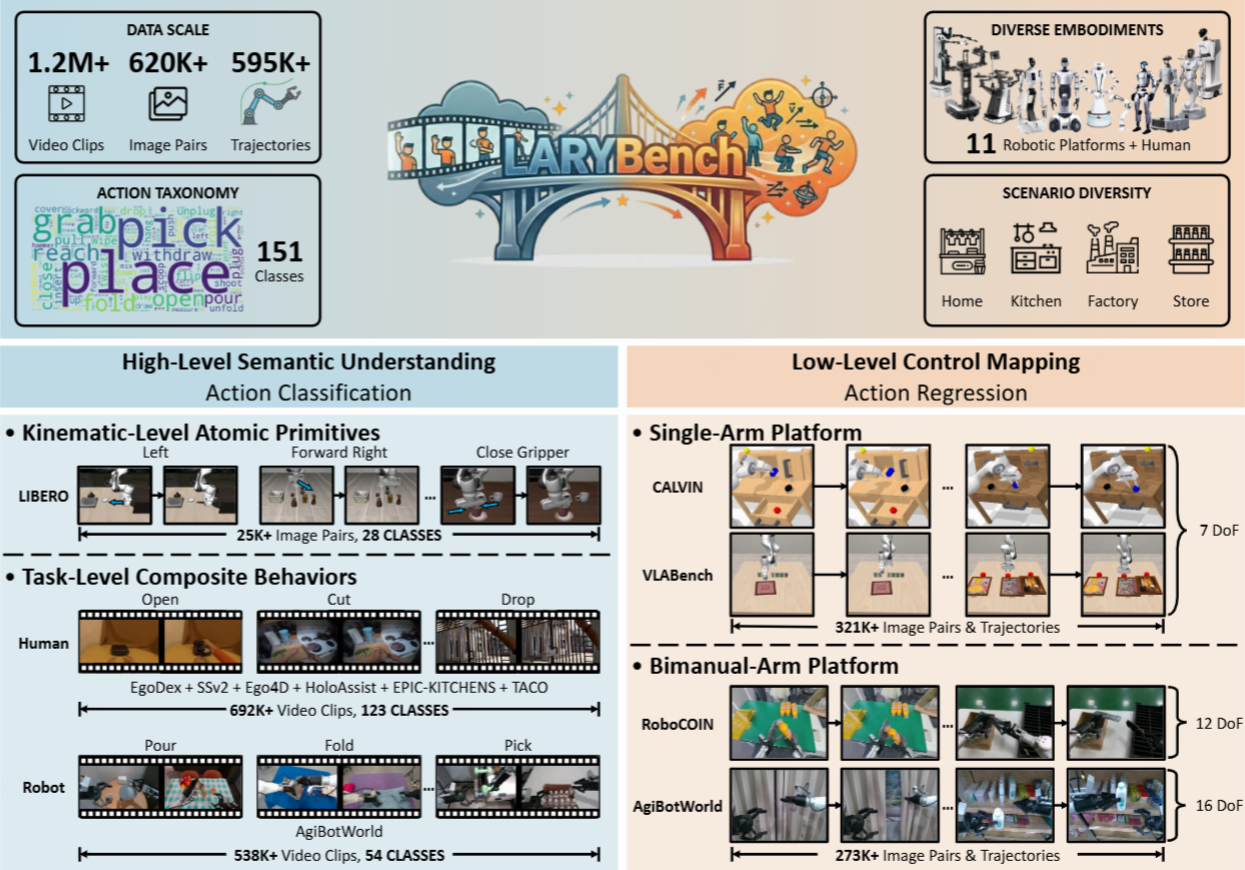
The Meituan Technical Team has introduced LARYBench (Latent Action Representation Yielding Benchmark), a systematic evaluation framework designed to guide the learning of general latent action representations from extensive visual datasets. Positioned as the 'ImageNet' for embodied AI, LARYBench provides a standardized method for measuring how models understand and execute physical actions. Experimental findings reveal a significant shift in AI development: general vision models demonstrate superior performance in action generalization and control precision compared to specialized action expert models. Furthermore, the benchmark proves that embodied action representations can effectively emerge from large-scale human video data, suggesting that specialized robotic data may not be the only path to achieving high-level embodied intelligence.
Key Takeaways
- Introduction of LARYBench: A systematic benchmark designed to evaluate and guide the learning of general latent action representations from large-scale visual data.
- Superiority of General Models: General vision models significantly outperform specialized embodied AI action expert models in both action generalization and control precision.
- Emergence from Human Videos: The research demonstrates that embodied action representations can emerge naturally from large-scale human video data.
- A New Standard: LARYBench is defined as the 'ImageNet' for embodied action representation, providing a foundational metric for the industry.
In-Depth Analysis
The LARYBench Framework: A Systematic Approach to Action Representation
The release of LARYBench (Latent Action Representation Yielding Benchmark) by the Meituan Technical Team marks a significant milestone in the field of embodied AI. By establishing a systematic evaluation benchmark, LARYBench aims to solve the challenge of learning general latent action representations from massive visual datasets. Much like how ImageNet revolutionized computer vision by providing a standardized dataset for image recognition, LARYBench is designed to define the standard for how AI models interpret and represent physical actions. The benchmark focuses on the transition from raw visual input to actionable latent representations, providing a structured way to measure the effectiveness of different modeling approaches.
General Vision Models vs. Specialized Action Experts
One of the most striking findings presented in the LARYBench report is the performance gap between general vision models and specialized action expert models. Traditionally, the industry has leaned toward developing 'expert' models specifically trained for embodied intelligence tasks. However, experimental results within the LARYBench framework indicate that general vision models—those trained on broader, more diverse datasets—exhibit significantly better action generalization. This means that general models are more capable of applying learned actions to new, unseen scenarios. Furthermore, these general models also showed higher control precision, suggesting that the breadth of knowledge in general vision models contributes more effectively to fine-grained motor control than the narrow focus of specialized expert models.
The Power of Large-Scale Human Video Data
LARYBench provides empirical evidence for a critical hypothesis in AI research: that embodied action representations can emerge from large-scale human video data. This finding suggests that AI does not necessarily require direct robotic experience or specialized embodied datasets to understand the mechanics of action. By observing human movements in vast quantities of video data, general vision models can internalize the underlying representations of physical interaction. This 'emergence' of action representation from passive observation opens new doors for training embodied AI, as it allows developers to leverage the nearly infinite supply of human video content available online to improve the physical capabilities of AI systems.
Industry Impact
The introduction of LARYBench is poised to reshape the development priorities of the embodied AI industry. By demonstrating that general vision models are more effective than specialized experts, the research encourages a shift toward more versatile, large-scale model architectures. The ability to learn action representations from human videos reduces the dependency on expensive and difficult-to-collect robotic trajectory data, potentially accelerating the deployment of AI in physical environments. As a systematic benchmark, LARYBench will likely become a standard tool for researchers to validate their models' generalization and precision, fostering a more competitive and standardized environment for AI development.
Frequently Asked Questions
Question: What is the primary purpose of LARYBench?
LARYBench (Latent Action Representation Yielding Benchmark) is a systematic evaluation benchmark designed to guide and measure the learning of general latent action representations from large-scale visual data, serving as a standard similar to ImageNet for the embodied AI field.
Question: Why do general vision models perform better than specialized expert models in this benchmark?
According to the experimental results, general vision models possess superior action generalization and control precision. This suggests that the broad representations learned by general models are more effective for embodied tasks than the narrow training provided to specialized action expert models.
Question: Can AI learn to perform physical actions just by watching human videos?
Yes, the LARYBench results demonstrate that embodied action representations can emerge from large-scale human video data, allowing models to learn the fundamentals of action and control without relying solely on specialized embodied intelligence data.