
LARYBench Released: Defining the ImageNet for Embodied Action Representation and Measuring Generalization from Human Videos
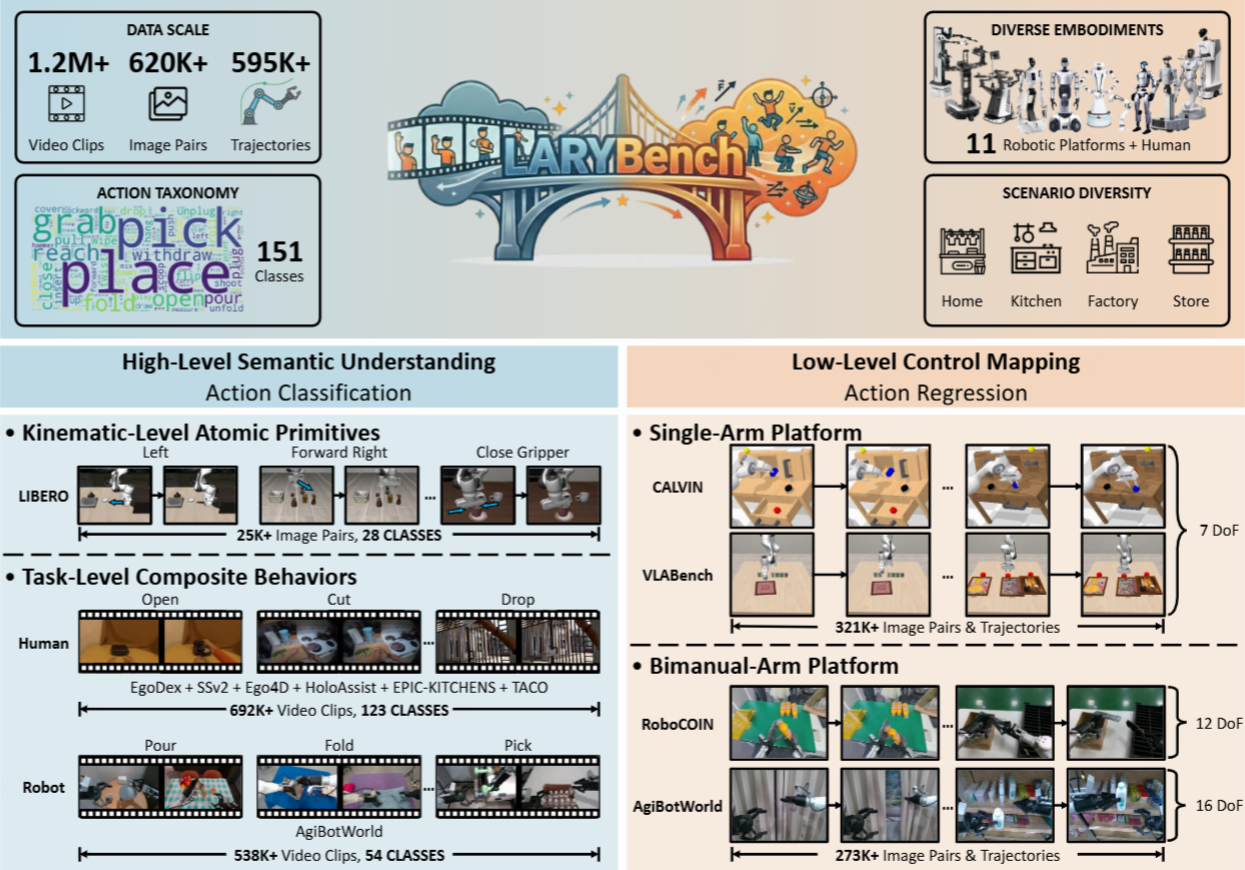
Meituan's technology team has officially introduced LARYBench (Latent Action Representation Yielding Benchmark), a systematic evaluation framework designed to guide the learning of general latent action representations from large-scale visual data. The benchmark's findings represent a significant shift in the field of embodied AI, revealing that general-purpose vision models demonstrate superior performance in action generalization and control precision compared to specialized action expert models. Crucially, the research indicates that embodied action representations can naturally emerge from extensive human video datasets. By providing a standardized metric for measuring how models learn from human behavior, LARYBench aims to serve as a foundational 'ImageNet' for the development of embodied intelligence and robotic control systems.
Key Takeaways
- Introduction of LARYBench: A new systematic benchmark designed to evaluate and guide the learning of general latent action representations from visual data.
- Superiority of General Models: Experimental results show that general vision models outperform specialized embodied AI expert models in both generalization and control precision.
- Emergence from Human Data: The benchmark proves that embodied action representations can emerge effectively from large-scale human video datasets.
- Standardizing Embodied AI: LARYBench is positioned as a critical metric, drawing parallels to the impact of ImageNet on the field of computer vision.
In-Depth Analysis
The Framework of LARYBench
The Meituan technology team has developed LARYBench, which stands for Latent Action Representation Yielding Benchmark. This system is designed to address a critical gap in the development of embodied AI: the need for a systematic way to evaluate how models learn and represent actions within a latent space. By focusing on "latent action representation," the benchmark provides a structured methodology for assessing how well an AI can translate visual information into actionable data. This is particularly relevant as the industry moves toward more complex robotic and autonomous systems that must interpret a wide variety of visual inputs to perform physical tasks.
LARYBench serves as a guide for researchers to utilize large-scale visual data more effectively. The goal is to move beyond simple task-specific learning and toward a more generalized understanding of movement and interaction. By establishing this benchmark, the Meituan team provides a standardized environment where different architectures and training methodologies can be compared objectively, ensuring that progress in the field is measurable and reproducible.
General Vision Models vs. Specialized Experts
One of the most striking findings revealed by the LARYBench experimental results is the performance gap between general vision models and specialized embodied AI action expert models. Traditionally, the industry has often relied on "expert models"—AI systems specifically trained and fine-tuned for narrow, embodied tasks. However, LARYBench demonstrates that general vision models, which are trained on broader and more diverse datasets, actually exhibit significantly better performance.
This superiority is observed in two key areas: action generalization and control precision. Action generalization refers to the model's ability to apply learned movements to new, unseen scenarios or environments. Control precision involves the accuracy and refinement of the physical actions executed by the system. The fact that general models excel in these areas suggests that the broad features learned by general-purpose vision systems provide a more robust foundation for embodied intelligence than the narrow features captured by specialized models. This finding could potentially shift the focus of AI research toward leveraging large-scale foundation models for robotic control rather than building niche experts from scratch.
Emergence of Representation from Human Videos
A core contribution of the LARYBench research is the validation that embodied action representations can emerge from large-scale human video data. This is a pivotal discovery because it suggests that AI does not necessarily need to be trained exclusively on robotic data or within simulated environments to understand physical actions. Instead, by observing the vast amount of human activity captured in video format, models can derive an implicit understanding of how actions are structured and executed.
This "emergence" indicates that the underlying patterns of human movement contain sufficient information to inform embodied AI systems. LARYBench provides the first systematic measurement of this generalization, proving that the transition from observing human behavior to executing robotic tasks is not only possible but highly effective. This opens up a massive repository of data—human videos—as a primary training source for the next generation of embodied AI, potentially accelerating the development of robots that can operate in human-centric environments.
Industry Impact
The release of LARYBench is poised to have a profound impact on the AI and robotics industries. By defining what is essentially an "ImageNet for embodied actions," Meituan has provided a necessary North Star for researchers. The shift in focus from specialized expert models to general vision models suggests a more scalable path forward for AI development, where foundation models can be adapted for physical tasks with higher precision and better generalization than previously thought possible.
Furthermore, the ability to learn from human videos reduces the dependency on expensive and difficult-to-collect robotic trajectory data. This could lower the barrier to entry for developing sophisticated embodied agents and encourage the use of diverse, real-world visual data. As the industry seeks to create AI that can interact seamlessly with the physical world, LARYBench provides the metrics and the evidence needed to prioritize general-purpose learning and human-centric data sources.
Frequently Asked Questions
Question: What is the primary purpose of LARYBench?
LARYBench (Latent Action Representation Yielding Benchmark) is a systematic evaluation system designed to measure and guide how AI models learn general latent action representations from large-scale visual data, specifically focusing on embodied intelligence.
Question: How do general vision models compare to specialized expert models in this benchmark?
According to the experimental results from LARYBench, general vision models significantly outperform specialized embodied AI action expert models in both the precision of control and the ability to generalize actions to new situations.
Question: Can AI learn how to perform actions just by watching human videos?
Yes, the LARYBench research demonstrates that embodied action representations can emerge from large-scale human video data, allowing models to learn generalized representations of actions that are applicable to embodied AI tasks.

