Meituan LongCat Releases General 365: A New Rigorous Benchmark for AI Reasoning Evaluation
The Meituan LongCat team has officially launched General 365, a new benchmark specifically designed to evaluate the reasoning capabilities of large language models. In an initial assessment involving 26 mainstream AI models, the benchmark revealed a significant performance gap in the industry. Gemini 3 Pro, currently regarded as one of the most capable models, achieved an accuracy rate of only 62.8%. Furthermore, the evaluation found that the vast majority of tested models failed to reach a 60% accuracy threshold, which is considered a basic passing grade. This release by Meituan sets a new standard for measuring cognitive depth in AI, highlighting that complex reasoning remains a formidable challenge for even the most advanced systems currently available.
Key Takeaways
- Launch of General 365: Meituan's LongCat team has introduced a new evaluation standard focused on AI reasoning.
- Industry-Wide Testing: The benchmark was applied to 26 mainstream models to assess the current state of the industry.
- Gemini 3 Pro Performance: As the top-performing model in the test, Gemini 3 Pro reached an accuracy of 62.8%.
- The 60% Threshold: Most models evaluated failed to achieve a 60% accuracy score, indicating a widespread struggle with complex reasoning tasks.
In-Depth Analysis
The Launch of General 365 by Meituan LongCat
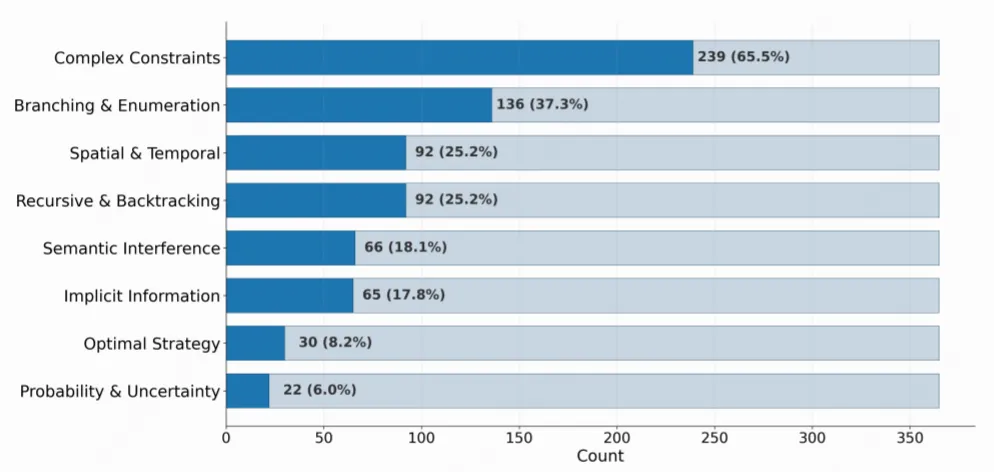
The Meituan LongCat team has officially entered the AI evaluation space with the release of General 365. This benchmark is positioned as a new "yardstick" for reasoning, a critical area where many large language models (LLMs) still face significant hurdles. By focusing on reasoning rather than simple knowledge retrieval or linguistic fluency, General 365 aims to provide a more granular look at the logical processing capabilities of modern AI. The introduction of this benchmark by a major technology team like Meituan suggests a growing need for specialized tools that can distinguish between surface-level performance and deep cognitive reasoning.
Performance Disparity Among Mainstream Models
In the inaugural testing phase of General 365, the LongCat team evaluated 26 mainstream models. The results provide a sobering look at the current limitations of artificial intelligence. Even the most advanced model currently available, Gemini 3 Pro, only managed to secure an accuracy rate of 62.8%. While this score places it at the top of the current field, it also highlights how much room for improvement remains in the realm of complex reasoning. The fact that the "strongest on earth" model is barely clearing the 60% mark suggests that the tasks within General 365 are designed to push models to their absolute logical limits.
The Reasoning Performance Gap
Perhaps the most striking finding from the Meituan LongCat report is that the vast majority of models failed to reach the 60% accuracy threshold. In many academic and professional settings, 60% is considered the minimum passing grade. The failure of most mainstream models to meet this benchmark indicates a systemic gap in the reasoning capabilities of current AI architectures. This data suggests that while AI has made massive strides in natural language processing and creative generation, the ability to maintain logical consistency and solve complex multi-step reasoning problems remains an elusive goal for the bulk of the industry's current offerings.
Industry Impact
The release of General 365 is likely to have a significant impact on how AI models are developed and marketed. By establishing a benchmark where even the industry leaders struggle, Meituan is shifting the focus toward logical precision and cognitive depth. This may encourage AI labs to move beyond scaling parameters and instead focus on architectural innovations that enhance reasoning. Furthermore, as more companies look to integrate AI into decision-making processes, benchmarks like General 365 will become essential for identifying which models can actually handle complex, real-world logic versus those that merely simulate intelligence through pattern matching.
Frequently Asked Questions
Question: What is the primary focus of the General 365 benchmark?
Answer: General 365 is specifically designed to evaluate the reasoning capabilities of AI models, serving as a new standard for measuring logical depth and problem-solving accuracy.
Question: Which model performed the best on the General 365 evaluation?
Answer: Gemini 3 Pro achieved the highest accuracy among the 26 models tested, with a score of 62.8%.
Question: How did the majority of mainstream AI models perform?
Answer: Most of the 26 mainstream models tested were unable to reach the 60% accuracy mark, which is often considered the baseline for a passing grade in reasoning tasks.