Kimi K3
Kimi K3: 2.8T Parameter Open Model for Frontier Intelligence, Long-Horizon Coding, and Multimodal Knowledge Work
Kimi K3 is a groundbreaking 2.8T-parameter open model featuring a 1-million-token context window. Built on Kimi Delta Attention and Stable LatentMoE, it excels in coding, research, and multimodal tasks.
2026-07-19
39500.0K
Kimi K3 Product Information
Kimi K3: The Revolutionary Open 3T-Class Frontier Intelligence Model
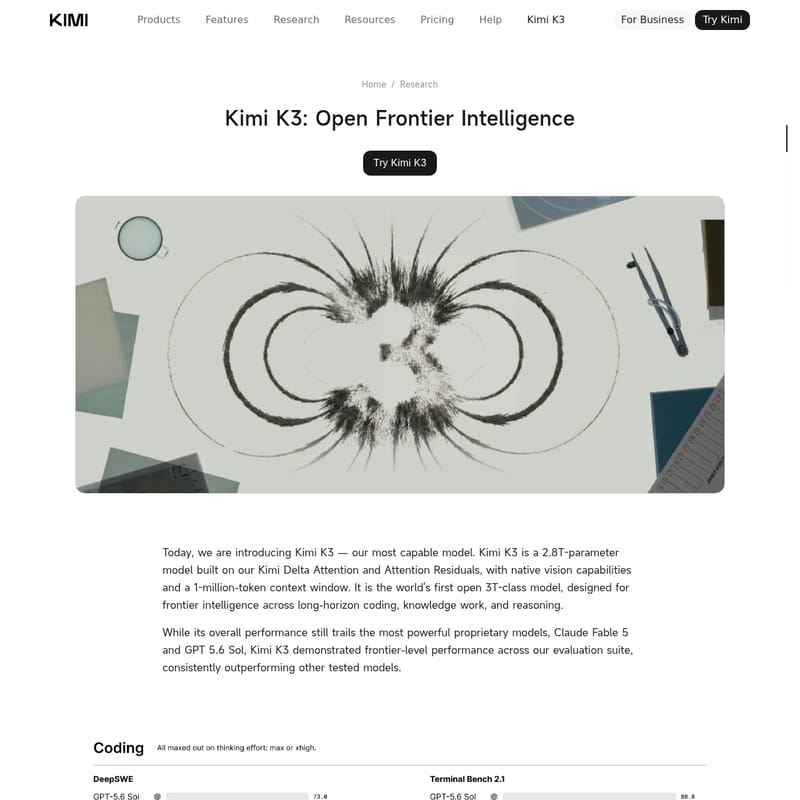
In the rapidly evolving landscape of artificial intelligence, Kimi K3 emerges as a landmark achievement. As the world's first open 3T-class model, Kimi K3 is designed to push the boundaries of frontier intelligence. This 2.8T-parameter powerhouse is engineered for long-horizon coding, complex knowledge work, and advanced reasoning. Built upon the innovative Kimi Delta Attention and Attention Residuals architecture, Kimi K3 offers a massive 1-million-token context window and native vision capabilities, making it a versatile tool for researchers, developers, and enterprises alike.
What’s Kimi K3?
Kimi K3 is the most capable model developed by Moonshot AI to date. It represents a significant leap in scaling, being the first open-source model to reach the 2.8 trillion parameter mark. While it maintains a competitive stance against top-tier proprietary models, Kimi K3 has demonstrated frontier-level performance across a wide evaluation suite, consistently outperforming other open and closed models in its class.
Kimi K3 is not just about size; it is about efficiency and intelligence. By utilizing the Stable LatentMoE framework, the model effectively activates 16 out of 896 experts, ensuring that it converts massive compute into high-level intelligence more effectively than its predecessors. Whether you are navigating massive code repositories or conducting deep scientific research, Kimi K3 provides the reasoning power required for the most demanding tasks.
Core Features of Kimi K3
1. Advanced Scaling Architecture
Kimi K3 is built on a sophisticated architectural backbone designed for stability and performance at scale:
- Kimi Delta Attention (KDA): Improves information flow across long sequence lengths.
- Attention Residuals (AttnRes): Selectively retrieves representations across model depth to improve efficiency.
- Stable LatentMoE: A Mixture of Experts framework that optimizes sparsity for better scaling efficiency—approximately 2.5× better than Kimi K2.
- Sigmoid Tanh Unit (SiTU) & Gated MLA: These enhancements improve activation control and attention selectivity.
2. Massive Context and Vision
With a 1-million-token context window, Kimi K3 can process enormous amounts of data in a single session. Its native vision capabilities allow it to understand text, images, and video within the same model, enabling true "vision in the loop" for developers and creators.
3. Long-Horizon Coding Proficiency
Kimi K3 excels at sustaining long engineering sessions with minimal human oversight. It can orchestrate terminal tools, navigate complex repositories, and optimize software across various GPU architectures.
4. Interactive Knowledge Work
Through Kimi Work, Kimi K3 introduces features like Widgets and Dashboards. Widgets allow for interactive components within chats that connect to local data, while Dashboards organize these components into a persistent, project-based view.
Use Cases for Kimi K3
Software Engineering and Kernel Optimization
Kimi K3 has proven its ability to optimize GPU kernels independently. In testing, it spent up to 24 hours profiling and rewriting tasks for NVIDIA H200 and other GPGPUs, outperforming models like GPT 5.5 and Opus 4.8. Furthermore, it successfully built MiniTriton, a compact GPU programming compiler, from scratch, demonstrating its ability to handle end-to-end system development.
Autonomous Chip Design
As a testament to its long-horizon agentic capabilities, Kimi K3 autonomously designed a chip to serve a nano model. In a 48-hour run, it used open-source EDA tools to build and verify a chip that closes timing at 100 MHz, packing over 1.46 million standard cells within 4 mm².
Scientific Research and Data Synthesis
Kimi K3 bridges the gap between scientific literature and code. In one instance, it reproduced complex universal relations in astrophysics by cross-validating over 20 papers, implementing numerical pipelines, and generating 3,000+ lines of Python code in just two hours—a task that usually takes a researcher weeks.
Multimodal Video Editing and Motion Design
Thanks to its native multimodal architecture, Kimi K3 can handle complex video editing tasks. It can select clips, synchronize frames to beats, and process audio. It even created a motion-graphics explainer of its own architecture using 3Blue1Brown-style animations.
How to Use Kimi K3
Kimi K3 is accessible across multiple platforms to suit different professional needs:
- Kimi App: Download the latest version on iOS, Android, or HarmonyOS, or visit kimi.com to access Kimi K3 agents.
- Kimi Work: Use the desktop application (version 3.1.0+) for Windows and Apple silicon Macs to utilize Widgets and Dashboards for professional projects.
- Kimi Code: Developers can run Kimi Code in their terminal and select the model using the
/modelcommand. - Kimi API: Developers can build applications using the
kimi-k3endpoint. Pricing is structured as follows:- Cache-hit input: $0.30/MTok
- Cache-miss input: $3.00/MTok
- Output: $15.00/MTok
- Kimi Enterprise: Organizations requiring data privacy and member management can subscribe to Kimi Enterprise for a secure, separated team environment.
FAQ
Q: When will the full model weights for Kimi K3 be released? A: The full model weights are scheduled for release by July 27, 2026.
Q: What makes Kimi K3 different from Kimi K2? A: Kimi K3 introduces Kimi Delta Attention and Stable LatentMoE, resulting in a 2.5× improvement in scaling efficiency and a significantly larger 2.8T parameter count.
Q: Does Kimi K3 support vision tasks? A: Yes, Kimi K3 has native vision capabilities, allowing it to process and reason across text, images, and videos seamlessly.
Q: Are there any limitations to be aware of? A: Kimi K3 is sensitive to thinking history; it is recommended to use compatible harnesses like Kimi Code to ensure stability. Additionally, it can be "excessively proactive," occasionally making decisions on behalf of the user when intent is ambiguous.
Q: What is the context window size? A: Kimi K3 supports a massive 1-million-token context window, ideal for long-form documents and large-scale coding projects.