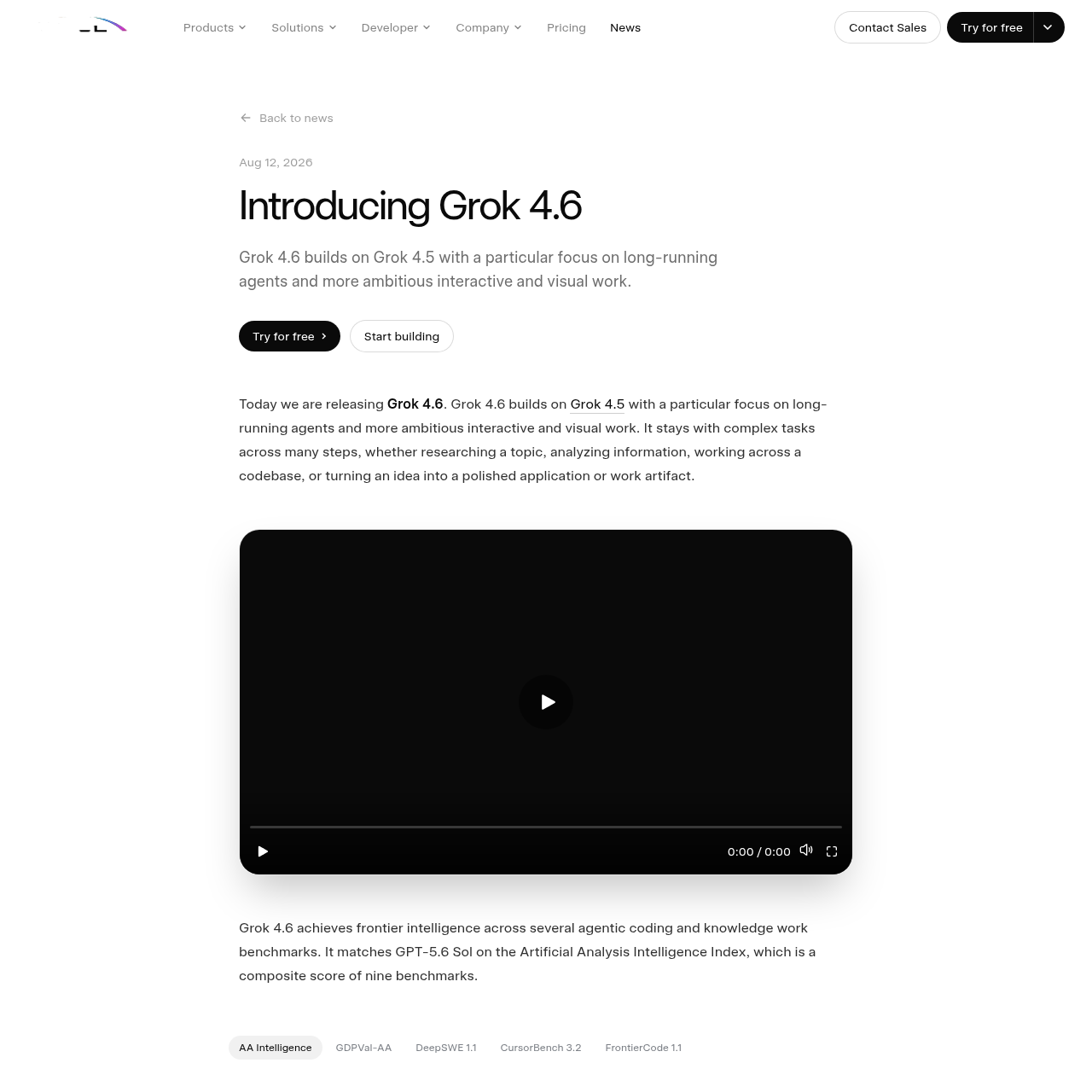
Grok 4.6 is an AI model focused on long-running agentic tasks, offering enhanced capabilities for complex coding, visual project development, and multi-step research workflows.
Chat BotResearching unfamiliar domainsStructuring applicationsImplementing core interactionsSelf-testing and verification of work
Estimated monthly visits
27.6M
Data period:
Listed on AIToolly
What Is Grok 4.6? Product Overview
What the product does and how it is positioned
Grok 4.6 builds upon its predecessor with a specialized focus on sustaining work over extended trajectories. It is engineered to handle complex, multi-step processes, ranging from researching unfamiliar topics to turning conceptual ideas into functional, polished software artifacts.
The model incorporates improvements from a supplemental training run that utilized curated, model-generated data for reasoning and technical concepts. It demonstrates strong performance in agentic coding and knowledge work, with built-in mechanisms for self-testing and verification during task execution.
What Can You Use Grok 4.6 For?
Source-supported ways to use the product
Software Engineering and Development
The model assists in navigating codebases, implementing core application interactions, and performing vulnerability patching.
Complex Research and Analysis
Users can leverage the model to research unfamiliar domains and analyze information across multiple steps to produce structured work artifacts.
Training Methodology
Grok 4.6 was developed through a supplemental training process that utilized high-quality engineering data and an improved optimizer. The training regimen focused on reasoning and advanced technical concepts to establish a robust foundation for subsequent SFT and RL stages.
Utilized model-generated data for reasoning and technical domains.
Applied model-based checks to filter problematic traces during SFT trajectory regeneration.
Trained on diverse agentic RL tasks including kernel optimization and computer-aided design.
What to Test Before Choosing Grok 4.6
Checks to run with your own material and workflow
Verify the model's performance on specific coding tasks by reviewing its results against the documented DeepSWE 1.1 or CursorBench 3.2 benchmarks.
Check the model's self-verification capabilities by observing its behavior during long-running, multi-step project tasks.
Answers based on the source-checked product record
What platforms currently support Grok 4.6?+
Grok 4.6 is available through Cursor and Grok Build, as well as via the API and partner platforms including OpenRouter, Vercel, and Cloudflare.
How does Grok 4.6 differ from the previous version?+
Grok 4.6 builds on Grok 4.5 with a specific focus on long-running agents and improved performance in ambitious interactive and visual project work.
What kind of data was used to train Grok 4.6?+
The model was trained using curated, model-generated data for reasoning, high-quality engineering data, and a wide range of agentic RL tasks across various technical domains.
Does the model perform any self-correction during tasks?+
Yes, on longer trajectories, the model has demonstrated self-testing and verification behaviors, checking its own work before proceeding to subsequent steps.
Are there safety measures implemented in Grok 4.6?+
The model includes a safety stack designed for utility and security, supported by extensive pre-deployment, post-deployment, and third-party testing.
More Chat Bot AI tools
Explore other recently added tools in the same category.