GPT‑5.4 mini and nano
Introducing GPT-5.4 mini and nano: Fast, Efficient AI Models Optimized for Coding and Subagents
OpenAI's GPT-5.4 mini and nano are high-performance small models designed for efficiency and speed. GPT-5.4 mini significantly improves over previous versions in coding, reasoning, and multimodal understanding, running over 2x faster than GPT-5 mini. GPT-5.4 nano offers a cost-effective solution for classification and simpler subtasks. These models excel in low-latency environments like coding assistants, computer-using systems, and real-time multimodal applications, providing professional-grade performance at a fraction of the cost.
2026-03-20
190300.0K
GPT‑5.4 mini and nano Product Information
GPT-5.4 mini and GPT-5.4 nano: High-Performance Small Models for Coding and Subagents
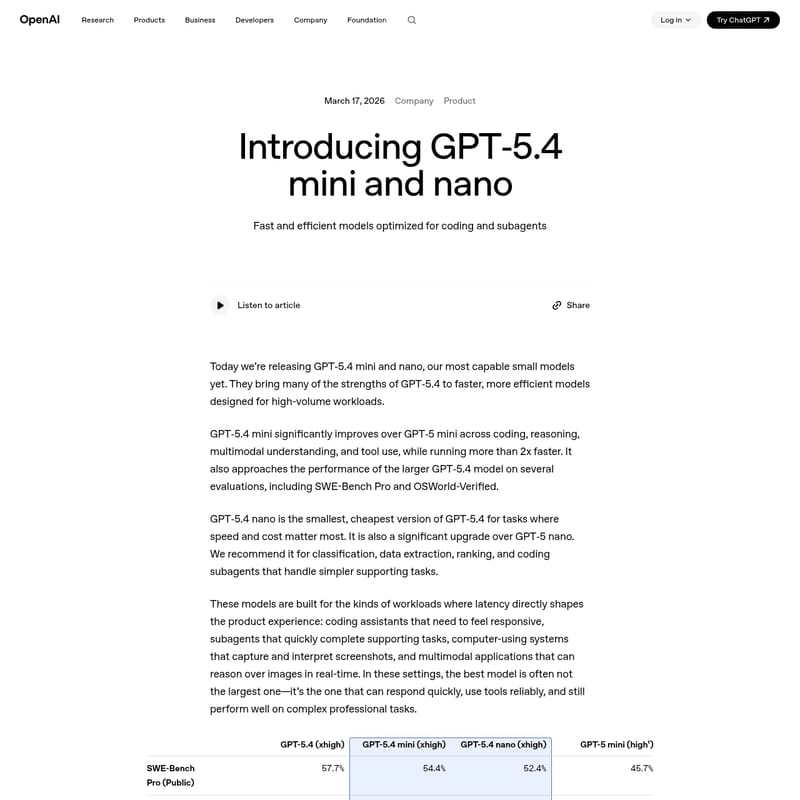
On March 17, 2026, OpenAI announced the release of GPT-5.4 mini and GPT-5.4 nano, the most capable small models in the GPT lineup to date. These models are engineered to bring the advanced strengths of the GPT-5.4 architecture to faster, more efficient frameworks optimized for high-volume workloads and low-latency applications.
What's GPT-5.4 mini and GPT-5.4 nano?
GPT-5.4 mini and GPT-5.4 nano are specialized, compact AI models designed to bridge the gap between high-level reasoning and operational speed. While larger models excel at complex planning, GPT-5.4 mini significantly improves upon the previous GPT-5 mini across coding, reasoning, and tool use, performing more than twice as fast. It achieves performance levels that approach the flagship GPT-5.4 model on critical benchmarks like SWE-Bench Pro and OSWorld-Verified.
GPT-5.4 nano represents the smallest and most affordable entry in the GPT-5.4 family. It is specifically built for tasks where cost-efficiency and rapid response times are the primary requirements, such as data extraction, classification, and supporting coding subagents.
Key Features of GPT-5.4 mini and nano
Exceptional Coding and Reasoning
Both models offer a significant upgrade in coding iteration. GPT-5.4 mini delivers a strong performance-per-latency tradeoff, outperforming GPT-5 mini at similar speeds. It is designed for:
- Codebase navigation and targeted edits.
- Debugging loops and front-end generation.
- High-pass rates on SWE-Bench Pro (54.4%) and Terminal-Bench 2.0 (60.0%).
Advanced Multimodal and Computer Use
GPT-5.4 mini is highly effective at interpreting dense user interfaces and screenshots. On the OSWorld-Verified benchmark, it scored 72.1%, nearly matching the 75.0% score of the full GPT-5.4 model. This makes it ideal for real-time vision tasks and computer-using systems.
Subagent Orchestration
These models are built for a "multi-model" workflow. In systems like Codex, GPT-5.4 can act as the central coordinator while delegating narrower, reasoning-intensive tasks to GPT-5.4 mini subagents. This parallel processing allows for faster execution of file reviews and document processing at a lower cost.
Technical Specifications
- Context Window: GPT-5.4 mini features a 400k context window.
- Input Support: Support for text, image inputs, function calling, web search, and computer use.
- Efficiency: GPT-5.4 mini runs 2x faster than GPT-5 mini.
Use Cases for GPT-5.4 mini and nano
Responsive Coding Assistants
Developers can integrate GPT-5.4 mini into IDE extensions and CLI tools to provide instantaneous feedback. Because it handles debugging and code generation with low latency, the coding experience feels more fluid and responsive.
High-Volume Data Processing
For tasks like ranking, classification, and citation recall, GPT-5.4 nano provides a cost-effective solution. It is perfect for processing large datasets where using a larger model would be cost-prohibitive.
Computer-Using Systems
Systems that need to capture screenshots and interpret UI elements in real-time benefit from the multimodal capabilities of GPT-5.4 mini. It can quickly reason over images to complete navigation tasks efficiently.
Complex Workflow Delegation
In professional environments, GPT-5.4 mini serves as a powerful subagent. It can handle supporting tasks—such as searching codebases or reviewing specific files—while a larger model maintains the high-level project judgment.
Availability and Pricing
GPT-5.4 mini Pricing
- API: $0.75 per 1M input tokens / $4.50 per 1M output tokens.
- Codex: Available in the app, CLI, and IDE extension, using only 30% of the standard GPT-5.4 quota.
- ChatGPT: Available to Free and Go users via the "Thinking" feature, and as a fallback for other users.
GPT-5.4 nano Pricing
- API Only: $0.20 per 1M input tokens / $1.25 per 1M output tokens.
FAQ
Q: How much faster is GPT-5.4 mini compared to GPT-5 mini? A: GPT-5.4 mini runs more than 2x faster than GPT-5 mini while delivering significantly improved results in coding and reasoning.
Q: Can GPT-5.4 mini handle images? A: Yes, GPT-5.4 mini is a multimodal model that supports both text and image inputs, specifically optimized for computer use and UI interpretation.
Q: Is GPT-5.4 nano available in ChatGPT? A: No, GPT-5.4 nano is currently only available via the API for tasks where speed and cost are the most critical factors.
Q: What is the context window for GPT-5.4 mini? A: GPT-5.4 mini features a substantial 400k context window, allowing it to process large amounts of information in a single prompt.
Q: How does the subagent system work in Codex? A: In Codex, a larger model like GPT-5.4 handles planning and judgment, then delegates narrower subtasks to GPT-5.4 mini subagents to run in parallel, reducing costs by approximately two-thirds.