AstraPixels favicon

AstraPixels

A web-based astronomical visualization tool for tracking celestial objects and sky events using real-time orbital data.

Research AssistantTracking the current and future…Applying custom names to celestial bodiesBrowsing a database of claimed and…Orbital Computation Engine
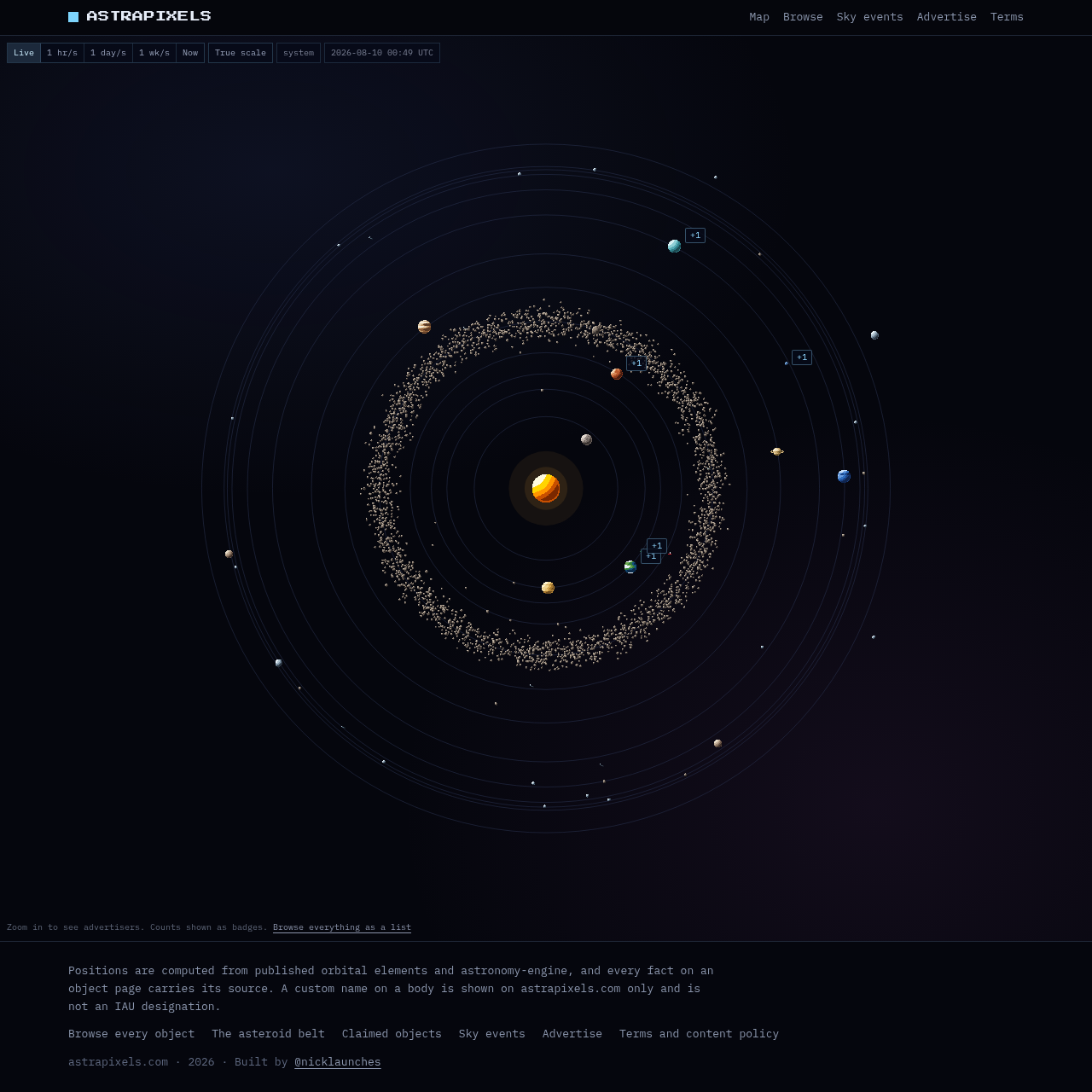
AstraPixels product interface screenshot
Listed on AIToolly

What Is AstraPixels? Product Overview

What the product does and how it is positioned

AstraPixels is a digital mapping platform designed to visualize the positions and movements of celestial bodies. It utilizes an astronomy engine to process published orbital elements, providing users with a true-scale view of the solar system.

The tool includes features for browsing specific regions like the asteroid belt and tracking upcoming sky events. Users can interact with the map through various time scales and have the option to apply custom names to objects within the interface.

What Can You Use AstraPixels For?

Source-supported ways to use the product

Celestial Object Tracking

Monitoring the real-time or projected positions of asteroids and other space objects using orbital data.

Sky Event Discovery

Identifying and planning for upcoming astronomical occurrences through the platform's event directory.

How to Use AstraPixels

The documented workflow, where available

  1. 1

    Access the Map

    Navigate to the interactive map interface to view the current layout of celestial objects.

  2. 2

    Adjust Time Parameters

    Select a time scale such as live, hourly, or weekly to observe object trajectories.

  3. 3

    Browse Objects

    Search for specific bodies or explore the asteroid belt to view detailed orbital facts and sources.

Orbital Data and Computation

The core functionality of the platform relies on the integration of published orbital elements with a dedicated astronomy engine. This system computes the precise coordinates of celestial bodies to ensure the map reflects accurate positions based on available scientific data.

Every fact presented on an object's page is linked to its specific data source, allowing for verification of the orbital elements used in the calculation. This transparency is intended to support the reliability of the visual representation.

  • Utilization of published orbital elements for position calculations.
  • Integration with an astronomy engine for real-time data processing.
  • Source attribution for individual object data points.

What to Test Before Choosing AstraPixels

Checks to run with your own material and workflow

  • Confirm that the source of orbital data is listed for specific celestial objects.
  • Verify that custom names are clearly distinguished from official IAU designations.
  • Check the accuracy of the true-scale visualization against known astronomical distances.
  • Review the sky events section for upcoming astronomical dates and details.

AstraPixels Sources and Last Checked

What was checked and when

Last checked

AstraPixels Frequently Asked Questions

Answers based on the source-checked product record

How are the positions of celestial objects determined?

Positions are computed using published orbital elements processed through a specialized astronomy engine.

Are the custom names on the platform official?

No, custom names are only displayed on the AstraPixels website and do not represent official IAU designations.

What time increments can be used to view the map?

Users can view the map in real-time or select increments of one hour, one day, or one week.

Does the platform provide information on astronomical events?

Yes, the platform includes a dedicated section for browsing and tracking various sky events.

Can I see the source of the information for a specific object?

Every fact presented on an object's individual page includes a reference to its data source.

Explore other recently added tools in the same category.