Academa: Transforming STEM Education Through the 'Lecture Videos as Code' Paradigm and LLMs
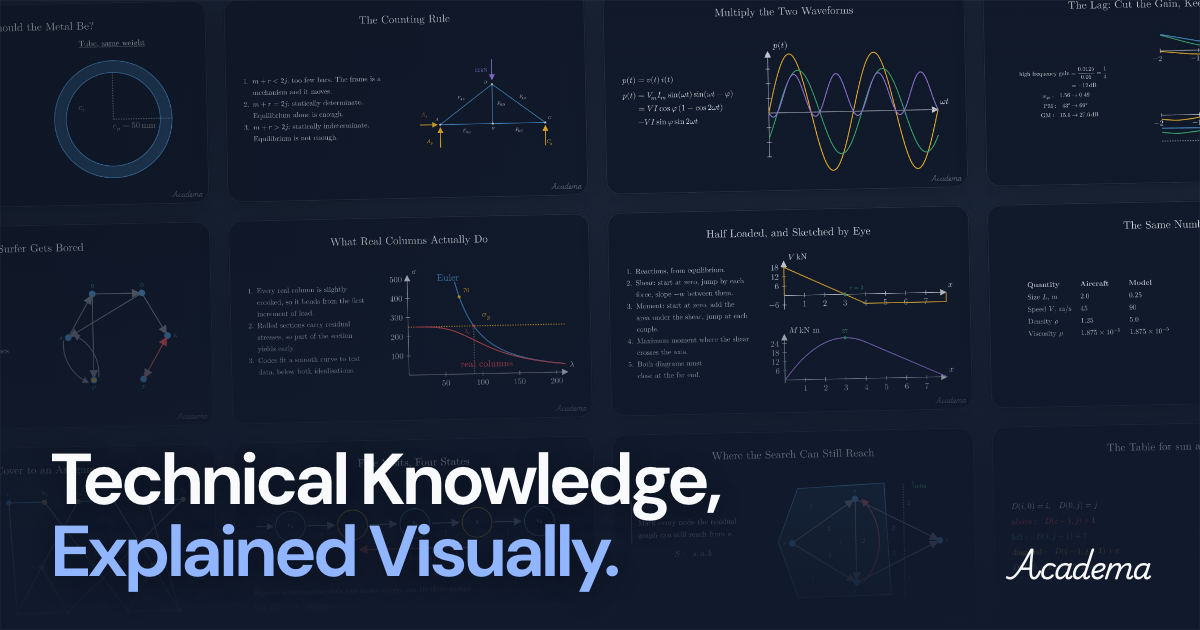
Academa, a new project featured on Hacker News, introduces a revolutionary approach to creating STEM educational content by treating lecture videos as maintainable source code. Traditional video production for platforms like Coursera or Khan Academy is notoriously difficult to edit once finalized. Academa solves this by allowing educators to write lectures using a specific syntax—defining speech, drawings, and equations—which a compiler then transforms into video using text-to-speech and computer graphics. By leveraging the code-generation capabilities of Large Language Models (LLMs), Academa aims to make educational content as iterative and updateable as software, marking a significant shift in the EdTech landscape. This approach ensures that errors can be corrected by simply updating the source code and re-compiling, rather than re-recording entire segments.
Key Takeaways
- The 'Lecture as Code' Concept: Academa treats STEM lecture videos as source code, making them as maintainable and updateable as software applications.
- Solving the Production Bottleneck: Traditional video production is rigid; Academa allows for easy error correction and content updates by modifying code rather than re-recording media.
- Compiler-Driven Content: The platform uses a compiler to transform descriptive code into video through text-to-speech (TTS) and computer graphics.
- LLM Integration: Academa leverages the power of Large Language Models, which have already proven highly effective in software engineering, to automate the generation of educational lecture code.
In-Depth Analysis
The Evolution of the Digital Blackboard
Online STEM education has historically been defined by the "blackboard" paradigm. Whether on platforms like Khan Academy, MIT OpenCourseWare, or YouTube, the core experience involves a professor performing a presentation: writing equations, drawing plots, and explaining concepts in real-time. While this format is highly effective for learning, it is incredibly difficult to produce and maintain.
As noted by the creators of Academa, the current workflow for educational video is linear and static. Once a video is recorded, edited, and published, it becomes a fixed asset. If an educator discovers a mistake two weeks later—a common occurrence in complex STEM subjects—they face a difficult choice: leave the error in place or undergo the costly and time-consuming process of re-production. Academa identifies this as a fundamental flaw in the current paradigm of online education, suggesting that the medium of "video" as a static file is the primary obstacle to high-quality, evolving educational content.
Bridging the Gap: Lecture Videos as Source Code
To solve the maintenance problem, Academa proposes a shift from video production to video programming. By describing the actions of a teacher as discrete lines of code, the lecture becomes a dynamic entity. The original content provides a clear example of this syntax:
say "Look at this square." while : draw squaresay "Suppose each side has length s." while : label square . side "s"say "Then its area is s squared." while : write "A = s^2"
In this model, every action—speech, drawing, and notation—is a command. This "source code" is then processed by a compiler that integrates text-to-speech technology and computer graphics to render a final video. This transformation mirrors the software development lifecycle: developers write code, ship it, find bugs, and then ship a new version. By applying this to lectures, Academa enables educators to "fix" a video by simply editing a line of code and re-compiling the asset. This ensures that educational materials can remain accurate and up-to-date with minimal overhead.
The Synergy Between LLMs and Educational Programming
The timing of Academa’s emergence is closely tied to the rise of Large Language Models (LLMs). The project notes that LLMs have had their most significant impact to date in the field of software engineering. This is because LLMs are exceptionally proficient at generating and manipulating structured code.
By framing a lecture as code, Academa creates a bridge that allows LLMs to generate long-form STEM content. Instead of asking an AI to generate a video directly—which is computationally expensive and often lacks precision—Academa allows the AI to generate the instructions for the video. This leverages the LLM's strength in logic and coding to produce educational content that is both precise and easy for humans to audit and edit. The "Lecture as Code" idea is powerful on its own, but when combined with the generative capabilities of AI, it creates a scalable system for producing high-quality STEM education at a fraction of the traditional cost.
Industry Impact
The introduction of Academa and the "lecture as code" philosophy could have profound implications for the EdTech industry. Currently, the barrier to entry for creating high-quality STEM courses is high, requiring specialized recording equipment, editing skills, and significant time. By moving the production into a code-based environment, Academa lowers this barrier, allowing subject matter experts to focus on content rather than production logistics.
Furthermore, this approach could lead to a new era of "version-controlled education." Just as open-source software thrives on community contributions and iterative improvements, educational lectures could be hosted on platforms like GitHub, where educators worldwide could submit "pull requests" to improve explanations or correct errors in a lecture's source code. This would move online education away from a library of static videos toward a living, breathing ecosystem of maintainable knowledge.
Frequently Asked Questions
Question: What is the main advantage of 'lecture videos as code' over traditional recording?
Answer: The primary advantage is maintainability. In traditional video, fixing a mistake requires re-recording and re-editing. With 'lecture as code,' an educator can simply edit the text or the command in the source file and re-compile the video, similar to how a programmer fixes a bug in software.
Question: How does Academa use AI to create these videos?
Answer: Academa utilizes Large Language Models (LLMs) to help generate the source code for the lectures. Since LLMs are highly effective at writing code, they can be used to draft the sequences of speech, drawings, and equations that the Academa compiler then turns into a finished STEM video.
Question: What technologies are used to turn the code into a visual video?
Answer: The process involves a compiler that takes the source code and utilizes text-to-speech (TTS) for the narration and computer graphics for the visual elements, such as drawing shapes or writing mathematical equations on a virtual blackboard.