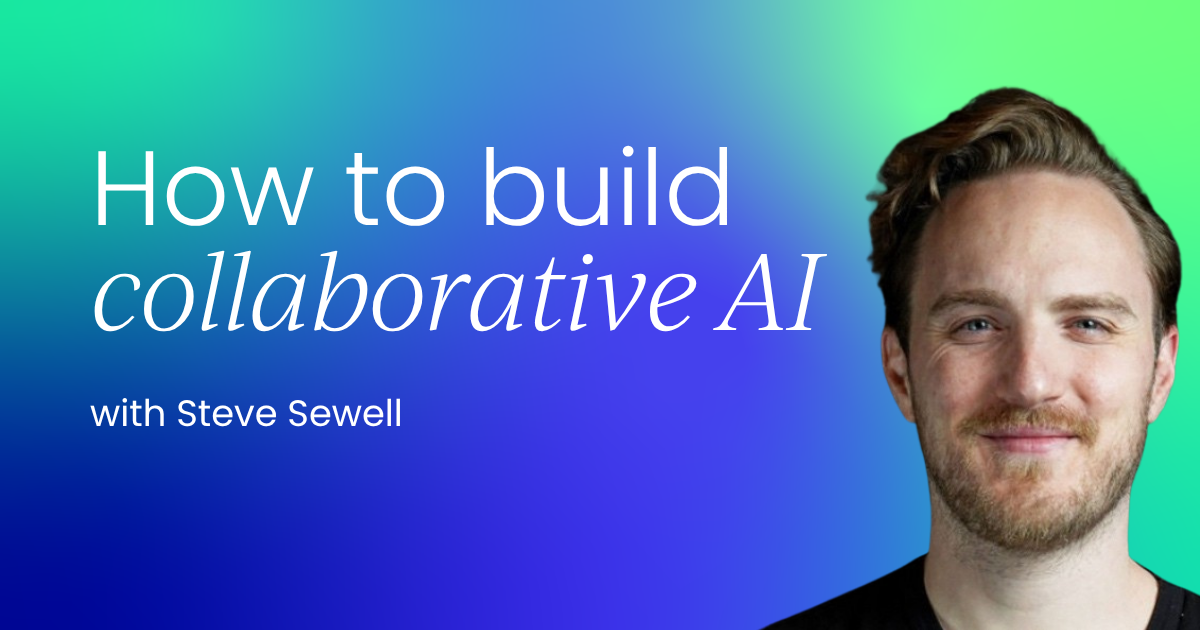
Building AI in the Age of Collaborative Coding: Insights from Builder.io CEO Steve Sewell
Steve Sewell, the co-founder and CEO of Builder.io, challenges the current approach many development teams are taking toward AI integration. While AI adoption is high, Sewell argues that most teams are failing to capture its true potential by treating it as a simple productivity tool rather than a collaborative partner. The core of the issue lies in the traditional, fragmented workflow between design and development. By shifting toward 'collaborative coding' and AI-native workflows, teams can bridge the design-to-code gap, moving beyond basic autocomplete features to a more integrated, visual development process. This analysis explores Sewell's perspective on why the industry must rethink its AI strategy to achieve meaningful gains in software delivery and innovation.
Key Takeaways
- Shift from Tools to Partners: AI is evolving from a simple autocomplete utility into a collaborative partner that understands design intent and architectural context.
- The Design-to-Code Gap: A primary inefficiency in modern development is the manual translation of visual designs into functional code, a process AI is uniquely positioned to solve.
- Beyond Micro-Tasks: To truly leverage AI, teams must move past using it for small code snippets and start using it for full-feature implementation and visual development.
- Human-Centric AI Workflows: The future of coding involves a "human-in-the-loop" approach where developers oversee AI-driven transformations rather than writing every line of boilerplate.
In-Depth Analysis
The Evolution of AI in the Development Lifecycle
Steve Sewell, CEO of Builder.io, highlights a fundamental shift in how software is being built. While the initial wave of AI adoption in coding focused on "micro-productivity"—such as GitHub Copilot suggesting the next line of code—the next phase is defined by "collaborative coding." This involves AI systems that can reason about the entire application structure. Sewell argues that many teams are currently "getting it wrong" by treating AI as a glorified search engine or a better version of Stack Overflow. Instead, the real value lies in integrating AI into the collaborative workflow between designers and developers.
In the current landscape, developers often use AI to solve isolated logic problems or to generate boilerplate code. However, this approach ignores the broader context of the product being built. Collaborative coding suggests a model where the AI understands the project's design system, the existing codebase, and the ultimate user experience goals. This allows the AI to act as a bridge between different stages of the development lifecycle, ensuring that the transition from a conceptual design to a functional product is seamless and high-fidelity.
Bridging the Visual-Technical Divide
One of the most significant pain points in software engineering is the handoff between design teams and engineering teams. Traditionally, this involves a developer looking at a static design (like a Figma file) and manually recreating it in code. Sewell posits that AI-native development should eliminate this manual labor. By using "Visual Copilots," teams can feed visual context directly into AI models, which then generate high-quality, production-ready code that matches the design perfectly. This doesn't just save time; it reduces the "lost in translation" errors that occur during manual implementation.
The challenge with traditional handoffs is that designs are often expressive and fluid, while code is rigid and structured. AI models, particularly those trained on vast amounts of front-end code and design patterns, are becoming increasingly adept at interpreting visual hierarchy and translating it into clean CSS and JSX. By automating the "visual-to-code" pipeline, teams can ensure that the final product is a 1:1 reflection of the designer's vision, while also adhering to the developer's architectural standards.
The Rise of AI-Native Workflows
An AI-native workflow is not just about adding an AI plugin to an existing Integrated Development Environment (IDE). It requires rethinking the development process from the ground up. Sewell emphasizes that for AI to be truly effective, it needs to understand the "source of truth"—which is often the visual design. By moving toward a visual development environment where AI handles the heavy lifting of code generation, developers are freed to focus on higher-level architecture, logic, and user experience. This shift represents a move from "writing code" to "assembling and refining systems."
This transition also necessitates a change in team culture. Engineering leaders must encourage a mindset where AI is seen as a force multiplier. Instead of fearing automation, developers should embrace the role of an "AI Orchestrator." In this role, the human developer provides the creative direction and technical oversight, while the AI executes the repetitive and detail-oriented tasks of implementation. This collaborative synergy is what Sewell believes will define the most successful engineering teams in the coming years.
Industry Impact
The move toward collaborative, AI-driven coding has profound implications for the tech industry. First, it lowers the barrier to entry for building complex user interfaces, potentially democratizing high-end web development. Small teams can now achieve the output of much larger organizations by leveraging AI to handle the front-end heavy lifting.
Second, it shifts the value proposition of a front-end engineer from someone who "knows CSS" to someone who can "orchestrate AI systems" to deliver business value. This will likely lead to a change in hiring practices, with a greater emphasis on architectural thinking and system design over syntax memorization.
Finally, as tools like Builder.io's Visual Copilot become more prevalent, the speed of product iteration will increase exponentially. Companies will be able to move from concept to deployment in a fraction of the time previously required, leading to a more dynamic and competitive software market. The ability to rapidly prototype and ship production-grade features will become a key differentiator for businesses in every sector.
Frequently Asked Questions
Question: What is the difference between AI autocomplete and collaborative coding?
AI autocomplete focuses on predicting the next few characters or lines of code based on the immediate context within a file. Collaborative coding involves the AI understanding broader project goals, such as converting a design file into a functional component or refactoring a whole module to meet new requirements while maintaining design consistency.
Question: How does visual development change the role of a developer?
Visual development doesn't replace developers; it changes their focus. Instead of spending hours on CSS layouts and boilerplate HTML, developers act as architects and reviewers. They ensure the AI-generated code meets performance, accessibility, and security standards, while focusing their creative energy on complex business logic and system integration.
Question: Why does Steve Sewell believe most teams are using AI incorrectly?
Sewell suggests that teams are often stuck in the "tool" mindset, using AI to speed up old, inefficient processes rather than redesigning their workflows to be AI-first. By not addressing the design-to-code gap and failing to integrate AI into the visual design process, they miss out on the largest efficiency gains possible in the modern era.