
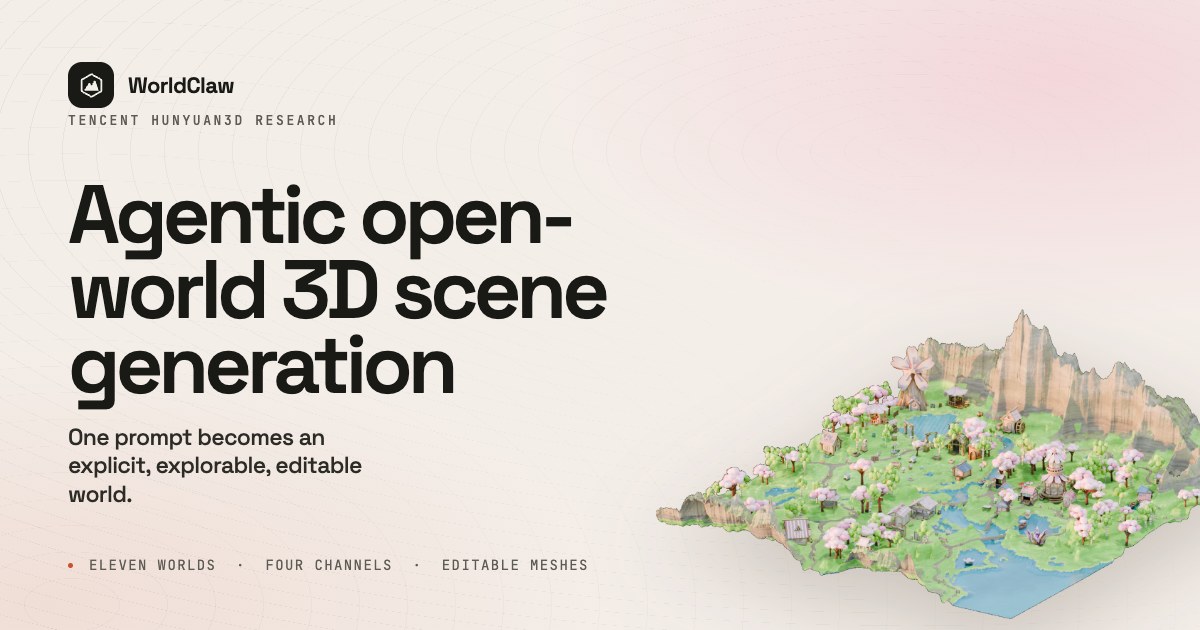
WorldClaw: Tencent Hunyuan Unveils Agentic 3D Open-World Generation at Scale
Tencent Hunyuan has introduced WorldClaw, a pioneering system designed for agentic 3D open-world generation. This technology enables the transformation of a single, open-ended prompt into a comprehensive, explicit, explorable, and editable 3D environment. By leveraging an agentic approach, WorldClaw addresses the complexities of large-scale world-building, moving beyond simple object generation to create vast, interactive spaces. The system emphasizes scalability, allowing for the creation of detailed 3D worlds that are not only visually explicit but also fully functional for exploration and modification. This development represents a significant advancement in generative AI, providing a streamlined workflow for developers to generate complex 3D landscapes from minimal input, potentially transforming how virtual environments are designed and deployed.
Key Takeaways
- Prompt-to-World Capability: WorldClaw generates entire 3D open worlds from a single, open-ended text prompt.
- Agentic Framework: The system utilizes an agentic approach to manage the complexities of large-scale 3D environment construction.
- Explorable and Editable: Generated worlds are not static; they are designed to be explicit, fully explorable, and easily editable by users.
- Scalable Generation: The technology is built to handle 3D generation at scale, moving beyond isolated assets to expansive environments.
In-Depth Analysis
The Shift to Agentic 3D Generation
The introduction of WorldClaw by Tencent Hunyuan marks a pivotal shift in the field of generative artificial intelligence, specifically within the 3D modeling domain. Traditional 3D generative tools have largely focused on the creation of individual assets—isolated objects like chairs, cars, or characters. WorldClaw, however, introduces an "agentic" framework. In the context of 3D generation, an agentic system implies a level of autonomous decision-making or structured workflow management that can interpret a broad, open-ended prompt and translate it into a complex, multi-faceted environment. This approach allows the AI to handle the intricate spatial relationships and architectural logic required to build a cohesive world, rather than just a collection of disparate parts.
By moving from "asset generation" to "agentic world generation," the technology reduces the manual overhead typically associated with scene assembly. The ability to start with an open-ended prompt suggests that the underlying model possesses a deep understanding of environmental context, allowing it to populate a 3D space with relevant structures, terrains, and details that align with the user's initial vision. This transition is essential for scaling 3D content creation to meet the demands of modern digital experiences.
Scalability and Open-World Construction
One of the most significant claims regarding WorldClaw is its ability to perform 3D generation "at scale." In the realm of 3D design, scalability refers to the capacity to generate large, high-fidelity environments without a linear increase in manual labor or computational bottlenecks. Creating an "open-world" environment is a task that traditionally requires teams of artists and developers months or even years to complete. WorldClaw aims to automate this process, providing a path toward the rapid prototyping and deployment of vast virtual landscapes.
The "open-world" nature of the output implies a level of continuity and depth. Unlike a simple 3D scene, an open world suggests a space that is expansive and interconnected. For a generative system to achieve this at scale, it must maintain consistency across large distances and manage varying levels of detail. The focus on scalability indicates that WorldClaw is designed to handle the heavy lifting of environmental layout and asset placement, allowing creators to focus on the higher-level creative aspects of their projects.
Explorability and Editability: The Three Pillars
WorldClaw defines its output through three critical attributes: it is explicit, explorable, and editable. These pillars distinguish the system from "black-box" generative models that might produce a visual representation of a 3D scene (such as a 2D video or a static image) without providing the underlying 3D data.
- Explicit: This suggests that the generated world consists of clear, defined 3D geometry and data structures. It is not a mere visual hallucination but a tangible digital construct that can be integrated into standard 3D engines.
- Explorable: The generated environments are designed for interaction. Users can navigate through the space, suggesting that the AI accounts for collision, pathing, and spatial logic that makes a world functional for avatars or cameras.
- Editable: Perhaps most importantly, the worlds are editable. This means that the output is not a final, unchangeable file. Instead, users can modify the generated environment, adjusting specific elements to suit their needs. This feature is crucial for professional workflows, where AI is used as a foundational tool that human creators then refine and polish.
Industry Impact
The emergence of agentic 3D world generation like WorldClaw has profound implications for several sectors of the technology industry. In the gaming industry, the ability to generate explorable and editable open worlds from prompts could drastically reduce development cycles and costs, particularly for indie developers or small studios. It allows for the rapid iteration of level designs and the creation of diverse environments that would otherwise be cost-prohibitive.
Beyond gaming, the fields of Virtual Reality (VR), Augmented Reality (AR), and digital twin simulation stand to benefit. For industrial simulations or urban planning, the capacity to generate explicit 3D environments at scale provides a powerful tool for visualization and testing. Furthermore, as the demand for high-quality 3D content in the metaverse and social platforms grows, systems like WorldClaw offer a scalable solution for user-generated content, enabling non-technical users to build complex virtual spaces with the same ease as writing a text description.
Frequently Asked Questions
Question: What is the primary difference between WorldClaw and standard 3D asset generators?
WorldClaw focuses on "agentic" open-world generation at scale, meaning it creates entire interconnected environments from a single prompt, whereas standard generators often focus on creating individual, isolated 3D objects.
Question: Can the 3D worlds generated by WorldClaw be modified after they are created?
Yes, one of the core features of WorldClaw is that the generated worlds are "editable." This allows users to take the explicit 3D data produced by the AI and make manual adjustments or refinements to the environment.
Question: What does "agentic" mean in the context of WorldClaw?
In this context, "agentic" refers to the system's ability to act as an intelligent agent that can interpret open-ended prompts and autonomously manage the complex process of building a structured, logical, and large-scale 3D world.
