
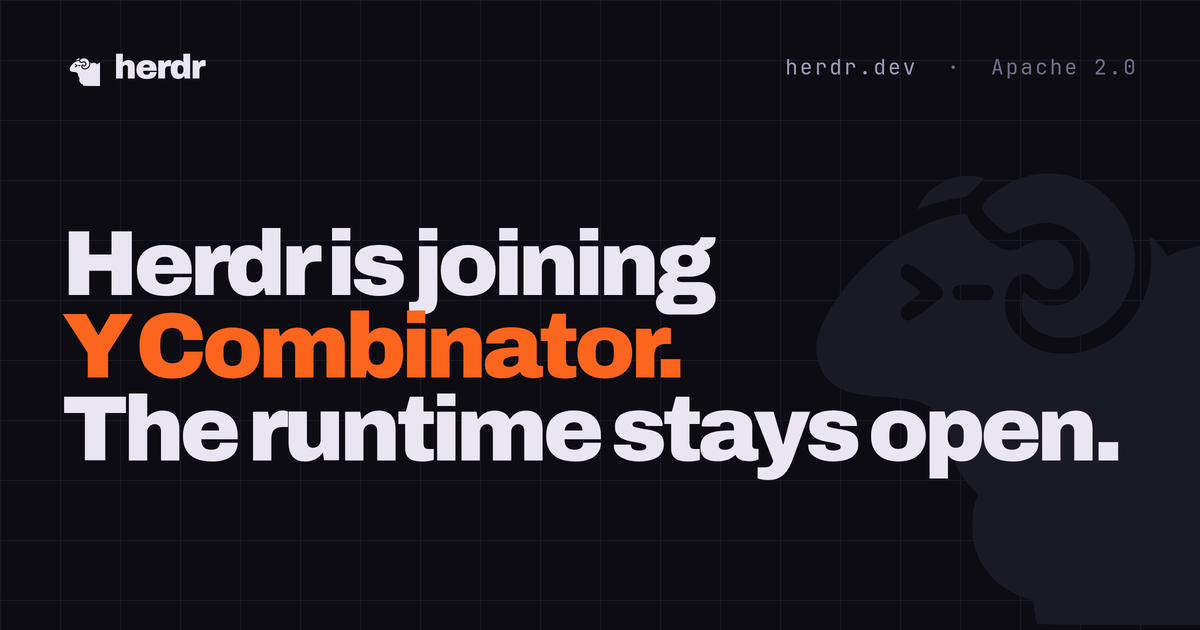
Herdr Joins Y Combinator to Scale Its Open Runtime for Persistent Terminal-Based AI Coding Agents
Herdr, a startup founded by developer Can, has officially announced its entry into Y Combinator while committing to keeping its core runtime open. Developed to address the management and engineering bottlenecks in AI-assisted development, Herdr offers a specialized runtime and Terminal User Interface (TUI) for CLI coding agents. Unlike standalone AI applications, Herdr focuses on integrating agents directly into the developer's terminal environment, treating panes and tabs as first-class primitives. This architecture supports persistent agent operations that can run for hours or days across various projects. By prioritizing a TUI that alerts users only when necessary, Herdr aims to streamline the developer experience, moving away from the trend of isolated, product-specific agents toward a more integrated, developer-centric infrastructure.
Key Takeaways
- Y Combinator Entry: Herdr has officially joined the Y Combinator accelerator program, marking a significant milestone for the solo-founded project.
- Open Runtime Commitment: Despite joining YC, the founder has confirmed that the Herdr runtime will remain open for the community.
- Terminal-Centric Architecture: The platform is built as a runtime for CLI coding agents, utilizing terminal panes and tabs as primary organizational structures.
- Focus on Persistence: Herdr enables AI agents to run continuously for extended periods—ranging from hours to days—across different project environments.
- Developer-First TUI: The Terminal User Interface (TUI) is designed to minimize distractions, organizing work by projects and alerting developers only when human intervention is required.
In-Depth Analysis
Solving the Management and Engineering Bottleneck
The genesis of Herdr stems from a fundamental realization by its founder, Can, during a period of career reflection. While exploring the landscape of software engineering and AI tools, the founder identified a critical "bottleneck" that was not necessarily the capability of the AI agents themselves, but rather the management and engineering overhead required to utilize them effectively. The original news highlights a frustration with the current industry trend where every company releases a proprietary, standalone agent. Herdr proposes a reversal of this logic: instead of forcing developers to adopt new tools or learn specific interfaces for every product, agents should integrate seamlessly into the developer's existing workflow. This philosophy shifts the focus from the agent as a standalone product to the agent as a manageable component of the engineering process.
The Terminal as the Foundation for AI Runtimes
Herdr defines its core offering as a "runtime," a term that carries specific weight in the context of CLI coding agents. The developer's terminal is described as the "root" and the "connection" for essential tasks such as code editing, server management, and CI maintenance. By building the runtime within the terminal, Herdr treats terminal elements—panes and tabs—as first-class primitives. In this system, a terminal pane is assigned to an agent, tabs are organized by projects, and these configurations remain persistent. This structural approach addresses a common limitation in current AI tools: the lack of long-term persistence. According to the original report, Herdr allows agents to run for hours or even days, ensuring that the location of the execution becomes secondary to the continuity of the task. This persistence is vital for complex engineering projects that require more than a single session of AI interaction.
The TUI: Efficiency Through Minimalist Design
While the runtime provides the engine, the Terminal User Interface (TUI) serves as the primary interaction layer for Herdr. The TUI is not merely an aesthetic choice but a functional one, designed to reflect the core concepts of the platform. It allows developers to track multiple agents at a glance without becoming overwhelmed by a "pile of agents." By dividing work into distinct projects, the TUI helps maintain focus and organization. A key feature mentioned in the announcement is the alerting system; the TUI is designed to notify the developer only when an agent actually requires human input. This "alert-by-necessity" model is intended to reduce cognitive load and prevent the friction often associated with managing automated tools. Furthermore, because the TUI is bundled with the installation, it remains a first-class, accessible interface for any environment where Herdr is deployed.
Industry Impact
The move of Herdr into Y Combinator, while keeping its runtime open, signals a growing interest in the infrastructure layer of the AI agent ecosystem. As the industry moves past the initial excitement of standalone LLM interfaces, the focus is shifting toward how these agents can be integrated into professional DevOps and software engineering workflows. Herdr’s approach challenges the "walled garden" model of AI agents by advocating for a runtime that fits the developer's existing environment (the terminal) rather than forcing the developer into a new application. This could influence how future AI tools are developed, prioritizing interoperability and persistence over isolated features. By focusing on the terminal—a tool synonymous with professional engineering—Herdr positions itself as a utility for "power users" who require long-running, project-aware AI assistance.
Frequently Asked Questions
Question: What makes Herdr different from other AI coding agents?
Herdr is not just another standalone agent; it is a runtime and TUI designed to manage agents within the terminal. It focuses on persistence, allowing agents to run for days, and organizes them using terminal primitives like panes and tabs, rather than requiring a separate application.
Question: Why did the founder choose a TUI (Terminal User Interface) over a traditional GUI?
The TUI is chosen because the terminal is the natural environment for software engineering tasks like editing code and running servers. The TUI allows for bundled installation, project-based organization, and a low-distraction environment where developers are only alerted when an agent needs help.
Question: Will Herdr become a closed-source product after joining Y Combinator?
According to the founder's announcement, while Herdr is joining Y Combinator to grow, the runtime is intended to stay open, maintaining its accessibility for the developer community.
