Fireworks.ai Announces Kimi K3: Achieving State-of-the-Art Performance Through Strategic Model Routing and Cost Efficiency
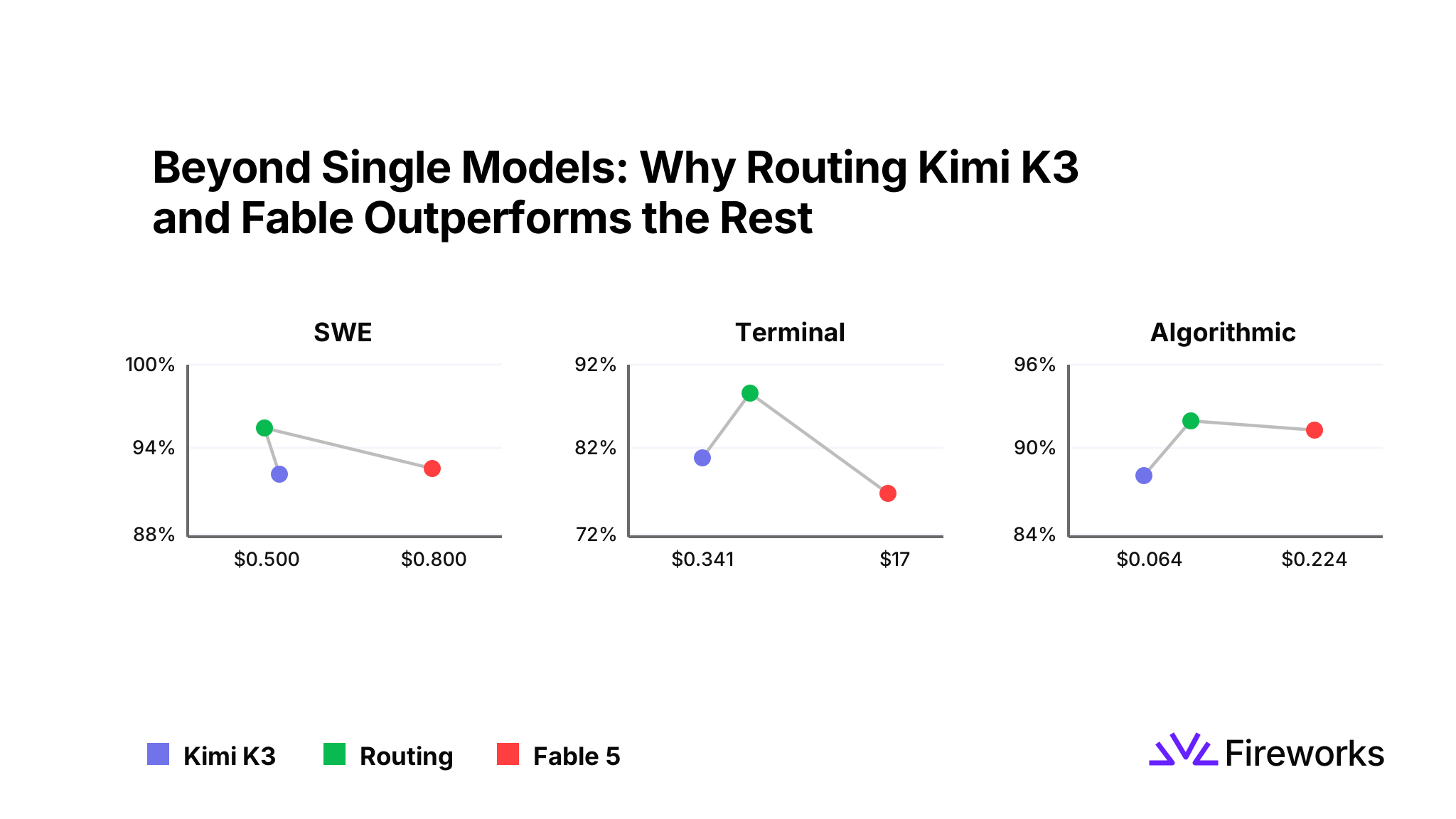
Fireworks.ai has announced a major milestone with the introduction of Kimi K3, an open-frontier model that demonstrates high competitiveness with the closed Fable 5 model. By implementing an intelligent routing system between Kimi K3 and Fable, the company has achieved State-of-the-Art (SoTA) results, reaching 93% accuracy across approximately 1,000 agentic tasks. This strategic approach not only optimizes performance but also delivers significant economic benefits, reducing costs by up to 50x on long agentic loops compared to using Fable alone. Alongside these technical breakthroughs, Fireworks.ai revealed its Series D funding success and the achievement of $1B in Annual Recurring Revenue (ARR), signaling a shift in the industry away from wasteful single-model reliance toward cost-optimized, multi-model routing architectures.
Key Takeaways
- State-of-the-Art Performance: The combination of Kimi K3 and Fable 5 through intelligent routing achieves SoTA results with 93% accuracy on agentic tasks.
- Massive Cost Efficiency: Utilizing Kimi K3 on the Fireworks platform can reduce costs by up to 50x, particularly in long-running agentic loops.
- Financial Milestone: Fireworks.ai has officially announced its Series D funding round and reached a significant milestone of $1B in Annual Recurring Revenue (ARR).
- Shift in AI Strategy: The company advocates for a "Route, Don't Pick" philosophy, arguing that single-model reliance is wasteful and no longer represents the frontier of AI efficiency.
- Comprehensive Benchmarking: Performance was validated across 1,030 real-world agentic tasks spanning software engineering, legal, and algorithmic domains.
In-Depth Analysis
The Evolution of Model Performance: Kimi K3 and Fable 5
The AI landscape is witnessing a transition where open models are beginning to challenge the dominance of closed-source giants. Fireworks.ai's latest data suggests that Kimi K3 is not just a participant in this race but a primary competitor to Fable 5. The core of this breakthrough lies in the synergy between the two. While Kimi K3 is a frontier-quality open model, its true potential is unlocked when paired with Fable.
According to the report, the combination of Kimi K3 and Fable 5 represents the new State-of-the-Art (SoTA). This was measured through a rigorous testing harness involving 1,030 tasks designed to simulate real agent loops. The results were definitive: a routing strategy between these two models achieved a 93% accuracy rate. This suggests that the future of high-quality intelligence does not depend on finding a single "perfect" model, but rather on the predictable complementarity between different models. Kimi K3 serves as a cost-optimized powerhouse that can handle a vast majority of work types, allowing more expensive models like Fable to be utilized only when strictly necessary.
Benchmarking Real-World Agentic Loops
To validate the efficacy of Kimi K3, Fireworks.ai conducted extensive testing across five distinct categories of work. This multi-dimensional approach ensures that the model's performance is not limited to simple text generation but extends to complex, multi-step operations. The benchmarks included:
- SWE (Software Engineering): 460 tasks focused on real repository bug fixes, modeled after the SWE-bench standard. This tests the model's ability to navigate complex codebases.
- Terminal Operations: 89 tasks involving long agentic operations such as security audits, cryptography, reverse engineering, and system administration. These tasks require high levels of logic and persistence.
- Algorithmic Challenges: 100 problems styled after LeetCode and AtCoder, testing the pure mathematical and logical reasoning of the models.
- Multi-Language Implementation: 225 tasks requiring code implementation across six different programming languages, highlighting the model's versatility.
- Legal Agents: 120 tasks graded by lawyers, representing a specialized legal-agent benchmark that demands high precision and adherence to professional standards.
By averaging these benchmarks, Fireworks.ai demonstrated that Kimi K3 is cost-optimized across all work types. The use of "Oracle routing"—a method that measures theoretical best performance by selecting the most cost-effective correct option—showed that the K3 and Fable duo outperforms single-model deployments consistently.
Economic Disruption: The 50x Cost Advantage
One of the most striking revelations in the announcement is the economic impact of switching from a single-model approach to a routed architecture. Fireworks.ai claims that Kimi K3 can be up to 50x lower in cost when run on their platform compared to using Fable alone for long agentic loops. This is a critical factor for enterprises and developers building autonomous agents that require thousands of iterations to complete a task.
The philosophy of "Don't pick a model. Route." addresses the inherent wastefulness of current AI deployment strategies. In many use cases, a high-cost model is used for tasks that a more efficient, frontier-quality open model like K3 could handle with equal accuracy. By routing tasks based on complexity and cost-performance ratios, organizations can maintain SoTA quality while drastically reducing their operational overhead. This economic efficiency is likely a major contributor to Fireworks.ai's reported $1B ARR and successful Series D funding.
Industry Impact
The announcement from Fireworks.ai signals a paradigm shift in the AI industry. For a long time, the narrative was centered on the "one model to rule them all" approach, where developers sought the single most powerful closed-source model. The success of Kimi K3 and the routing methodology proves that the industry is moving toward a hybrid ecosystem.
This shift emphasizes the importance of infrastructure that can support intelligent routing. As open models like Kimi K3 reach frontier-level quality, the value proposition of closed models changes from being the only option to being a specialized component of a larger, more efficient system. Furthermore, the achievement of $1B ARR by a company focusing on model efficiency and routing suggests that the market is ready to prioritize sustainability and cost-effectiveness alongside raw intelligence. This will likely encourage more development in open-source frontier models and the software layers required to manage them effectively.
Frequently Asked Questions
Question: What is Oracle routing and how was it used in these benchmarks?
Oracle routing is a measurement methodology used to determine the best theoretical performance of a multi-model system. It works by running a specific task through each available model and then selecting the cheapest option that provides the correct answer. In this study, it was used to demonstrate how Kimi K3 and Fable 5 can be combined to achieve maximum accuracy at the lowest possible cost.
Question: How does Kimi K3's cost compare to Fable 5?
Kimi K3 is significantly more cost-effective, offering up to a 50x reduction in costs when deployed on the Fireworks platform, especially for long-running agentic loops. While Fable 5 remains a high-quality closed model, Kimi K3 provides frontier-level quality at a fraction of the price, making it ideal for the majority of tasks in a routed system.
Question: In which specific areas does Kimi K3 show its strength?
Kimi K3 has been validated across a wide range of complex tasks, including software engineering (bug fixes), terminal-based operations (security and sysadmin), algorithmic problem solving, multi-language coding, and specialized legal tasks. It is designed to be cost-optimized across all these work types.