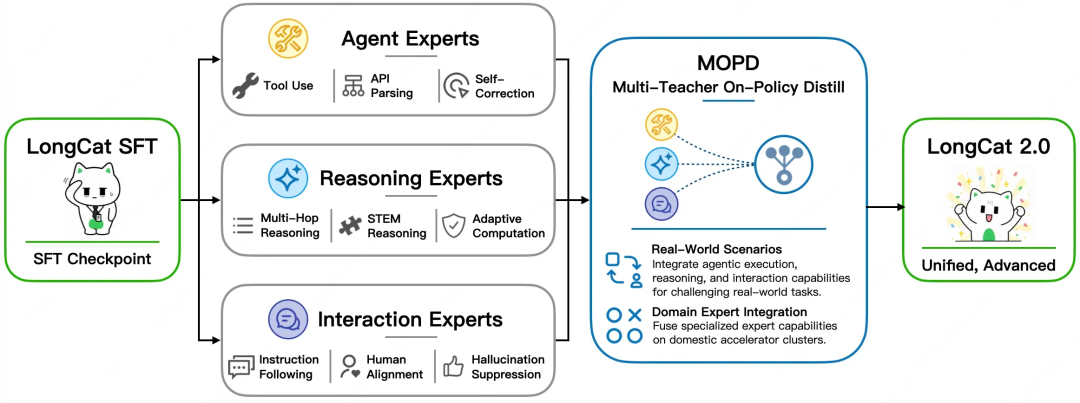
Meituan Launches LongCat-2.0: A 1.6 Trillion Parameter Model Breakthrough on Domestic Computing Clusters
Meituan has officially unveiled LongCat-2.0, a pioneering large-scale model featuring 1.6 trillion parameters. This release marks a significant milestone as the industry's first trillion-parameter model to complete its entire training and inference lifecycle on a domestic computing cluster consisting of 50,000 cards. LongCat-2.0 utilizes a dynamic activation architecture, with an average of 48 billion active parameters and a range between 33 billion and 56 billion. Designed with a native 1-million-token context window, the model is specifically optimized for "Agentic Coding" tasks. Its core objective is to provide enhanced efficiency and stability for complex code understanding, generation, and execution, demonstrating the robust capabilities of domestic hardware in supporting massive-scale AI development.
Key Takeaways
- Massive Scale: LongCat-2.0 features a total of 1.6 trillion (1.6T) parameters, making it one of the largest models in the industry.
- Domestic Hardware Milestone: It is the first trillion-parameter model to be trained and deployed entirely on a 50,000-card domestic computing cluster.
- Dynamic Architecture: The model utilizes a dynamic activation range of 33B to 56B parameters, with an average of 48B parameters activated during tasks.
- Ultra-Long Context: Native support for a 1-million-token (1M) context window allows for the processing of massive amounts of information.
- Specialized Focus: The architecture is purpose-built for "Agentic Coding," focusing on the stability and efficiency of code understanding, generation, and execution.
In-Depth Analysis
A New Benchmark for Domestic Computing Infrastructure
The release of LongCat-2.0 by the Meituan technical team represents a pivotal moment for the domestic AI industry. The most striking aspect of this announcement is the successful utilization of a 50,000-card domestic computing cluster for the full-process training and inference of a trillion-parameter model. Training a model of this magnitude—1.6 trillion parameters—from scratch requires immense computational power and sophisticated orchestration. By completing this process on domestic hardware, Meituan has demonstrated that large-scale AI development is no longer dependent solely on international hardware ecosystems. This achievement validates the stability and scalability of domestic computing clusters, proving they can handle the rigorous demands of pre-training and inferencing models that exceed the trillion-parameter threshold.
Architectural Innovation: Dynamic Activation and 1M Context
LongCat-2.0 is not just large; it is architecturally sophisticated. While the total parameter count reaches 1.6 trillion, the model employs a dynamic activation strategy. On average, only 48 billion parameters are active at any given time, with the dynamic range fluctuating between 33 billion and 56 billion. This approach suggests a Mixture-of-Experts (MoE) or a similar sparse architecture, which allows the model to maintain the representational power of a trillion-parameter system while keeping the computational cost of inference closer to that of a much smaller model.
Furthermore, the native support for a 1-million-token context window is a critical feature for modern AI applications. A 1M context window allows the model to "read" and "remember" vast amounts of data in a single session—equivalent to several thick books or an entire complex codebase. This capability is essential for the model's primary goal: Agentic Coding. By maintaining such a large context, LongCat-2.0 can understand the intricate dependencies within large software projects, ensuring that the code it generates or analyzes is contextually accurate and functionally sound.
Optimized for the Future of Agentic Coding
The design philosophy behind LongCat-2.0 is centered on "Agentic Coding." Unlike general-purpose models that may struggle with the precision required for software engineering, LongCat-2.0 was built from the ground up to handle the full lifecycle of coding tasks. This includes not just simple code generation, but deep code understanding and execution. The "Agentic" aspect implies that the model is designed to act as an autonomous or semi-autonomous entity capable of navigating complex coding environments.
Meituan's focus on efficiency and stability in these tasks suggests that LongCat-2.0 is intended for real-world, production-level software development. In an Agentic Coding scenario, the model must be able to reason through logic, identify bugs, and execute code to verify its findings. The combination of a 1.6T parameter knowledge base and a 1M context window provides the necessary depth and memory to perform these high-stakes tasks with a level of reliability that smaller or less specialized models cannot match.
Industry Impact
The launch of LongCat-2.0 has profound implications for the AI industry, particularly in the realm of specialized large language models (LLMs). First, it sets a high bar for domestic hardware utilization, encouraging other tech giants to explore the limits of domestic computing clusters. Second, by focusing on a specific, high-value domain like Agentic Coding, Meituan is moving the industry away from generic chatbots toward functional AI agents that can perform complex professional work.
This model proves that trillion-parameter scales are achievable and manageable through dynamic activation, which may influence future architectural trends toward more efficient, sparse models. Additionally, the native 1M context support pushes the boundaries of how much information an AI can process simultaneously, potentially revolutionizing how developers interact with large-scale legacy codebases and complex system architectures.
Frequently Asked Questions
Question: What does "dynamic activation" mean in the context of LongCat-2.0?
Dynamic activation refers to the model's ability to use only a fraction of its total 1.6 trillion parameters for any specific task. While the total capacity is 1.6T, the model dynamically selects between 33B and 56B parameters (averaging 48B) to process a given input. This increases efficiency and reduces the computational resources required for inference without sacrificing the knowledge stored in the full 1.6T parameter set.
Question: Why is the 50,000-card domestic cluster significant?
It is significant because it proves that domestic (Chinese) computing hardware is capable of supporting the entire lifecycle—from pre-training from scratch to full-scale inference—of a trillion-parameter model. This reduces reliance on external hardware providers and demonstrates the maturity of domestic AI infrastructure for ultra-large-scale workloads.
Question: What is "Agentic Coding" and how does LongCat-2.0 support it?
Agentic Coding refers to AI-driven software development where the model acts as an agent capable of understanding, generating, and executing code. LongCat-2.0 supports this through its massive parameter scale and 1M context window, which allow it to maintain a stable and efficient understanding of complex, large-scale coding projects and perform tasks with high precision.