Meituan Unveils LongCat-2.0: The First Trillion-Parameter Model Trained on a 50,000-Card Domestic Computing Cluster
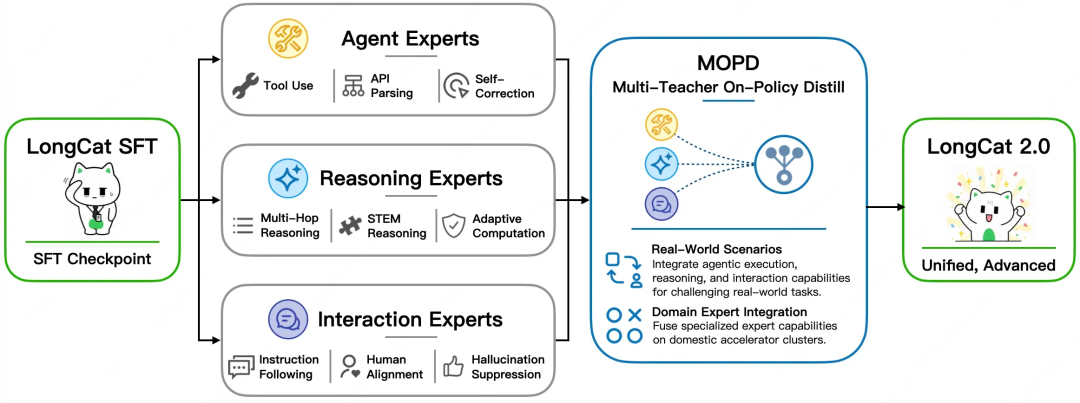
Meituan's technology team has officially released LongCat-2.0, a landmark trillion-parameter model that marks a significant achievement in domestic AI infrastructure. As the industry's first model of its scale to complete full-process training and inference on a 50,000-card domestic computing cluster, LongCat-2.0 features 1.6 trillion total parameters with an average activation of 48 billion. The model is pre-trained from scratch and natively supports a 1-million-token long context window. Specifically optimized for "Agentic Coding," LongCat-2.0 is designed to provide high efficiency and stability in complex code understanding, generation, and execution tasks. This release highlights the growing capability of domestic hardware to support massive-scale AI development and specialized coding agents.
Key Takeaways
- Massive Scale: LongCat-2.0 features 1.6 trillion total parameters, with a dynamic activation range between 33B and 56B (averaging 48B).
- Infrastructure Milestone: It is the first trillion-parameter model to complete its entire training and inference lifecycle on a domestic 50,000-card computing cluster.
- Long Context Support: The model natively supports a 1-million-token (1M) context window, pre-trained from scratch to handle extensive data inputs.
- Specialized Focus: The architecture is specifically engineered for "Agentic Coding," focusing on the stability and efficiency of code understanding, generation, and execution.
In-Depth Analysis
The Significance of the 50,000-Card Domestic Cluster
The release of LongCat-2.0 by Meituan represents a pivotal moment for the AI industry, particularly regarding hardware independence. The model was trained and deployed on a domestic computing cluster consisting of 50,000 cards. Completing the "full-process"—which includes pre-training from scratch, fine-tuning, and inference—on such a massive scale of domestic hardware proves that large-scale AI development is no longer strictly dependent on restricted global supply chains. Managing a cluster of 50,000 cards presents immense technical challenges, including interconnect bandwidth, fault tolerance, and synchronization across thousands of nodes. Meituan’s success in navigating these hurdles with LongCat-2.0 suggests a high level of maturity in domestic cluster management software and hardware integration.
Architectural Innovation: Trillion Parameters and Dynamic Activation
LongCat-2.0 utilizes a sophisticated architecture with 1.6 trillion total parameters. However, the model employs a dynamic activation strategy where only a fraction of these parameters—averaging 48 billion—are active during any given computation. The activation range fluctuates between 33 billion and 56 billion parameters. This approach allows the model to maintain the vast knowledge capacity of a trillion-parameter system while optimizing for the computational efficiency typically found in much smaller models. By pre-training this architecture from scratch, Meituan ensures that the model's foundational weights are optimized for this dynamic range, rather than relying on existing open-source checkpoints. This foundational work is critical for achieving the stability required for high-stakes tasks like automated coding.
Native 1M Context and the Rise of Agentic Coding
A standout feature of LongCat-2.0 is its native support for a 1-million-token context window. Unlike models that use post-training techniques to extend context length, LongCat-2.0 was designed with this capability from the outset. This is particularly vital for its primary application: Agentic Coding. In a coding environment, an "agent" must understand not just a single snippet of code, but potentially an entire repository, including documentation, dependency trees, and execution logs. The 1M context window allows LongCat-2.0 to ingest massive codebases in their entirety, facilitating deeper understanding and more accurate code generation. The goal of "Agentic Coding" goes beyond simple autocomplete; it aims for a model that can autonomously navigate complex coding tasks, ensuring that the generated code is not only syntactically correct but also contextually relevant and executable within a specific system architecture.
Industry Impact
The launch of LongCat-2.0 has profound implications for the global AI landscape. First, it demonstrates that the "Scaling Law" can be successfully applied using domestic hardware at the trillion-parameter level. This reduces the technological gap between leading global AI labs and domestic players. Second, by focusing on Agentic Coding, Meituan is positioning itself at the forefront of specialized AI. As the industry moves from general-purpose chatbots to specialized autonomous agents, the ability to process 1M tokens of code on a trillion-parameter backbone provides a significant competitive advantage. Finally, the successful inference of a 1.6T model on the same 50,000-card cluster used for training suggests a streamlined pipeline that could accelerate the deployment of other massive-scale models in the future.
Frequently Asked Questions
Question: What does "Agentic Coding" mean in the context of LongCat-2.0?
Answer: Agentic Coding refers to the model's ability to act as an autonomous or semi-autonomous agent within a software development environment. Instead of just generating code based on a prompt, the model is designed to understand entire codebases, generate complex logic, and support the execution process, ensuring higher stability and efficiency in real-world programming tasks.
Question: How does the 1.6T parameter count work with only 48B active parameters?
Answer: This indicates a Mixture-of-Experts (MoE) or a similar sparse activation architecture. While the model has a total "memory" or capacity of 1.6 trillion parameters, it only uses a specific subset (between 33B and 56B) for any single task. This allows for the intelligence of a massive model with the speed and lower power consumption of a smaller one.
Question: Why is the 50,000-card domestic cluster significant?
Answer: It proves that domestic hardware and software stacks are now capable of supporting the full lifecycle of the world's largest AI models. This includes the initial training from zero (pre-training) all the way to serving the model to users (inference), which requires extreme stability and high-speed data communication across all 50,000 units.