LongCat Open-Sources VitaBench 2.0: A New Standard for Long-Term Dynamic AI Agent Evaluation
LongCat, in collaboration with the Meituan Technical Team, has officially open-sourced VitaBench 2.0, marking a significant milestone in the evolution of AI evaluation. As the first benchmark specifically designed for real-life scenarios involving long-term dynamic user modeling, VitaBench 2.0 addresses a critical gap in current AI assessment methodologies. The framework provides a systematic approach to evaluating Large Language Models (LLMs) based on their ability to maintain personalization and demonstrate proactivity during extended, authentic, and evolving user interactions. By focusing on the complexities of real-world dynamics, VitaBench 2.0 sets a new benchmark for measuring how intelligent agents understand and adapt to human users over time, moving beyond static task completion to long-term relationship management.
Key Takeaways
- Pioneering Benchmark: VitaBench 2.0 is the first evaluation framework focused on long-term dynamic user modeling within real-life scenarios.
- Focus on Personalization: The benchmark systematically measures the ability of Large Language Models to maintain a personalized experience across extended interactions.
- Proactivity Assessment: It introduces a rigorous standard for evaluating how AI agents take initiative and demonstrate proactivity in dynamic user environments.
- Open-Source Contribution: Released by LongCat and the Meituan Technical Team, the tool is now available to the broader AI research community to drive standardization in agent modeling.
In-Depth Analysis
Redefining Agent Evaluation through Real-Life Scenarios
The release of VitaBench 2.0 by LongCat represents a fundamental shift in how the industry perceives and tests the capabilities of AI agents. Traditional benchmarks often focus on short-term task execution or static knowledge retrieval, which fails to capture the complexity of human-AI relationships in the real world. VitaBench 2.0 distinguishes itself by prioritizing "real-life scenarios," which are inherently unpredictable and require a high degree of adaptability. By modeling long-term dynamic user interactions, this benchmark challenges Large Language Models (LLMs) to move beyond one-off responses and instead manage a continuous flow of information that changes as the user's needs and context evolve.
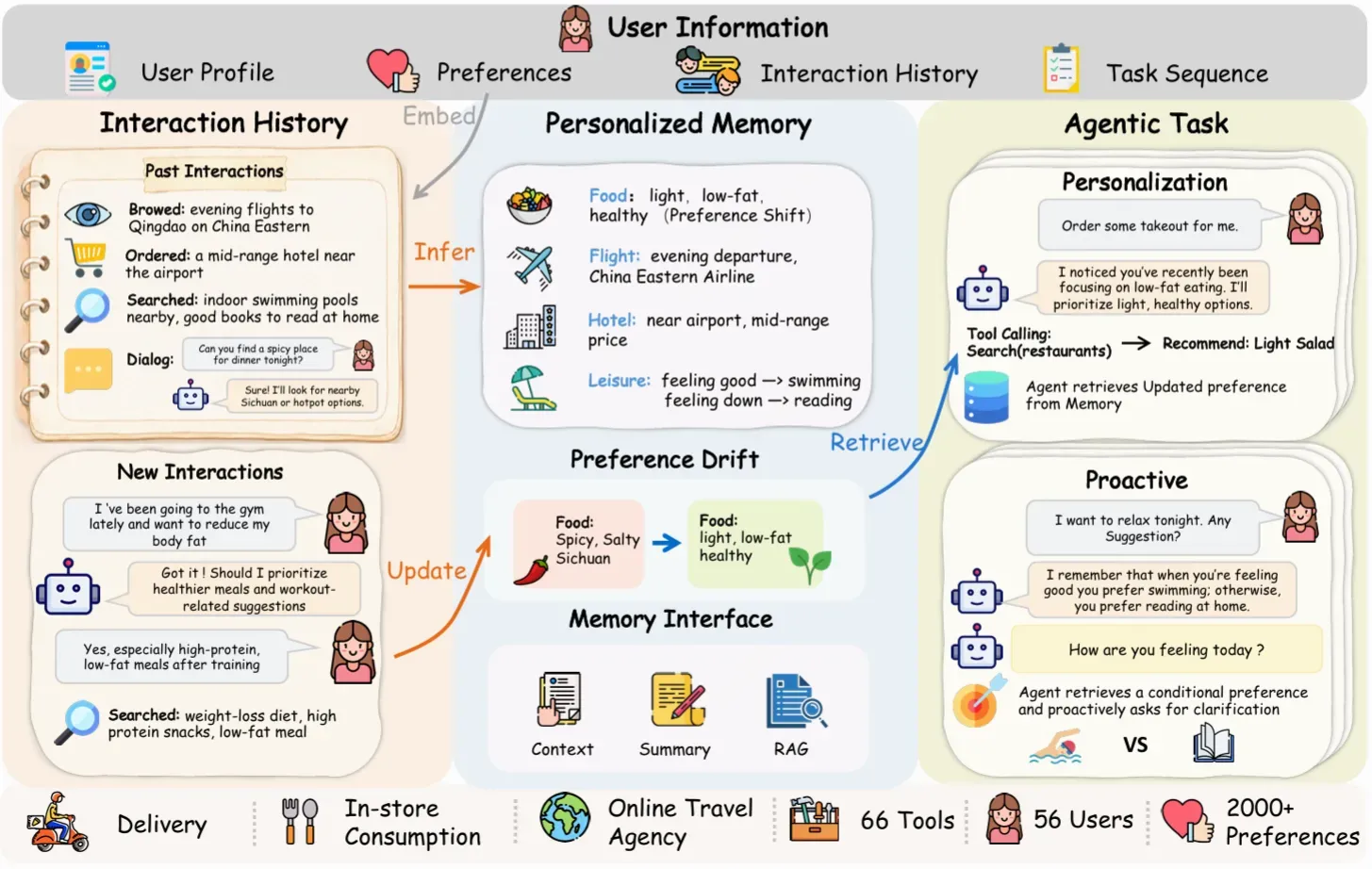
The "dynamic" aspect of VitaBench 2.0 is particularly noteworthy. In a real-world setting, a user's preferences, goals, and environment are not static. An effective AI agent must be able to track these changes over time, updating its internal model of the user to remain relevant. VitaBench 2.0 provides the structured environment necessary to test whether an LLM can maintain this consistency and relevance over the long term, rather than resetting its understanding with every new session.
The Core Pillars: Personalization and Proactivity
At the heart of VitaBench 2.0 are two critical metrics: personalization and proactivity. These are identified as the essential components for any AI agent intended for long-term deployment in user-centric roles. Personalization, in the context of this benchmark, refers to the agent's ability to tailor its behavior and responses based on a deep, evolving understanding of the specific user. This goes beyond simple memory; it involves synthesizing past interactions to inform future behavior in a way that feels authentic and helpful to the individual.
Proactivity, the second pillar, addresses a long-standing limitation in AI development. Most current agents are reactive, waiting for a specific prompt or command before taking action. VitaBench 2.0 evaluates an agent's ability to anticipate user needs and take the initiative within a dynamic interaction. This capability is vital for creating agents that act as true assistants rather than just sophisticated search engines. By systematically evaluating these two traits, VitaBench 2.0 provides a clear roadmap for developers looking to create more sophisticated, human-like digital entities that can operate autonomously and effectively in complex, long-term engagements.
Industry Impact
The introduction of VitaBench 2.0 is poised to have a profound impact on the AI industry, particularly in the development of personal assistants, customer service bots, and companion AI. By providing an open-source, standardized benchmark for long-term dynamic modeling, LongCat and the Meituan Technical Team are giving developers a common language and a set of goals to strive for. This standardization is likely to accelerate the transition from "chatbots" to "intelligent agents" that can truly integrate into a user's daily life.
Furthermore, the focus on real-life scenarios encourages the AI community to move away from laboratory-optimized models and toward systems that are robust enough for the messy, inconsistent nature of human reality. As personalization and proactivity become the new yardsticks for success, we can expect a surge in research and development focused on long-term memory architectures and proactive decision-making algorithms. VitaBench 2.0 does not just measure progress; it defines the direction in which the next generation of AI agents must travel to achieve true utility and user trust.
Frequently Asked Questions
Question: What makes VitaBench 2.0 different from existing AI benchmarks?
VitaBench 2.0 is unique because it is the first benchmark to focus specifically on long-term dynamic user modeling in real-life scenarios. While other benchmarks might test logic, coding, or short-term memory, VitaBench 2.0 evaluates how well an AI agent can maintain personalization and show proactivity over an extended period of authentic interaction with a user.
Question: Who developed VitaBench 2.0 and is it accessible to the public?
VitaBench 2.0 was developed by the Meituan Technical Team and released under the LongCat initiative. It has been open-sourced, meaning the AI research community and developers worldwide can access and use it to evaluate their own models and contribute to the advancement of dynamic agent modeling.
Question: Why are personalization and proactivity the main focus of this benchmark?
These two qualities are essential for creating AI agents that can function effectively in the real world. Personalization ensures the agent remains relevant to the specific user over time, while proactivity allows the agent to be a helpful assistant that anticipates needs rather than just reacting to commands. VitaBench 2.0 identifies these as the key indicators of a sophisticated, long-term intelligent agent.