Meituan Unveils LongCat-2.0: A 1.6 Trillion Parameter Model Optimized for Agentic Coding on Domestic Clusters
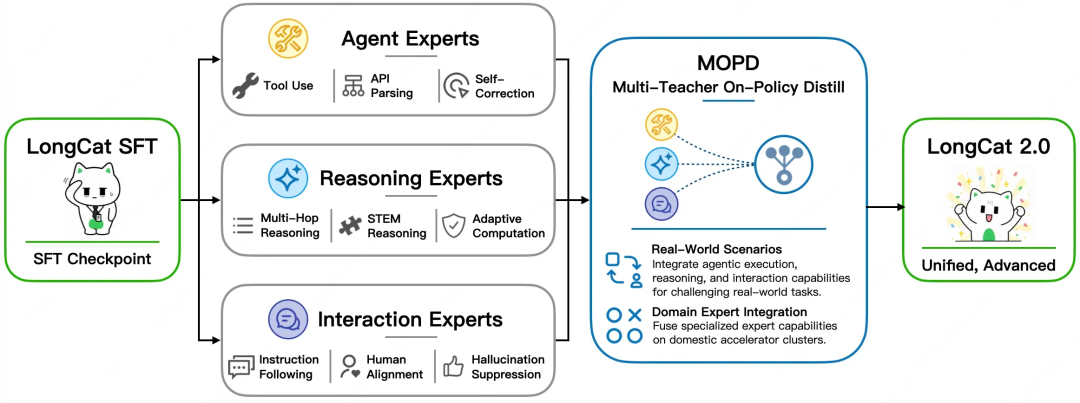
Meituan's technology team has officially released LongCat-2.0, a landmark large language model featuring 1.6 trillion parameters. This model distinguishes itself as the first of its scale to complete the entire training and inference lifecycle on a domestic computing cluster of 50,000 cards. Designed specifically for Agentic Coding, LongCat-2.0 supports a native 1M long-context window and was pre-trained from scratch. With a dynamic activation range between 33B and 56B (averaging 48B), the model is engineered to provide high efficiency and stability in complex code understanding, generation, and execution tasks. This release marks a significant milestone for domestic AI infrastructure and the evolution of autonomous coding agents.
Key Takeaways
- Massive Scale and Efficiency: LongCat-2.0 features a total of 1.6 trillion parameters, utilizing a dynamic activation strategy that ranges from 33B to 56B parameters to balance power and performance.
- Domestic Hardware Milestone: It is the industry's first trillion-parameter model to undergo full-process training and inference on a domestic 50,000-card computing cluster.
- Native Long-Context Support: The model is built from the ground up to support a 1M context window, enabling the processing of massive codebases and complex documentation.
- Agentic Coding Focus: The architecture is specifically optimized for the 'Agentic Coding' workflow, which encompasses code understanding, generation, and autonomous execution.
- Pre-trained from Scratch: Unlike models that rely on existing weights, LongCat-2.0 is a natively pre-trained model designed for maximum stability in real-world programming tasks.
In-Depth Analysis
Breakthroughs in Domestic Computing Infrastructure
The release of LongCat-2.0 represents a pivotal achievement in the field of large-scale artificial intelligence, particularly regarding the utilization of domestic hardware. Training a model with 1.6 trillion parameters is a monumental task that requires immense computational resources and highly sophisticated software-hardware co-optimization. Meituan has successfully navigated these challenges by utilizing a domestic computing cluster consisting of 50,000 cards. This is the first time a model of this magnitude has completed its full lifecycle—from initial pre-training to final inference—on such a massive domestic infrastructure.
The technical specifications of the model reveal a sophisticated approach to parameter management. While the total parameter count stands at 1.6T, the model employs a dynamic activation mechanism. On average, only 48B parameters are activated during a given task, with the activation range fluctuating between 33B and 56B. This dynamic range suggests that LongCat-2.0 is designed to be computationally efficient, focusing its power where it is most needed while maintaining the vast knowledge base inherent in a trillion-parameter architecture. By proving that such a scale is achievable on domestic clusters, Meituan has set a new benchmark for the independence and capability of domestic AI development stacks.
Native 1M Context and the Shift to Agentic Coding
One of the most significant features of LongCat-2.0 is its native support for a 1M long-context window. In the current AI landscape, the ability to process long sequences of data is critical, especially for specialized tasks like software engineering. LongCat-2.0 was pre-trained from scratch with this capability in mind, rather than relying on post-training extensions. This native support allows the model to maintain a high degree of coherence and stability when analyzing extensive code repositories, long-form technical manuals, or complex execution logs.
The primary objective behind this architectural design is to excel in 'Agentic Coding.' This concept moves beyond simple code completion and enters the realm of autonomous or semi-autonomous programming agents. For a model to be effective in an agentic capacity, it must be able to understand the broader context of a project, generate functional code, and oversee its execution. LongCat-2.0 is optimized to handle these three pillars—understanding, generation, and execution—with a focus on efficiency and stability. The 1M context window is the foundation of this capability, providing the 'memory' required for the model to act as a reliable agent within a real-world coding environment. By focusing on these specific tasks, Meituan is positioning LongCat-2.0 as a functional tool for the next generation of software development workflows.
Industry Impact
The launch of LongCat-2.0 has profound implications for both the AI hardware and software sectors. First, it validates the maturity of domestic 50,000-card clusters for training world-class, trillion-parameter models. This reduces the industry's perceived reliance on specific international hardware ecosystems and demonstrates that domestic infrastructure can support the most demanding AI workloads.
Second, the focus on Agentic Coding signals a shift in the AI industry from general-purpose assistants to specialized, functional agents. As models like LongCat-2.0 become more stable and efficient at executing code, the role of the AI in the software development lifecycle will likely evolve from a passive suggester to an active participant. The integration of 1M context support further pushes the boundaries of what AI can achieve in complex, data-heavy environments, potentially leading to more robust and autonomous AI-driven engineering solutions across the industry.
Frequently Asked Questions
What are the parameter specifications of LongCat-2.0?
LongCat-2.0 is a trillion-parameter model with a total of 1.6T parameters. It uses a dynamic activation strategy where the average activation is approximately 48B parameters, with a dynamic range typically falling between 33B and 56B depending on the specific task requirements.
What is the significance of the 50,000-card cluster used for LongCat-2.0?
It is the first time a model of this scale (1.6T parameters) has completed the full process of training and inference on a domestic computing cluster of this size. This demonstrates the capability of domestic hardware to support the entire lifecycle of massive-scale AI models.
What is 'Agentic Coding' and how does LongCat-2.0 support it?
Agentic Coding refers to the model's ability to act as an agent that understands, generates, and executes code. LongCat-2.0 supports this through its native 1M long-context window and an architecture optimized for stability and efficiency in real-world programming tasks, allowing it to handle complex, multi-step coding workflows autonomously.