GLM 5.2 and the Impending AI Margin Collapse: A Shift in Model Economics
The AI industry is on the verge of a significant economic transformation as open-weights models like Z.ai's GLM 5.2 begin to rival proprietary frontier models. While market attention has previously focused on the low training costs of models like DeepSeek V3, the real economic battleground is inference. Frontier AI labs currently maintain high gross margins—estimated at up to 90% on compute—to amortize massive upfront training and salary expenditures. However, the emergence of GLM 5.2 as a genuine competitor to Claude 3 Opus suggests that the era of high-margin proprietary inference may be ending. This shift indicates a 'margin collapse' where the cost of intelligence scales with demand, challenging the traditional business models of major AI providers and moving the industry toward a new phase of economic reality.
Key Takeaways
- The Rise of GLM 5.2: Z.ai’s GLM 5.2 is identified as the first open-weights model to reach the performance benchmark of a genuine competitor to Claude 3 Opus.
- Training vs. Inference Costs: The market often misinterprets AI economics by focusing on fixed, upfront training costs rather than the marginal, scaling costs of inference.
- High Profit Margins: Frontier AI labs currently operate with high estimated gross margins (roughly 90% on compute) to recover their massive investments in R&D and compute.
- Impending Margin Collapse: The availability of high-performance open-weights models threatens the ability of proprietary labs to maintain high inference premiums, signaling a shift in the industry's financial structure.
In-Depth Analysis
The DeepSeek Misconception and the Reality of AI Costs
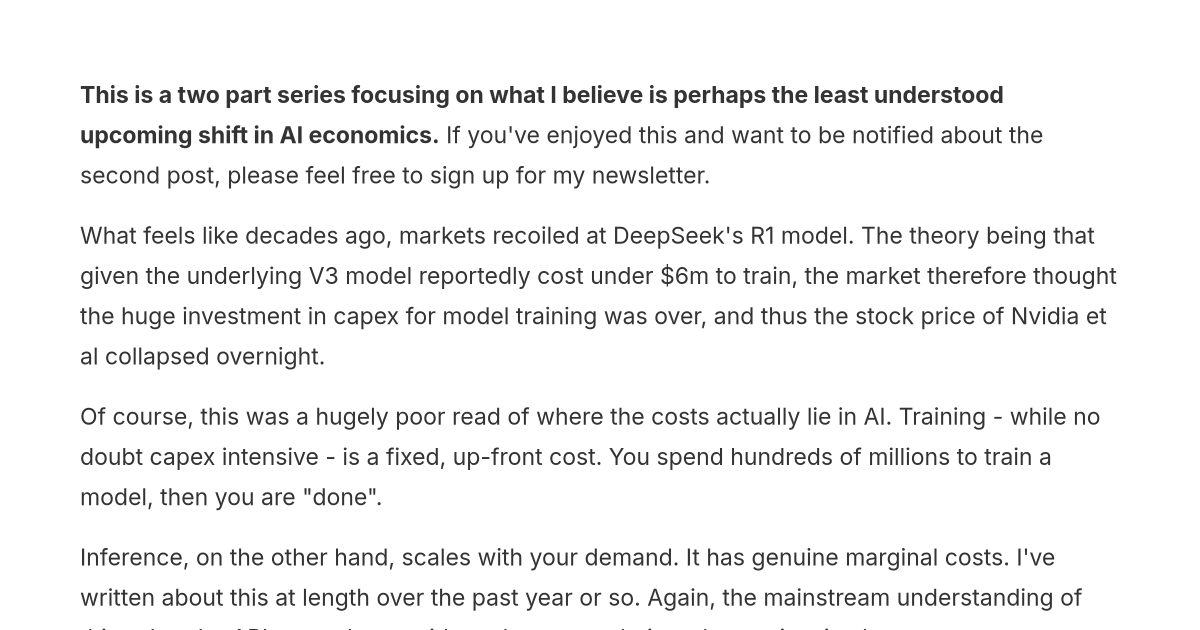
The market's reaction to DeepSeek’s R1 and V3 models—which reportedly cost under $6 million to train—led to a temporary collapse in the stock prices of hardware providers like Nvidia. This reaction was based on the theory that the era of massive capital expenditure (capex) for model training was over. However, this perspective represents a fundamental misunderstanding of AI economics. Training is a fixed, upfront cost; once a model is trained, the expenditure is essentially complete for that version.
The true economic driver is inference, which scales directly with user demand and carries genuine marginal costs. While the mainstream view assumes that API pricing reflects the actual costs of the providers, the reality is that frontier labs like OpenAI and Anthropic likely maintain significant margins. Estimates suggest that while these labs may charge $25 per million tokens (MTok), the actual cost of compute versus the rack rate could allow for a gross margin of approximately 90%. Even when accounting for support, payment processing, and other operational services—as seen in leaked financials suggesting a 60% gross margin—the core business model remains focused on amortizing high salary and training costs through highly profitable inference services.
GLM 5.2: A New Benchmark for Open Weights
The introduction of GLM 5.2 from Z.ai marks a pivotal moment in the competitive landscape. For the first time, an open-weights model is reaching the "bar" required to be considered a genuine competitor to high-end proprietary models like Claude 3 Opus. This development is critical because it provides a high-performance alternative to the closed-source ecosystems that currently dominate the market.
The business model of frontier AI labs relies on the ability to turn a profit on a Cost of Goods Sold (COGS) basis by spreading the fixed costs of training over a vast volume of inference. When open-weights models like GLM 5.2 offer comparable performance, the justification for the high premiums charged by proprietary labs begins to erode. If users can access similar intelligence through open-weights models with lower overhead, the high-margin inference model that sustains the current frontier labs faces an existential threat.
The Shift from Amortization to Actual Profitability
Currently, the strategy for many AI labs is to spend heavily on compute and talent to build a model, then amortize those costs over millions of inference requests. The goal is to move from being profitable on a simple COGS basis to achieving overall corporate profitability. However, this strategy depends on maintaining a significant gap between the cost of compute and the price charged to the consumer.
As open-weights models close the performance gap, the "DeepSeek moment" evolves from a surprise about training efficiency into a broader realization about the sustainability of inference margins. The author suggests that we are entering a period where the least understood shift in AI economics—the collapse of these margins—will become the primary narrative, as the competitive advantage of proprietary models is challenged by accessible, high-performance alternatives like GLM 5.2.
Industry Impact
The emergence of GLM 5.2 and the subsequent potential for an AI margin collapse will likely force a restructuring of how AI companies approach monetization. If the gross margins on inference drop from 90% toward a more competitive commodity level, frontier labs will need to find new ways to justify their massive capex and R&D spending. This could lead to a shift in focus from selling raw model access to providing integrated services, or it may force a consolidation in the market as only those with the most efficient inference infrastructure can survive a low-margin environment. Furthermore, the success of open-weights models ensures that high-level intelligence becomes more accessible, potentially accelerating innovation across other sectors while simultaneously squeezing the profits of the model creators themselves.
Frequently Asked Questions
Question: Why is GLM 5.2 considered a significant model in the current AI market?
GLM 5.2, developed by Z.ai, is significant because it is described as the first open-weights model to reach the performance level of a genuine competitor to Claude 3 Opus, a leading proprietary frontier model.
Question: What is the difference between training costs and inference costs in AI economics?
Training costs are fixed, upfront expenditures required to create a model. Inference costs are marginal costs that scale with the volume of demand and usage. While training is capex-intensive, inference is where the ongoing operational costs and profit margins are realized.
Question: What does "margin collapse" mean in the context of AI?
Margin collapse refers to the potential reduction in the high profit margins currently enjoyed by AI labs on their inference services. This is expected to happen as open-weights models provide high-performance alternatives, forcing proprietary providers to lower their prices and reducing their ability to amortize high development costs.