Meituan Launches LongCat-2.0: A 1.6 Trillion Parameter Model Trained on 50,000 Domestic GPUs
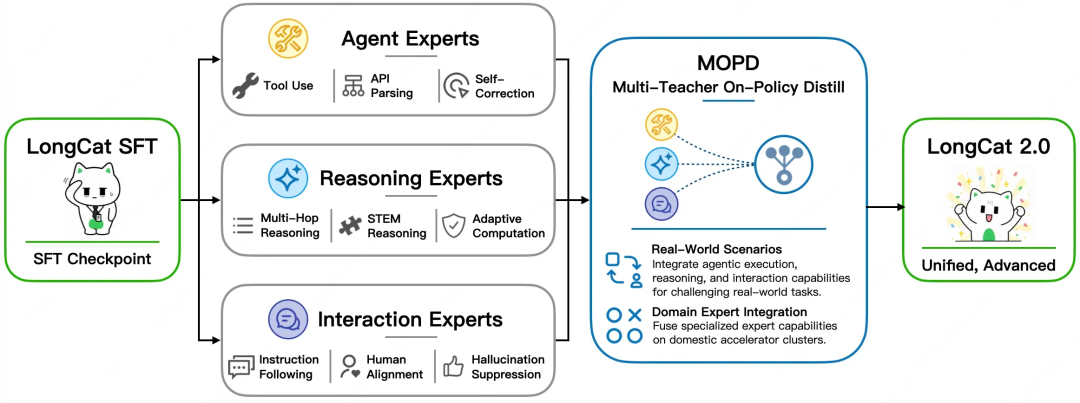
Meituan's technical team has officially unveiled LongCat-2.0, a groundbreaking large language model featuring 1.6 trillion parameters. This release marks a significant milestone as the industry's first trillion-parameter model to complete its entire training and inference lifecycle on a domestic computing cluster consisting of 50,000 cards. LongCat-2.0 utilizes a Mixture-of-Experts (MoE) style architecture with a dynamic activation range of 33B to 56B parameters and native support for a 1-million-token ultra-long context window. Specifically engineered for 'Agentic Coding,' the model is designed to enhance efficiency and stability in complex programming tasks, including code comprehension, generation, and execution. The successful deployment on localized hardware highlights a major advancement in large-scale AI infrastructure and model development capabilities.
Key Takeaways
- Massive Scale: LongCat-2.0 features a total of 1.6 trillion parameters, with an average activation of approximately 48B and a dynamic range between 33B and 56B.
- Infrastructure Milestone: It is the first trillion-parameter model to undergo full-process training and inference on a domestic computing cluster of 50,000 cards.
- Ultra-Long Context: The model provides native support for a 1M (one million) token context window, allowing for extensive data processing.
- Targeted Application: The architecture is specifically optimized for 'Agentic Coding' tasks, focusing on stable code understanding and execution.
In-Depth Analysis
Breakthrough in Domestic Computing Infrastructure
The release of LongCat-2.0 by Meituan represents a pivotal moment for the AI industry, particularly regarding hardware independence. Training a model with 1.6 trillion parameters is a feat that requires immense computational power and sophisticated software-hardware synchronization. By successfully completing the full training and inference cycle on a cluster of 50,000 domestic computing cards, Meituan has demonstrated that localized hardware can support the most demanding AI workloads. This achievement addresses the critical need for scalable infrastructure that can handle trillion-parameter architectures without relying on restricted global supply chains. The "full-process" aspect—covering everything from initial pre-training to final inference—suggests a highly optimized software stack capable of managing the communication overhead and stability issues inherent in such a massive GPU cluster.
Architectural Efficiency and the 1M Context Window
LongCat-2.0 is not just about size; it is about the efficiency of its activation. While the total parameter count reaches 1.6T, the model employs a dynamic activation strategy where only 33B to 56B parameters are active at any given time (averaging around 48B). This approach, likely based on Mixture-of-Experts (MoE) principles, allows the model to maintain the representational power of a trillion-parameter system while keeping the computational cost of inference manageable. Furthermore, the native support for a 1-million-token context window is a transformative feature. In the realm of large-scale software development, a 1M context window allows the model to "read" and understand entire codebases or massive technical documentations in a single pass, eliminating the need for complex RAG (Retrieval-Augmented Generation) pipelines that often lose nuance in long-range dependencies.
Optimized for Agentic Coding Tasks
The core design philosophy of LongCat-2.0 revolves around "Agentic Coding." Unlike general-purpose models that may struggle with the logic and precision required for programming, LongCat-2.0 was pre-trained from scratch with the specific goal of mastering code. The model is built to function as an agent—not just generating snippets of code, but understanding the broader context of a project to execute and debug tasks autonomously. By focusing on efficiency and stability in code generation and execution, Meituan is positioning LongCat-2.0 as a specialized tool for the next generation of AI-driven software engineering, where the model acts as a reliable partner in the development lifecycle rather than a simple autocomplete utility.
Industry Impact
The introduction of LongCat-2.0 has profound implications for the AI sector. First, it proves the viability of domestic 50,000-card clusters for training world-class, trillion-parameter models, which may encourage further investment in localized AI hardware. Second, the focus on Agentic Coding with a 1M context window sets a new benchmark for specialized AI applications. As enterprises look for more reliable ways to automate software development, models that can handle massive contexts and exhibit stable "agentic" behavior will become the industry standard. Meituan’s success in pre-training this model from scratch also signals a shift toward deep, full-stack ownership of AI technology, from the hardware layer up to the specialized application layer.
Frequently Asked Questions
Question: What are the specific parameter details of LongCat-2.0?
LongCat-2.0 has a total of 1.6 trillion (1.6T) parameters. However, it uses a dynamic activation system where the average activation is approximately 48 billion (48B) parameters, with a range fluctuating between 33B and 56B depending on the task.
Question: What hardware was used to train LongCat-2.0?
The model was trained and is run for inference on a domestic computing cluster consisting of 50,000 cards. It is the first model of this scale to complete the entire training and inference process on such a localized infrastructure.
Question: What is the primary use case for this model?
LongCat-2.0 is specifically designed for "Agentic Coding." Its architecture and 1M context window are optimized for high-efficiency code understanding, generation, and execution within complex, real-world programming environments.