
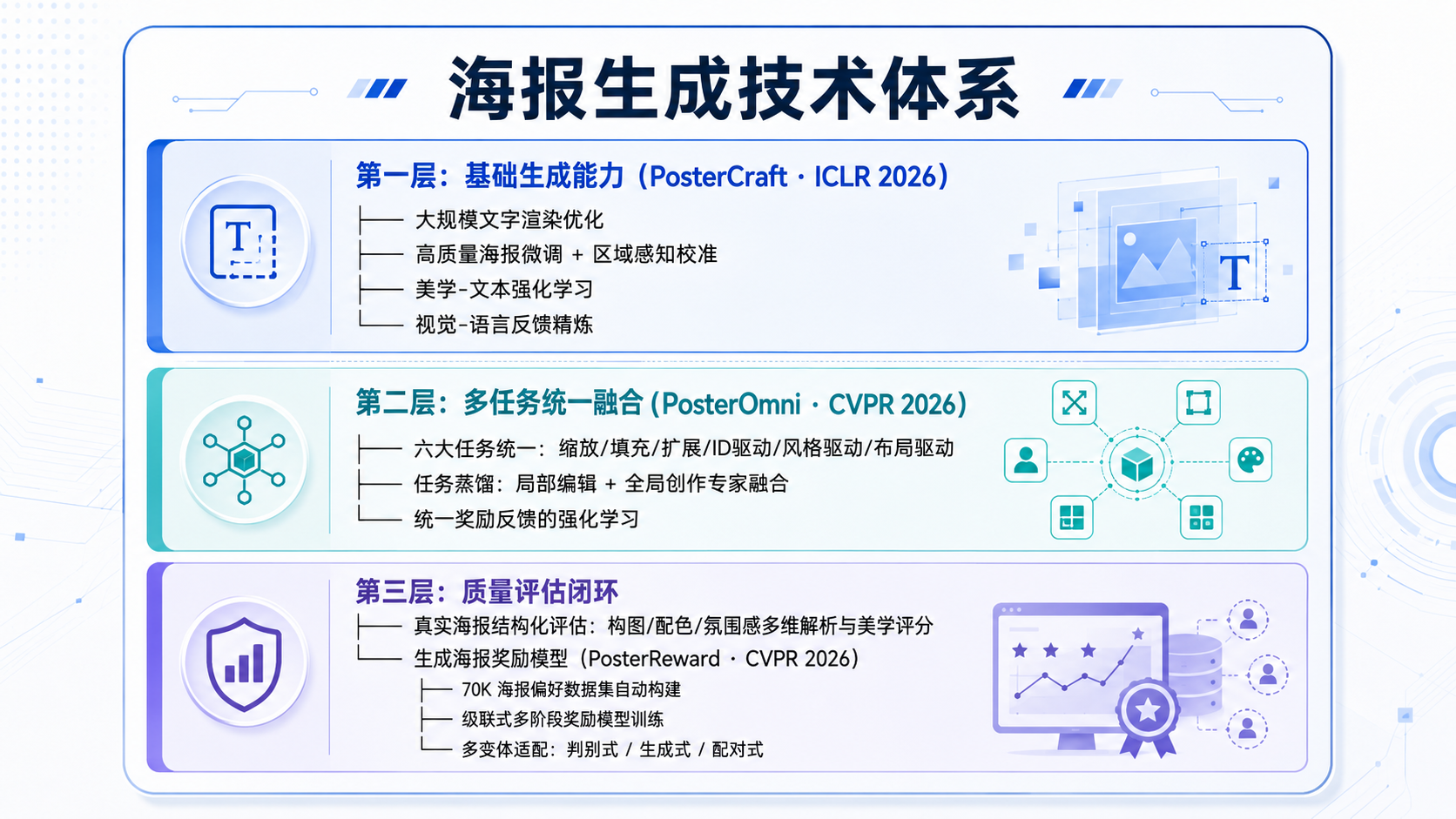
Meituan Open Sources AIGC Poster Generation Framework: Analyzing the Generation-Editing-Evaluation Technical Loop
Meituan's Intelligent Creation Team has officially unveiled and open-sourced its comprehensive technical system for AIGC-driven poster generation. The framework is built upon a sophisticated "Generation-Editing-Evaluation" closed loop, designed to bridge the gap between raw AI output and production-ready commercial assets. Currently deployed within Meituan Waimai and various Brand IP scenarios, this system addresses the practical challenges of automated design by integrating creative generation with precise editing tools and automated quality assessment. By open-sourcing the entire technical stack, Meituan aims to provide the developer community with a proven, industrial-grade solution for scalable visual content creation. This move signifies a major step in the practical application of AIGC within the food delivery and digital branding sectors, offering a structured approach to maintaining design quality at scale.
Key Takeaways
- Comprehensive Technical System: Meituan has developed a full-stack AIGC framework specifically for poster generation, moving beyond simple image creation to a structured production workflow.
- Closed-Loop Methodology: The system operates on a "Generation-Editing-Evaluation" (生成-编辑-评判) cycle, ensuring that outputs are not only created but also refined and verified for quality.
- Proven Industrial Application: The technology is already operational in high-volume commercial environments, including Meituan Waimai (food delivery) and Brand IP development.
- Full Open-Source Commitment: Meituan has made the entire technical system available to the public, encouraging community adoption and further innovation in the AIGC space.
In-Depth Analysis
The "Generation-Editing-Evaluation" Technical Closed Loop
Meituan's approach to AIGC poster generation is defined by its rigorous three-stage closed loop. This structure addresses the common pitfalls of generative AI in professional design—namely, the lack of control and the inconsistency of quality.
- Generation: This initial phase focuses on the core creative process, utilizing generative models to produce base designs. By establishing a dedicated system for this, Meituan allows for the rapid creation of diverse visual concepts tailored to specific prompts or merchant needs.
- Editing: Recognizing that raw AI outputs often require fine-tuning, the "Editing" component provides the necessary tools to modify and adjust generated posters. This ensures that specific brand elements, text placements, and layout requirements can be precisely managed, making the AI a collaborative tool rather than a black-box generator.
- Evaluation: The final stage of the loop involves an automated or semi-automated assessment of the generated content. This "Evaluation" mechanism is critical for industrial-scale production, as it filters out low-quality outputs and ensures that every poster meets the aesthetic and functional standards required for commercial use in the Meituan ecosystem.
Implementation in Meituan Waimai and Brand IP
The practical value of this AIGC system is demonstrated through its integration into Meituan's core business units. In the context of Meituan Waimai, the demand for visual content is immense, with thousands of merchants requiring high-quality promotional posters. The AIGC system allows for the mass production of customized visuals that can help merchants improve their digital storefronts without the prohibitive costs of traditional design services.
Furthermore, the application in Brand IP scenarios highlights the system's ability to handle complex creative tasks. Managing a brand's intellectual property requires strict adherence to style guides and character consistency. The "Generation-Editing-Evaluation" loop provides the necessary constraints and refinement tools to ensure that AI-generated content remains "on-brand," a feat that is often difficult to achieve with standard generative models. By successfully applying this tech to Brand IP, Meituan proves that AIGC can handle sophisticated, high-stakes creative work.
Industry Impact
The decision by the Meituan Intelligent Creation Team to open-source this technology carries significant weight for the AI industry. While many companies are developing internal AIGC tools, few have released a complete, end-to-end system that has been battle-tested in a large-scale commercial environment.
By sharing the "Generation-Editing-Evaluation" framework, Meituan is providing a blueprint for how other enterprises can industrialize AIGC. This open-source contribution is likely to accelerate the development of automated design tools across various sectors, particularly in e-commerce and digital marketing. It shifts the industry focus from merely "generating images" to "building reliable production pipelines," which is essential for the long-term viability of AI in professional creative workflows. Moreover, it establishes Meituan as a leader in the practical application of intelligent creation technologies.
Frequently Asked Questions
Question: What makes Meituan's AIGC system different from standard image generators?
Unlike standard generators that focus solely on the initial image creation, Meituan's system includes integrated editing and evaluation phases. This creates a "closed loop" that ensures the final output is refined and meets specific commercial quality standards, making it suitable for professional use rather than just experimental art.
Question: Where is this technology currently being used?
Meituan has successfully implemented this AIGC poster generation system in its food delivery platform (Meituan Waimai) and for various Brand IP projects. These applications demonstrate the system's ability to handle both high-volume merchant needs and high-quality brand-specific creative tasks.
Question: Is the code for this system available to the public?
Yes, Meituan has fully open-sourced the technical system. This allows developers and researchers to study, implement, and build upon the "Generation-Editing-Evaluation" framework for their own AIGC projects.