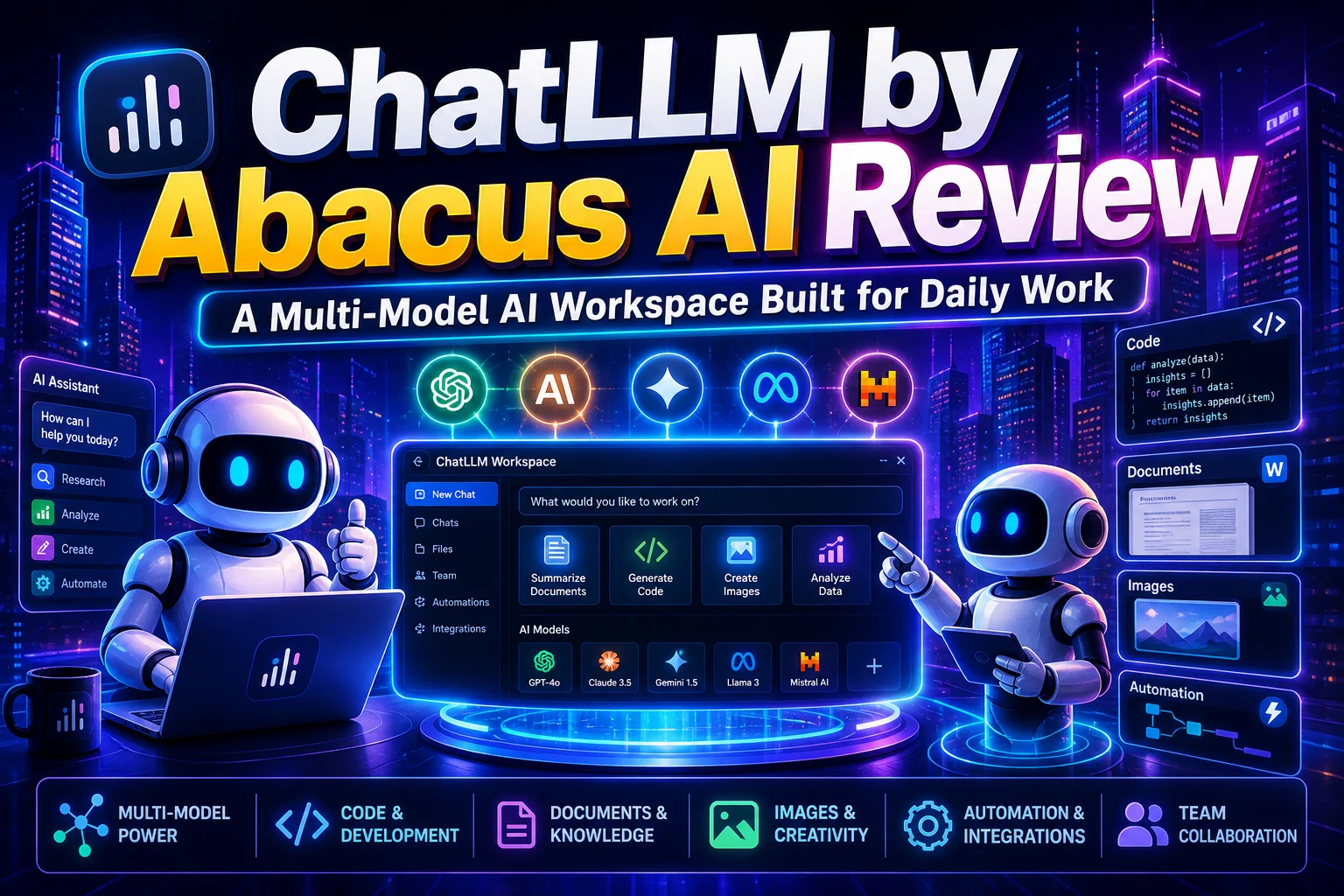
Comprehensive Review of ChatLLM by Abacus AI: A Versatile Multi-Model Workspace for Professional Productivity and Coding
This in-depth review explores ChatLLM by Abacus AI, a specialized AI workspace designed to integrate multiple large language models into a single, professional environment. The analysis evaluates the platform's core features, including its support for various AI models, the implementation of specialized AI agents, and the inclusion of advanced coding tools tailored for daily work. Furthermore, the review examines the platform's integration capabilities, pricing structures, and usage limits, providing a direct comparison with industry leaders like ChatGPT. By offering a centralized hub for diverse AI functionalities, ChatLLM aims to optimize professional workflows and enhance output quality through a structured, multi-model approach that addresses the limitations of single-model platforms.
Key Takeaways
- Unified Multi-Model Access: ChatLLM provides a single interface that supports a variety of AI models, allowing users to leverage different LLMs for specific tasks.
- Specialized Professional Tools: The platform includes dedicated AI agents and advanced coding tools designed to streamline daily professional and technical workflows.
- Enterprise-Ready Features: The review highlights critical business components such as deep integrations, clear pricing structures, and defined usage limits.
- Direct ChatGPT Alternative: ChatLLM is positioned as a comprehensive workspace that competes directly with ChatGPT by offering broader model flexibility and specialized work-oriented features.
In-Depth Analysis
The Multi-Model Workspace Concept
The review of ChatLLM by Abacus AI emphasizes the platform's primary value proposition: the transition from a single-model chat interface to a comprehensive multi-model workspace. In the current AI landscape, professionals often find themselves switching between different platforms to access the unique strengths of various large language models (LLMs). ChatLLM addresses this friction by consolidating these models into a single environment. This approach not only simplifies the user experience but also allows for a more nuanced application of AI, where the most suitable model can be selected for a specific query, whether it involves creative writing, logical reasoning, or data analysis.
Furthermore, the inclusion of AI agents represents a significant step toward automation within the workspace. These agents are designed to handle more complex, multi-step tasks that go beyond simple prompt-and-response interactions. By integrating these agents into the daily workflow, ChatLLM aims to transform the AI from a simple chatbot into a proactive assistant capable of managing sophisticated professional requirements.
Specialized Tools for Developers and Integrations
A critical aspect of the ChatLLM review is its focus on coding tools and technical integrations. For developers and technical professionals, the platform offers specialized features that enhance the coding process. These tools are integrated directly into the workspace, reducing the need for external software and allowing for a more seamless transition between conceptualizing code and implementing it. The review notes that these features are built specifically for "daily work," suggesting a focus on reliability and practical utility rather than experimental features.
Integrations also play a vital role in the ChatLLM ecosystem. The ability to connect the AI workspace with existing professional tools and data sources is essential for modern enterprise environments. The review examines how these integrations facilitate a smoother flow of information, allowing the AI to access and process data within the context of the user's established workflow. This connectivity is a key differentiator for users who require their AI tools to be deeply embedded in their professional infrastructure.
Comparative Positioning and Operational Transparency
When comparing ChatLLM to ChatGPT, the review highlights several strategic differences. While ChatGPT remains the industry benchmark, ChatLLM distinguishes itself through its multi-model flexibility and its focus on a structured work environment. The review provides a detailed look at how ChatLLM stacks up in terms of user interface, model responsiveness, and the breadth of available features. This comparison is crucial for users deciding whether to stick with a familiar single-model provider or move to a more versatile aggregator platform.
Operational transparency is another area covered extensively in the review. By detailing the pricing models and usage limits, the analysis provides potential users with the information necessary to evaluate the platform's cost-effectiveness. In a professional setting, understanding the constraints of usage and the scalability of costs is as important as the technical capabilities of the AI itself. ChatLLM’s approach to these operational factors suggests a target audience that values predictability and professional-grade service levels.
Industry Impact
The emergence of platforms like ChatLLM signals a shift in the AI industry toward consolidation and specialized workspaces. As the number of high-performing LLMs grows, the value of "aggregator" platforms increases, providing users with a curated and unified experience. This trend suggests that the future of professional AI may not be dominated by a single model, but rather by sophisticated environments that can orchestrate multiple models to solve complex problems. For the AI industry, this means an increased focus on interoperability, API efficiency, and the development of specialized agents that can operate across different model architectures.
Frequently Asked Questions
Question: How does ChatLLM differ from a standard ChatGPT subscription?
ChatLLM distinguishes itself by offering a multi-model workspace where users can access various AI models within a single interface, whereas ChatGPT is primarily focused on OpenAI's proprietary models. Additionally, ChatLLM includes specialized AI agents and coding tools specifically designed for professional daily workflows and deep integrations.
Question: What kind of technical tools does ChatLLM provide for developers?
The platform includes advanced coding tools and integrations designed to assist with daily technical tasks. These features are built to streamline the development process within the AI workspace, allowing for better code generation, debugging, and workflow management compared to standard chat interfaces.
Question: Does the review cover the cost and limitations of using ChatLLM?
Yes, the review provides an analysis of ChatLLM’s pricing structures and usage limits. This information is intended to help professional users and enterprises understand the financial and operational parameters of the platform, especially when compared to other AI services like ChatGPT.