Managing AI Coding with Agent Evaluation Thinking: A 310,000-Line Refactoring Case Study
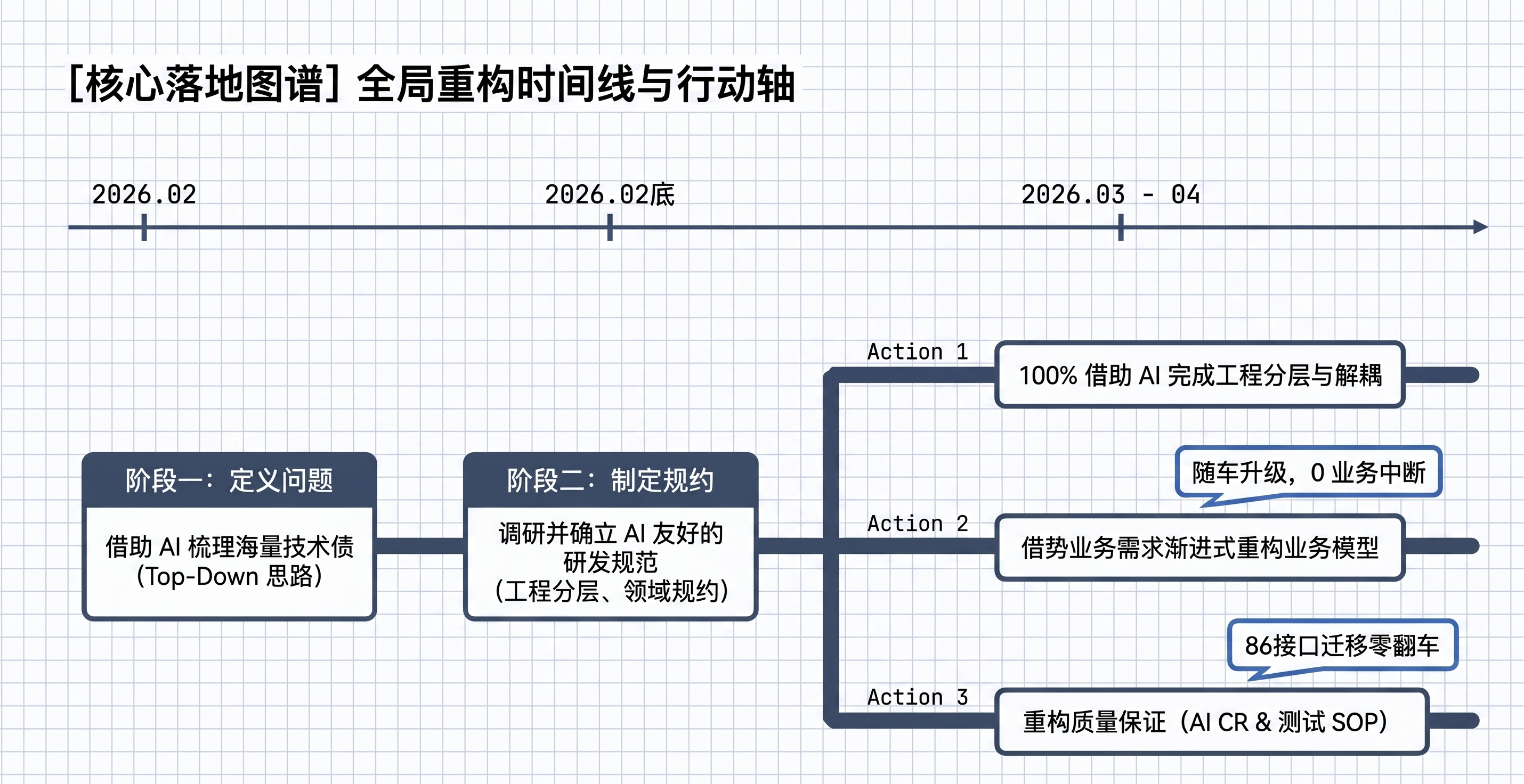
Meituan's technical team has shared a groundbreaking approach to managing AI-driven software development, centered on the successful refactoring of 310,000 lines of code. As AI-generated code now accounts for over 90% of development in specific contexts, the primary challenge has shifted from increasing coding speed to establishing effective constraints. Without unified standards, AI risks amplifying technical chaos and debt. To mitigate this, Meituan implemented 'Agent Evaluation Thinking,' a framework that includes technical debt sorting, rule construction, a standardized refactoring SOP, and a Pre-PR mechanism. This strategy successfully transforms high-cost, specialized refactoring projects into continuous, daily iterative actions, ensuring long-term system stability and maintainability in an AI-dominant coding environment.
Key Takeaways
- Shift in Focus: In an era where over 90% of code is AI-generated, the critical factor for system success is the ability to constrain AI rather than the speed of code production.
- Agent Evaluation Thinking: Meituan utilizes an evaluation-centric approach to manage AI coding, ensuring that AI agents operate within defined technical boundaries.
- Four-Pillar Framework: The management strategy relies on technical debt sorting, rule construction, a standardized refactoring SOP, and a Pre-PR mechanism.
- Continuous Refactoring: By integrating these mechanisms, large-scale refactoring (310,000 lines) is converted from a high-cost special project into a sustainable daily routine.
- Prevention of Chaos: Unified standards are essential to prevent AI from exponentially increasing technical debt and system disorder.
In-Depth Analysis
The Paradigm Shift: From Speed to Constraint in AI Coding
The technical landscape has reached a point where AI is responsible for generating the vast majority of code—exceeding 90% in the practices documented by Meituan. This shift fundamentally changes the role of the software engineer and the manager. When code can be produced almost instantaneously, the bottleneck is no longer the manual labor of typing lines of code, but the oversight required to ensure that code adheres to system architecture and quality standards. The original news highlights a critical warning: without unified specifications and constraints, the sheer volume of AI-generated output can act as a force multiplier for chaos. The faster an AI writes, the faster technical debt can accumulate if the AI is not properly governed. Therefore, the core competency in modern software engineering is shifting toward the design and implementation of constraints that guide AI agents toward high-quality, standardized output.
Implementing Agent Evaluation Thinking and the Refactoring SOP
To manage this transition, Meituan adopted 'Agent Evaluation Thinking,' treating the AI coding process as a managed system that requires constant validation and structured guidance. This methodology was put to the test in a massive undertaking involving the refactoring of 310,000 lines of code. The process is built upon four specific technical actions. First, technical debt sorting allows the team to identify exactly where the AI needs to focus its corrective efforts. Second, the construction of 'Rules' provides the AI with the necessary boundaries and standards it must follow during the coding process. Third, a standardized Refactoring SOP (Standard Operating Procedure) ensures that the AI's actions are predictable and repeatable across different modules of the system. Finally, the Pre-PR (Pull Request) mechanism acts as a gatekeeper, ensuring that AI-generated refactoring meets all criteria before it is even considered for integration. This structured approach ensures that the AI functions as a disciplined agent rather than an unguided generator.
Transforming Refactoring into a Daily Iterative Action
One of the most significant outcomes of Meituan's practice is the change in the economic and operational model of code maintenance. Traditionally, refactoring 310,000 lines of code would be viewed as a high-cost, high-risk 'special project' that requires dedicated time and resources, often stalling feature development. However, by applying Agent Evaluation Thinking and the Pre-PR mechanism, Meituan has successfully turned refactoring into a 'daily action.' Because the AI is constrained by rules and guided by an SOP, it can continuously identify and fix small portions of technical debt during regular iterations. This reduces the overhead associated with large-scale maintenance and ensures that the codebase remains healthy over time. The success of this 310,000-line project demonstrates that with the right management framework, AI can handle the heavy lifting of code maintenance, allowing the system to evolve healthily alongside new feature development.
Industry Impact
The practices shared by Meituan provide a blueprint for the industry as it moves toward 'AI-Native' software engineering. The significance lies in the transition from using AI as a simple autocomplete tool to managing it as a sophisticated agent within a rigorous engineering framework. For the broader AI and software industry, this highlights that the future of development is not just about better models, but about better management systems for those models. As other companies reach the '90% AI-generated code' threshold, the adoption of similar 'Agent Evaluation' and 'Pre-PR' mechanisms will likely become standard practice to prevent the collapse of complex systems under the weight of unmanaged AI output. Meituan’s success proves that large-scale technical debt can be addressed efficiently if AI is treated as a manageable component of the development lifecycle.
Frequently Asked Questions
Question: Why is 'constraint' more important than 'speed' in AI-assisted coding?
As AI can generate code at a rate far exceeding human capacity, the primary risk is no longer slow delivery but the rapid accumulation of non-standard, chaotic code. Constraints ensure that the high volume of AI output remains consistent with the existing system architecture and quality standards, preventing technical debt from spiraling out of control.
Question: How does the Pre-PR mechanism change the refactoring process?
The Pre-PR mechanism allows for the validation of AI-generated code changes before they reach the formal review stage. By automating the check against rules and standards, it enables refactoring to happen continuously during daily iterations, rather than as a separate, high-cost project that interrupts the development cycle.
Question: What are the core components of Meituan's AI coding management framework?
The framework consists of four key elements: technical debt sorting (identifying issues), rule construction (setting boundaries), a refactoring SOP (standardizing the process), and a Pre-PR mechanism (ensuring quality before integration).