
Managing AI Coding with Agent Evaluation Logic: A Practice of 310,000 Lines of Code Refactoring
The Meituan technical team has introduced a transformative approach to managing AI-driven development, focusing on a massive 310,000-line code refactoring project. As AI now generates over 90% of code in certain environments, the primary challenge has shifted from increasing generation speed to establishing robust constraints. Without unified standards, AI risks amplifying system chaos and technical debt. By utilizing Agent evaluation logic, the team implemented a framework consisting of technical debt sorting, rule construction, refactoring Standard Operating Procedures (SOPs), and a Pre-PR mechanism. This methodology successfully transitions code refactoring from a high-cost, specialized endeavor into a continuous, daily iterative process, ensuring long-term system stability and maintainability in the era of AI-generated software.
Key Takeaways
- Shift in Focus: When AI generates over 90% of code, the system's success depends on the constraints placed on the AI rather than the speed of code production.
- Scale of Practice: The methodology was proven through the refactoring of 310,000 lines of code, addressing the inherent chaos of unmanaged AI output.
- Core Framework: Management is achieved through four pillars: technical debt sorting, rule construction, refactoring SOPs, and a Pre-PR mechanism.
- Operational Efficiency: The approach transforms refactoring from a periodic, high-cost project into a sustainable, daily development activity.
In-Depth Analysis
From Speed to Constraints: Redefining AI Coding Management
In the traditional software development lifecycle, the bottleneck was often the speed of human manual coding. However, as AI capabilities have advanced to the point where they can generate more than 90% of a system's codebase, the bottleneck has shifted. The Meituan technical team highlights that the sheer volume of AI-generated code can lead to an exponential increase in system complexity and chaos if left unguided. The core insight of their practice is that the "走向" (direction/future) of a system is no longer determined by who writes code faster, but by the ability to constrain and govern the AI’s output.
Without a unified set of specifications and standards, AI acts as a force multiplier for technical debt. It can replicate patterns—both good and bad—at a scale that human reviewers struggle to manage. Therefore, the management of AI coding must move away from simple prompt engineering toward a comprehensive governance model. This model treats the AI as an "Agent" that must be evaluated and restricted within a predefined technical framework to ensure that the resulting code adheres to architectural integrity and quality standards.
The Framework of Agent Evaluation: Rules, SOPs, and Pre-PR
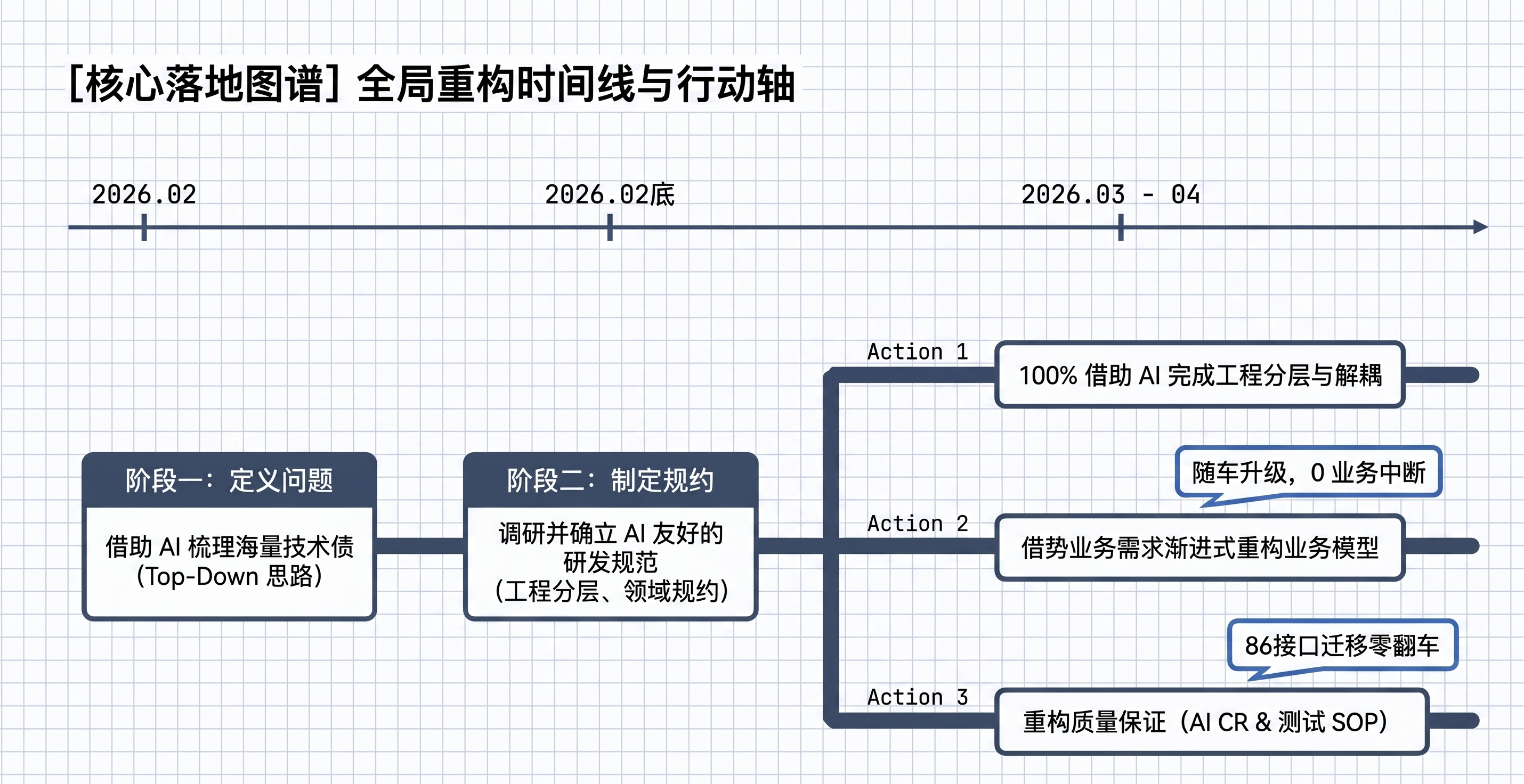
To manage the refactoring of 310,000 lines of code, the team developed a structured approach based on Agent evaluation logic. This process begins with a systematic sorting of technical debt to identify areas where AI-generated or legacy code deviates from desired standards. Once the debt is identified, the team focuses on "Rule Construction." These rules serve as the guardrails for the AI, ensuring that any code generated or modified meets specific architectural requirements.
Central to this management strategy is the implementation of a Refactoring Standard Operating Procedure (SOP) and a Pre-PR (Pull Request) mechanism. The SOP provides a consistent workflow for AI agents to follow, reducing variability in output. The Pre-PR mechanism acts as an automated gatekeeper, evaluating AI-generated changes before they even reach the human review stage. By integrating these steps, the team has successfully integrated refactoring into the daily iteration cycle. This prevents the accumulation of technical debt and ensures that the codebase remains clean and manageable without requiring massive, one-off refactoring专项 (special projects).
Industry Impact
The practice shared by the Meituan technical team signals a significant shift in the AI industry's approach to software engineering. As AI tools like GitHub Copilot and internal coding assistants become ubiquitous, the industry is moving toward a "Supervisor-Agent" model of development. The significance of this shift lies in the professionalization of AI management; it suggests that the future of software engineering will rely less on manual syntax mastery and more on the ability to design and enforce rigorous evaluation frameworks for AI agents.
Furthermore, this approach provides a blueprint for other large-scale enterprises facing the "AI chaos" problem. By demonstrating that 310,000 lines of code can be refactored and maintained through automated SOPs and Pre-PR checks, Meituan proves that high-quality software maintenance can be scaled alongside AI generation. This sets a new standard for AI governance in tech, emphasizing that the value of AI in coding is only as high as the quality of the constraints applied to it.
Frequently Asked Questions
Question: Why is "Agent evaluation logic" used for AI coding management?
Agent evaluation logic treats the AI as an autonomous entity that requires constant monitoring and validation against specific benchmarks. In the context of coding, this means instead of just checking if the code "works," the system evaluates whether the AI followed specific architectural rules and SOPs, ensuring the output aligns with long-term system health rather than just short-term functionality.
Question: What is the role of the Pre-PR mechanism in this refactoring practice?
The Pre-PR mechanism serves as an automated quality control layer that intercepts AI-generated code before it enters the formal Pull Request process. It checks the code against established rules and technical debt criteria, allowing for immediate corrections. This reduces the burden on human reviewers and ensures that only code meeting the "unified standards" is allowed to proceed, effectively preventing the amplification of chaos.
Question: How does this approach change the cost of code refactoring?
Traditionally, refactoring is a high-cost, specialized project that requires significant time and human resources. By using AI agents governed by SOPs and rules, the Meituan team has turned refactoring into a "daily action." This integration into the regular development iteration significantly lowers the cost and risk associated with maintaining a large codebase, as improvements are made incrementally and continuously.


