California Resident Challenges Flock Safety Over Data Privacy and CCPA Opt-Out Request
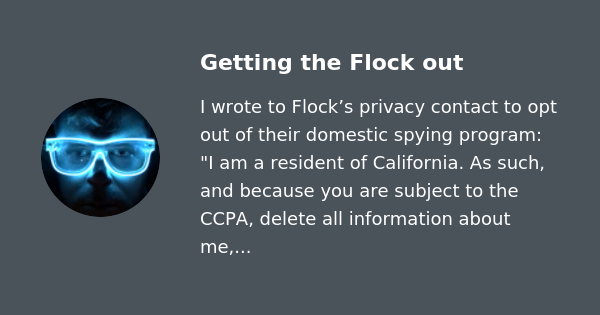
A California resident recently attempted to exercise their rights under the California Consumer Privacy Act (CCPA) by requesting that Flock Safety delete all personal and vehicle data from its databases. The individual formally requested that the company cease the collection and storage of information regarding themselves, their household, and their vehicles. In response, Flock Safety denied the request, stating they act solely as a service provider and data processor for their customers, who remain the owners and controllers of the data. The company directed the individual to contact the specific organizations using their services to fulfill privacy requests. This interaction highlights the complexities of data ownership and the limitations of direct privacy requests within the framework of third-party surveillance technology providers.
Key Takeaways
- A California resident formally requested data deletion and a future opt-out from Flock Safety's data collection under CCPA.
- Flock Safety denied the request, claiming they are a "service provider" and "processor," not the data owner.
- The company asserts that its customers (organizations) own the data and are responsible for responding to privacy and deletion requests.
- Flock Safety maintains that they do not sell, publish, or exchange data for their own commercial purposes, as per customer contracts.
In-Depth Analysis
The Privacy Request and Corporate Response
An individual residing in California initiated a formal privacy request to Flock Safety, citing the California Consumer Privacy Act (CCPA). The request demanded the deletion of all information pertaining to the individual, their vehicles, and household members from Flock Safety’s databases. Furthermore, the resident explicitly withheld permission for any future data collection or storage.
Flock Safety’s response, which reportedly included misspellings of the requester's name, stated that the request could not be completed. The company’s justification rests on its legal classification as a service provider. According to their statement, Flock Safety processes data on behalf of its customers, who act as the primary controllers of the information. Consequently, the company claims it lacks the authority to directly fulfill individual deletion requests, shifting the burden of privacy compliance onto the organizations that utilize their surveillance technology.
Data Ownership and Contractual Limitations
Flock Safety clarified its operational framework by emphasizing that its processing activities are strictly governed by customer contracts. These contracts dictate how data is handled and impose limitations on Flock Safety’s usage. The company highlighted that because the customers own the data, Flock Safety is prohibited from selling, publishing, or exchanging the information for independent commercial gain.
This defense positions Flock Safety as a neutral technical intermediary. However, for the consumer, this creates a significant hurdle: to have their data removed, they must identify and contact the specific organization—often a local law enforcement agency or private entity—that captured their license plate information through Flock Safety’s hardware. The original report notes that the data collection occurs when customers leverage License Plate Recognition technology, though the full details of the collection process were cut off in the source communication.
Industry Impact
This case underscores a growing tension in the surveillance and AI industry regarding the accountability of "service providers." As more companies deploy automated license plate recognition (ALPR) and AI-driven monitoring tools, the legal distinction between a data processor and a data controller becomes a critical point of friction for privacy rights. If technology providers can successfully deflect CCPA requests to their clients, it may complicate the ability of citizens to manage their digital footprints across distributed surveillance networks. This incident serves as a benchmark for how surveillance firms may navigate state-level privacy laws by leveraging their status as third-party processors.
Frequently Asked Questions
Question: Why did Flock Safety refuse the CCPA deletion request?
Flock Safety stated they are a service provider and data processor, not the data controller. They claim that their customers own the data and are the only ones authorized to approve or process deletion requests.
Question: Does Flock Safety sell the data it collects?
According to the company's response, they are not permitted to sell, publish, or exchange data for their own commercial purposes, as the data is owned by their customers and governed by specific contracts.
Question: What should a resident do if they want their data deleted from Flock Safety's systems?
Flock Safety recommends that individuals contact the specific organization or entity that engaged their services, as those customers are responsible for assessing and responding to privacy requests.