
Back to List
LangChain Announces Presence at Google Cloud Next 2026: Booth Details and Agent Development Focus
Industry NewsLangChainGoogle Cloud NextAI Agents

LangChain Announces Presence at Google Cloud Next 2026: Booth Details and Agent Development Focus

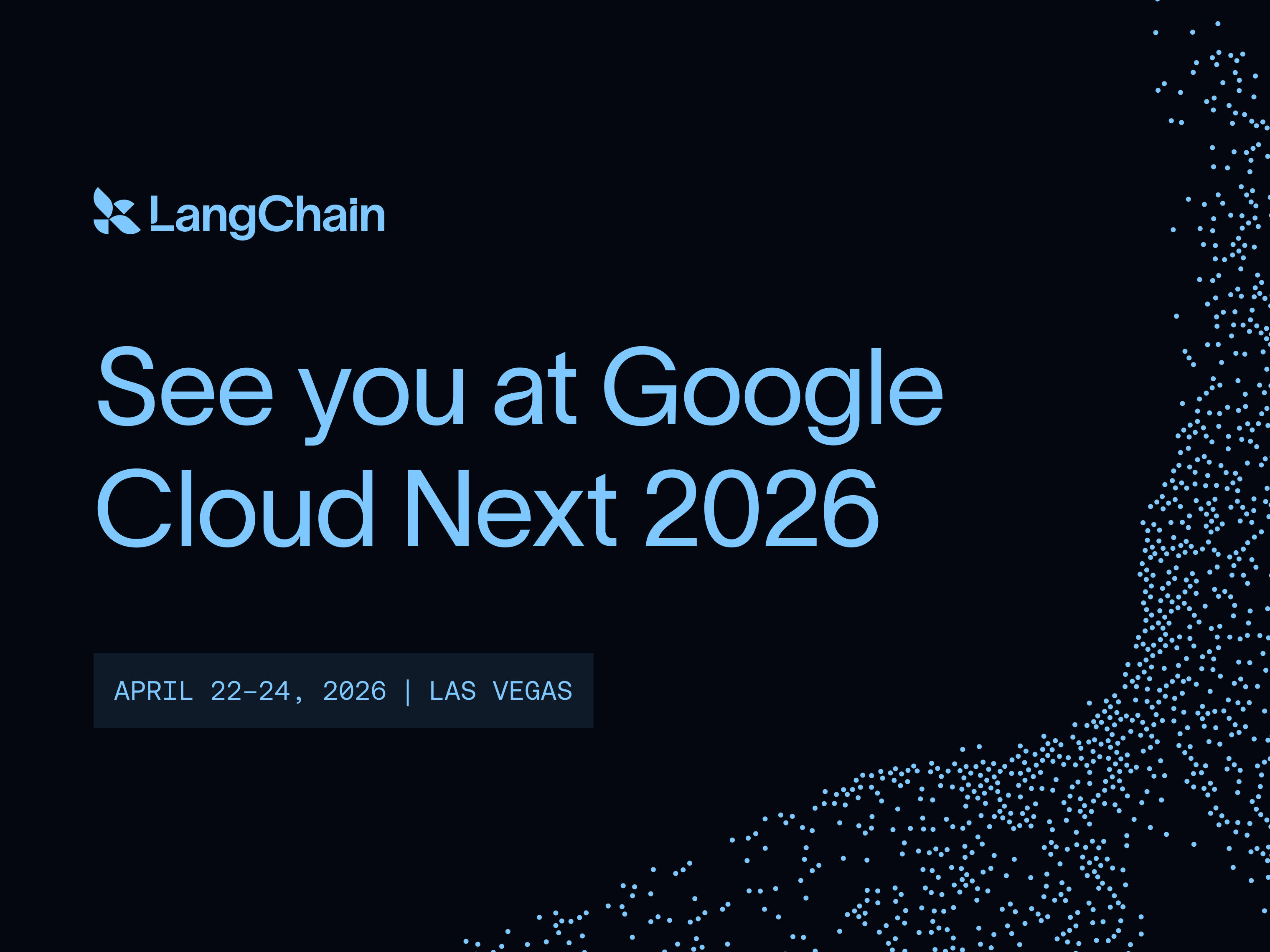
LangChain has officially announced its participation in the upcoming Google Cloud Next 2026 conference, scheduled to take place in Las Vegas. The event, hosted at the Mandalay Bay Convention Center from April 22 to April 24, will serve as a hub for developers and industry leaders. LangChain's presence will be centered at Booth #5006 in the Expo Hall, where the team aims to engage with attendees specifically focused on agent development. This announcement highlights the ongoing collaboration between LangChain and the Google Cloud ecosystem, providing a dedicated space for developers to explore tools and strategies for building sophisticated AI agents within the cloud infrastructure.

LangChain

Key Takeaways

  • Event Location: Google Cloud Next 2026 will be held at the Mandalay Bay Convention Center in Las Vegas.
  • Exhibition Dates: The event is scheduled for April 22-24, 2026.
  • Booth Information: LangChain will be located at Booth #5006 in the Expo Hall.
  • Core Focus: The LangChain team will be specifically engaging with developers working on agent development.

In-Depth Analysis

Strategic Presence at Google Cloud Next 2026

LangChain's participation in Google Cloud Next 2026 underscores the importance of physical networking and technical exchange within the AI development community. By establishing a physical presence at Booth #5006, LangChain provides a touchpoint for developers navigating the complexities of the Google Cloud ecosystem. The choice of venue—the Mandalay Bay Convention Center—reflects the scale of the event, which remains a primary gathering for cloud-native innovation and enterprise AI solutions.

Focus on Agent Development

A significant highlight of LangChain's announcement is its specific invitation to those working on agent development. As the AI industry shifts from simple chat interfaces to autonomous or semi-autonomous agents, LangChain's tooling has become central to this evolution. The presence at the Expo Hall from April 22-24 suggests a commitment to supporting developers who are integrating LangChain’s framework with Google Cloud’s infrastructure to build more capable and reliable AI agents.

Industry Impact

The collaboration between framework providers like LangChain and cloud giants like Google Cloud is a critical driver for the AI industry. By positioning themselves at Google Cloud Next, LangChain facilitates the bridge between high-level application development and underlying cloud compute and storage. This synergy is vital for the deployment of scalable AI agents, as it allows developers to discuss real-world implementation challenges and discover optimized workflows for agentic behavior in a cloud-first environment.

Frequently Asked Questions

Question: Where can I find LangChain at Google Cloud Next 2026?

LangChain will be located at Booth #5006 in the Expo Hall of the Mandalay Bay Convention Center.

Question: What are the dates for the LangChain exhibition at the event?

The team will be present from April 22 to April 24, 2026.

Question: Who should visit the LangChain booth?

While all attendees are welcome, LangChain is specifically looking to connect with developers who are currently working on agent development.

Related News

Meituan Showcases AI Innovations at ACL 2026: From Model Evaluation to Advanced Reasoning Paradigms
Industry News

Meituan Showcases AI Innovations at ACL 2026: From Model Evaluation to Advanced Reasoning Paradigms

At the prestigious ACL 2026 conference, the Meituan technical team presented six groundbreaking papers that signal a shift toward a new generative paradigm in artificial intelligence. These research contributions span a diverse array of critical NLP and AI domains, including large-scale model evaluation, complex process reasoning, and the optimization of competition-level mathematical thinking. Additionally, the papers explore advancements in reinforcement learning and generative recommendation systems. By focusing on these specific technical directions, Meituan aims to enhance the reasoning capabilities and practical utility of AI models. This selection highlights Meituan's commitment to pushing the boundaries of computational linguistics and natural language processing, providing insights into how the industry can transition from simple generation to more sophisticated, optimized reasoning and recommendation frameworks.

Meituan LongCat Team Launches General 365 Benchmark: Gemini 3 Pro Leads with 62.8% Accuracy
Industry News

Meituan LongCat Team Launches General 365 Benchmark: Gemini 3 Pro Leads with 62.8% Accuracy

The Meituan LongCat team has officially introduced General 365, a new benchmark designed to evaluate the reasoning capabilities of large language models. In a comprehensive assessment of 26 mainstream models, the results reveal a significant performance gap in the industry. Gemini 3 Pro, currently identified as the top-performing model, achieved an accuracy rate of 62.8%. However, the benchmark results highlight a broader challenge: the vast majority of tested models failed to reach the 60% accuracy threshold. This release establishes a new standard for measuring AI intelligence and underscores the current limitations of complex reasoning in even the most advanced AI systems.

Managing AI Coding Through Agent Evaluation: A Case Study of Refactoring 310,000 Lines of Code
Industry News

Managing AI Coding Through Agent Evaluation: A Case Study of Refactoring 310,000 Lines of Code

The Meituan technical team has shared a comprehensive framework for managing AI-driven development, centered on the successful refactoring of 310,000 lines of code. As AI begins to generate over 90% of codebases, the team argues that the bottleneck has shifted from coding speed to the implementation of effective constraints. Without standardized management, AI risks magnifying system complexity and chaos. The team's approach utilizes 'Agent evaluation thinking' to transform refactoring from a high-cost, specialized project into a continuous daily activity. This is achieved through four key pillars: technical debt assessment, rule construction, standardized operating procedures (SOPs), and a Pre-PR (Pull Request) mechanism. This methodology ensures that AI-generated code remains aligned with system architecture and quality standards, providing a blueprint for sustainable AI-assisted software engineering.