Back to List
Industry NewsLegalTraffic EnforcementFlorida Law

Florida Judge Declares Red Light Camera Tickets Unconstitutional in Landmark Ruling

A Florida judge has issued a ruling declaring red light camera tickets unconstitutional. This decision, published on March 9, 2026, could have significant implications for the use of automated traffic enforcement systems across the state. The specific details of the judge's reasoning and the scope of the ruling are not provided in the original news content, but the declaration itself marks a notable development in the ongoing debate surrounding the legality and fairness of red light cameras.

Hacker News

A Florida judge has ruled that red light camera tickets are unconstitutional. This significant decision was made public on March 9, 2026, as reported by Hacker News, citing CBS12.com. The ruling directly challenges the legality of automated enforcement systems used to issue citations for traffic violations at intersections. While the original news content does not elaborate on the specific legal arguments or the full scope of the judge's order, the declaration of unconstitutionality suggests a potential shift in how red light cameras are perceived and utilized within Florida's legal framework. This development is likely to spark further discussion and legal challenges regarding the implementation and validity of such traffic enforcement technologies.


Related News

Microsoft Reports $24.1 Billion in OpenAI-Linked Revenue, Dominating Over Half of Its AI Business
Industry News

Microsoft Reports $24.1 Billion in OpenAI-Linked Revenue, Dominating Over Half of Its AI Business

Microsoft has disclosed a significant financial milestone, reporting $24.1 billion in revenue directly linked to its partnership with OpenAI. This figure represents a pivotal shift in the company's financial structure, as OpenAI-related contributions now account for more than half of Microsoft's total AI-driven business for the period. The data underscores the immense commercial success of the Microsoft-OpenAI alliance and highlights the rapid enterprise adoption of generative AI technologies. As this partnership becomes the primary engine for Microsoft's AI growth, it sets a new benchmark for the industry regarding the monetization of advanced artificial intelligence models and the strategic value of deep-tech collaborations.

The Paradox of Typography: Analyzing the Emotional Impact of Fixed-Width Fonts and Blade Runner Title Cards
Industry News

The Paradox of Typography: Analyzing the Emotional Impact of Fixed-Width Fonts and Blade Runner Title Cards

This analysis explores the intricate relationship between functional design and emotional resonance in typography, as discussed in the context of developer environments and cinematic history. The article examines the 'typography paradox'—the idea that while well-designed type should be invisible to the reader, it inevitably conveys a specific 'feeling.' By looking at the author's experience using Claude Code within the Ghostty terminal on macOS, the piece highlights the importance of fixed-width typefaces like Apple's SF Mono. It further bridges the gap between technical utility and artistic expression by referencing the iconic title cards of Blade Runner, suggesting that even in data-heavy or structural environments, the visual form of letters builds a personal and emotional impression that transcends mere information delivery.

NVIDIA Vera Whitepaper Analysis: Examining the Olympus Core Architecture and Marketing Claims Against x86 Standards
Industry News

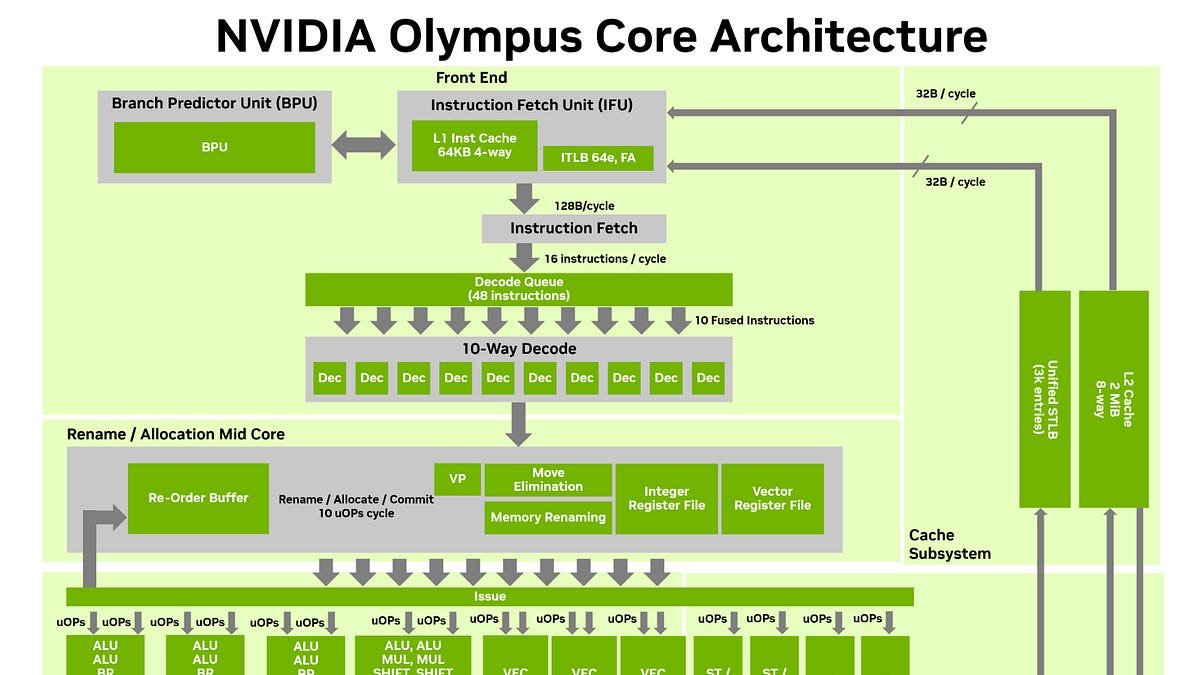
NVIDIA Vera Whitepaper Analysis: Examining the Olympus Core Architecture and Marketing Claims Against x86 Standards

NVIDIA has released a detailed 45-page whitepaper for Vera, its inaugural server CPU powered by the custom-designed Olympus core. The technical specifications reveal a formidable 88-core monolithic compute die utilizing the Arm v9.2 architecture, featuring a 10-wide decode front end, value prediction, and a substantial cache hierarchy. Despite the impressive hardware—which includes a 1.2 TB/s memory interface and a 3.4 TB/s coherency fabric—the whitepaper has drawn criticism for its marketing narrative. Analysts point out that NVIDIA's documentation mischaracterizes established x86 technologies, such as simultaneous multithreading and NUMA topologies, while employing unconventional metrics like "agentic benchmarks." This analysis explores the tension between Vera's genuine architectural innovations and the controversial storytelling used to promote it.