
From Imitation to Self-Correction: Exploring RSI Practice in Keeta Customer Service Models
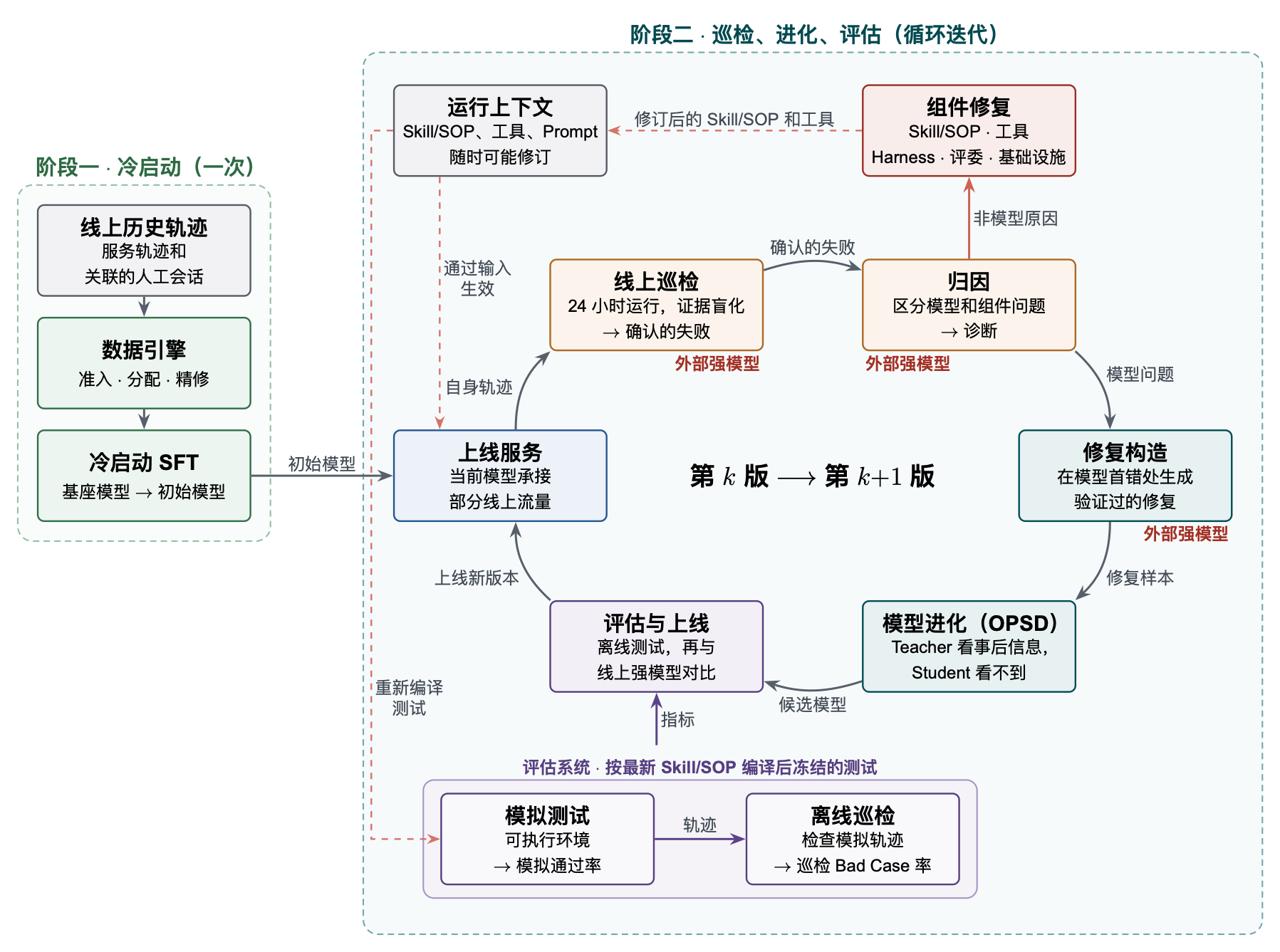
Can a customer service model become smarter the more it is used? The difficulty of Recursive Self-Improvement (RSI) lies not in 'learning', but in 'judging': whether a mistake was made, who is responsible, and which version of the rules defines the error. The Meituan technical team outlines their closed-loop process: online service, inspection and error finding, attribution and determination of responsibility, construction of fixes, Online Pseudo-Self-Distillation (OPSD), evaluation, and deployment, repeating the cycle continuously.
Key Takeaways
- Explore how customer service models achieve recursive self-improvement (RSI) to become smarter through usage.
- Highlight the core challenge of RSI: judging errors, assigning accountability, and standardizing rule versions.
- Detail Meituan's operational closed-loop process from online service to evaluation and deployment.
In-Depth Analysis
The Core Challenge of Recursive Self-Improvement (RSI)
Recursive Self-Improvement for customer service models faces a unique bottleneck. The primary difficulty is not the learning phase itself, but the judgment phase. Specifically, determining whether an error has occurred, identifying who or what is responsible for the mistake, and establishing which version of the rules dictates that an error took place are critical hurdles that must be overcome.
Meituan's Closed-Loop Iteration Process
To address these challenges, the team has established a structured operational closed-loop. This workflow consists of several sequential stages: online service deployment, inspection to find errors, attribution and determination of responsibility, construction of fixes, Online Pseudo-Self-Distillation (OPSD), and evaluation before going back online. This process operates in a continuous, repeating cycle to ensure ongoing model refinement.
Industry Impact
The practices shared by the Meituan technical team offer valuable insights into overcoming the limitations of static customer service models. By implementing a systematic approach to error detection, attribution, and online self-distillation, AI systems can iteratively enhance their performance and adaptability in real-world deployment scenarios.
Frequently Asked Questions
Question: What is the main difficulty in Recursive Self-Improvement (RSI) for customer service models?
Answer: The main difficulty lies not in 'learning', but in 'judging'—specifically determining if an error occurred, who is responsible, and which version of the rules defines the error.
Question: What steps comprise Meituan's closed-loop process for RSI?
Answer: The closed-loop includes online service, inspection for errors, attribution and determination of responsibility, construction of fixes, Online Pseudo-Self-Distillation (OPSD), and evaluation before launching.