
Building on Nemotron 3.5 Parse: Open Data, Fine-Tuning, and Faster Inference
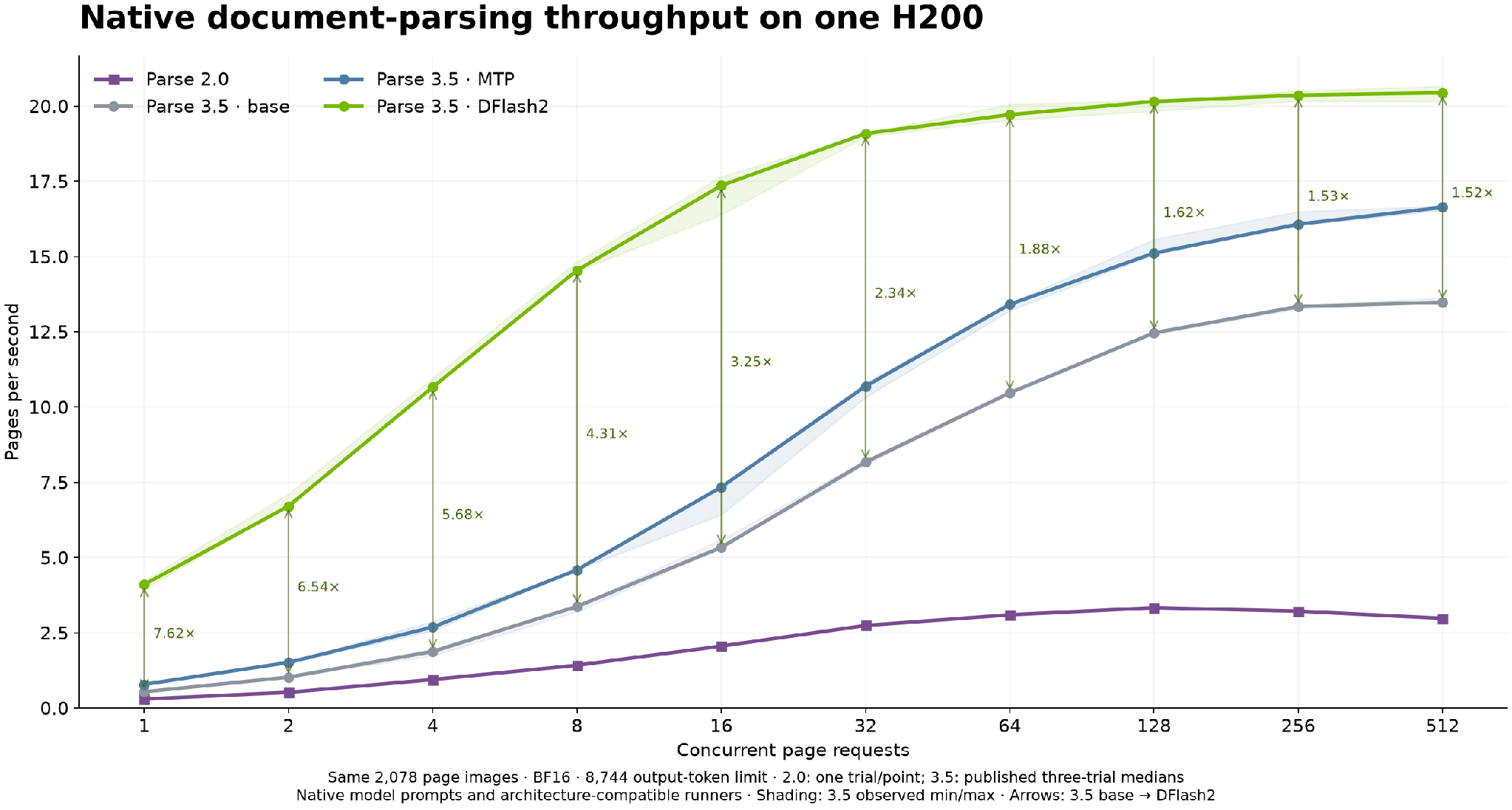
NVIDIA has open-sourced comprehensive assets for its Nemotron 3.5 Parse document model on Hugging Face, including three large-scale synthetic datasets totaling 18.88 million examples, a complete fine-tuning recipe, and a DFlash2 speculator. The release features 9.98 million charts, 1 million tables, and 7.9 million multilingual OCR pages designed to improve retrieval-augmented generation (RAG) and agentic AI pipelines. Additionally, incorporating RLVR with GRPO after supervised fine-tuning significantly reduced errors and boosted performance, while the DFlash2 speculator vastly increases inference throughput on hardware like the H200.
Key Takeaways
- NVIDIA released three open synthetic datasets for Nemotron 3.5 Parse comprising 9.98M charts, 1M tables, and 7.9M multilingual OCR pages.
- A complete fine-tuning recipe and a DFlash2 speculator were introduced to support custom adaptations and faster inference.
- Applying Reinforcement Learning via Verifiable Rewards (RLVR) with GRPO reduced loop-flagged outputs and raised overall model scores.
- The DFlash2 speculator substantially increases page processing throughput on modern hardware such as the H200.
In-Depth Analysis
Open Data Assets for Document Understanding
The release on the Hugging Face Blog highlights NVIDIA's push to make document extraction a measurable and adaptable system. By open-sourcing 18.88 million synthetic training examples under the OpenMDW 1.1 license, developers gain access to massive corpora specifically tailored for chart understanding, table structure recognition, and multilingual OCR. These assets address critical data bottlenecks in enterprise RAG and AI agent pipelines.
Fine-Tuning and Reinforcement Learning Integration
Adapting the compact 0.631-billion-parameter Nemotron 3.5 Parse model is further streamlined through a reproducible training recipe. By combining Supervised Fine-Tuning (SFT) with Reinforcement Learning via Verifiable Rewards (RLVR) using Group Relative Policy Optimization (GRPO), developers can drastically reduce loop-flagged errors and improve overall accuracy metrics, turning document parsing into a robust, verifiable pipeline.
Accelerated Inference with DFlash2
To tackle performance limitations at scale, NVIDIA integrated the DFlash2 speculative-decoding drafter. Measuring significant gains on hardware like the H200, the speculator accelerates page throughput substantially, enabling efficient deployment for high-concurrency enterprise applications that process scanned PDFs, presentation slides, and complex report layouts.
Industry Impact
The release of open synthetic data, fine-tuning recipes, and speculative decoding components for Nemotron 3.5 Parse marks a significant step forward for open-weights document intelligence. By lowering the barrier to customizing document parsers for specialized layouts, languages, and enterprise workflows, this initiative empowers RAG and agentic AI systems to achieve higher accuracy and operational efficiency.
Frequently Asked Questions
Question: What components were open-sourced for Nemotron 3.5 Parse?
Answer: NVIDIA open-sourced three synthetic datasets totaling 18.88 million examples (9.98M charts, 1M tables, and 7.9M multilingual OCR pages), a complete fine-tuning recipe, and a DFlash2 speculator.
Question: How does the DFlash2 speculator affect performance?
Answer: The DFlash2 speculator significantly boosts token and page throughput during inference, improving processing speeds on hardware like the NVIDIA H200.
Question: What license governs the newly released synthetic datasets?
The datasets and model components are made available under the commercial-friendly OpenMDW 1.1 license.