
Meituan Officially Launches LongCat-2.5: A 1.6-Trillion-Parameter Native Multimodal Model for Long-Horizon Agent Tasks
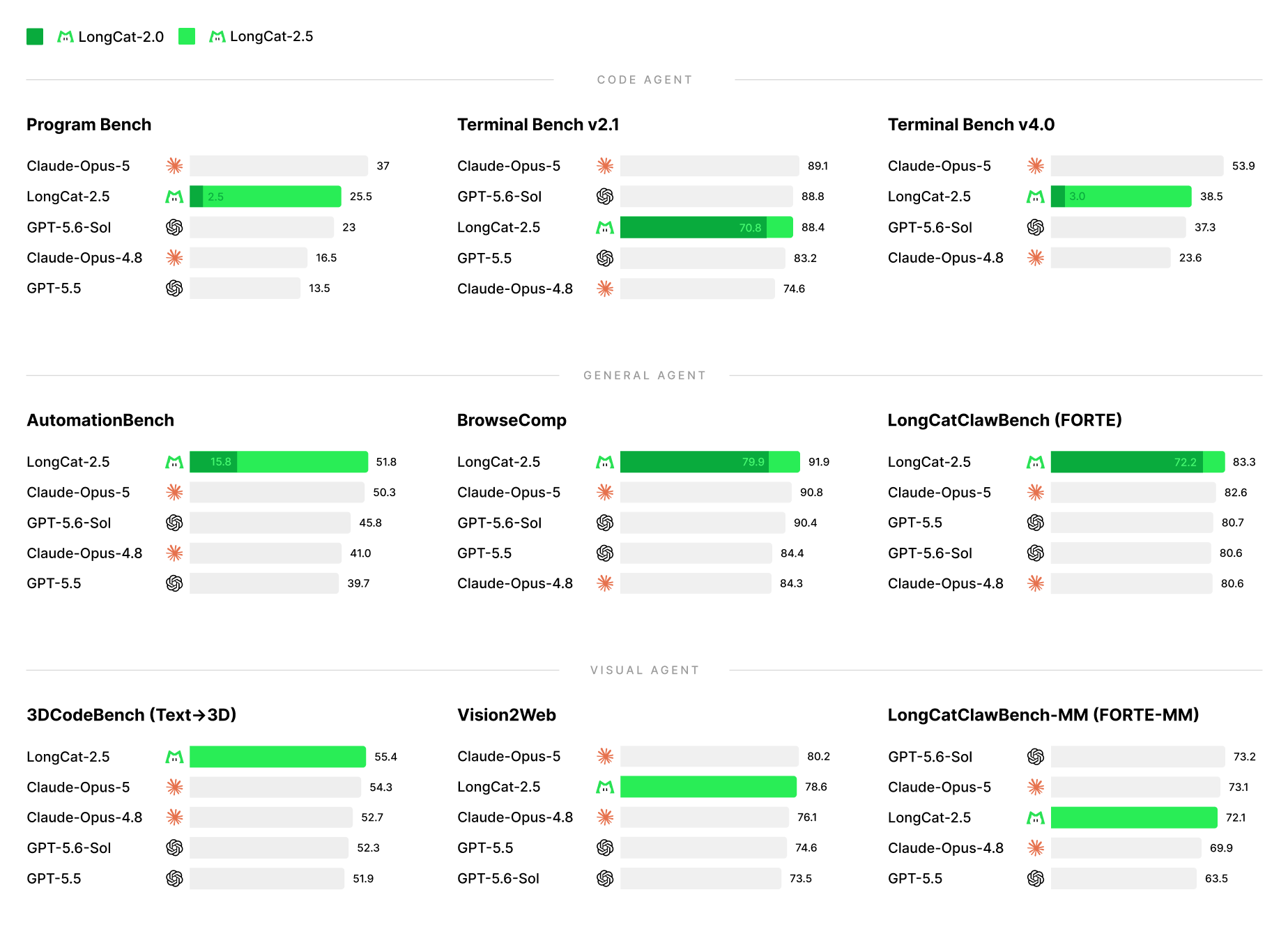
The Meituan Technical Team has officially unveiled LongCat-2.5, an advanced native multimodal foundation model tailored specifically for long-horizon autonomous agent tasks. Built on a massive architecture totaling 1.6 trillion parameters, the model activates approximately 48 billion parameters per token to balance high-capacity intelligence with operational efficiency. Representing an evolution from the earlier LongCat-2.0 system, LongCat-2.5 brings targeted enhancements in native visual comprehension and specialized agent programming capabilities. Designed to navigate complex, multi-step environments, the newly announced model reflects Meituan's technical trajectory toward unified multimodal understanding and programmatic execution for sophisticated agent workflows.
Key Takeaways
- Massive Sparse Architecture: Meituan's LongCat-2.5 features an overall parameter scale of 1.6 trillion parameters, with an active footprint of roughly 48 billion parameters per token.
- Long-Horizon Agent Focus: The model is architected specifically to handle long-range agentic tasks requiring sustained planning, multi-step execution, and autonomous decision-making.
- Native Multimodal Foundations: Built with native visual understanding from the ground up, avoiding fragmented cross-modal pipelines.
- Targeted Capabilities Upgrade: LongCat-2.5 builds upon its predecessor, LongCat-2.0, by substantially strengthening agent programming and native visual perception.
In-Depth Analysis
Sparse Architectural Scale: 1.6 Trillion Total and 48 Billion Active Parameters
The announcement of LongCat-2.5 by the Meituan Technical Team establishes a significant structural footprint in large-scale frontier modeling. With a total parameter count reaching 1.6 trillion, the model ranks among the largest publicly documented systems developed for agentic operations. However, the architectural design explicitly addresses the practical challenges of running trillion-parameter models by activating only approximately 48 billion parameters per token.
This sparsity ratio—activating roughly 3% of the total parameter count during any given inference step—indicates a sophisticated conditional routing paradigm. In long-horizon agent workflows, models are required to process extensive context windows, maintain iterative scratchpads, and execute hundreds of sequential actions. Maintaining a dense 1.6-trillion-parameter activation profile across long operational horizons would introduce severe computational bottlenecks. By restricting per-token activation to approximately 48 billion parameters, LongCat-2.5 maintains the computational cost and latency profile of a mid-sized foundation model while retaining the vast representational capacity and latent knowledge reservoir of a 1.6-trillion-parameter neural network.
Native Multimodality Built for Long-Horizon Agentic Execution
A central distinction highlighted in the release is the model's designation as a native multimodal model. Traditional agent systems often attempt to stitch together discrete vision encoders, optical character recognition tools, and decoupled text-based reasoning backbones. Such modular architectures frequently suffer from information degradation, translation latency, and misalignments between visual perception and action planning.
LongCat-2.5 addresses these operational friction points through native integration. Rather than treating visual data as an external attachment, the native multimodal framework processes sensory inputs and textual context in a shared representational space. For long-horizon agent tasks—such as interpreting complex user interfaces, navigating dynamic environments, analyzing spatial relationships, and processing multi-page visual documents—native visual comprehension ensures that visual signals are integrated directly into the model's core reasoning loops. This coherent visual grounding enables the agent to evaluate changing interface states, verify action outcomes visually, and sustain multi-step execution paths without falling out of alignment.
Evolution Beyond LongCat-2.0: Agent Programming and Visual Synergy
LongCat-2.5 represents a deliberate progression from the earlier LongCat-2.0 iteration, concentrating engineering refinements on two complementary domains: agent programming and native visual understanding.
In autonomous agent operations, programming proficiency serves as the primary engine for tool invocation, API orchestration, and structured logic formulation. Autonomous agents do not merely generate code snippets for human developers; they use executable code as a medium to query systems, manipulate data structures, and invoke runtime environments. By strengthening agent programming capabilities on top of a 1.6-trillion-parameter substrate, LongCat-2.5 equips the agent to generate, debug, and execute programmatic tasks autonomously. When combined with improved native visual perception, this programming capacity enables end-to-end operational loops where the agent reads visual screen states, writes appropriate code or API calls to interact with those states, observes the visual feedback of its action, and systematically works toward completing long-horizon objectives.
Industry Impact
The unveiling of LongCat-2.5 underscores several critical shifts occurring across the artificial intelligence and autonomous systems landscape:
- Shift Toward Agent-Specific Foundation Architectures: The transition from general-purpose conversational models to models engineered explicitly for "long-horizon agent tasks" marks a clear industry trend. Systems are increasingly evaluated not merely on single-turn benchmark prompts, but on their ability to execute sustained, multi-step actions across extended time horizons.
- Validation of High-Capacity Sparse Execution: Deploying a 1.6-trillion-parameter model with an active budget of approximately 48 billion parameters per token reinforces the industry-wide consensus that sparse execution is essential for practical agent deployment. It provides the parameter scale needed for intricate reasoning while keeping per-step inference practical.
- Unification of Vision and Code Execution: By focusing dual improvements on visual understanding and agent programming, Meituan highlights the convergence required for practical digital and physical agents. Modern agent workflows demand that perception and execution cannot exist in isolation; agents must simultaneously perceive interface visuals and programmatically interact with tools.
Frequently Asked Questions
What is LongCat-2.5 and who developed it?
LongCat-2.5 is a native multimodal foundation model engineered for long-horizon agent tasks, officially released by the Meituan Technical Team on November 2, 2026.
What are the core architectural specifications of LongCat-2.5?
The model features a total parameter count of 1.6 trillion, while activating approximately 48 billion parameters per token during inference to balance reasoning capacity with execution efficiency.
How does LongCat-2.5 improve upon LongCat-2.0?
LongCat-2.5 advances beyond its predecessor by delivering targeted enhancements in native visual understanding and specialized agent programming capabilities, both critical for executing complex, multi-step autonomous workflows.


