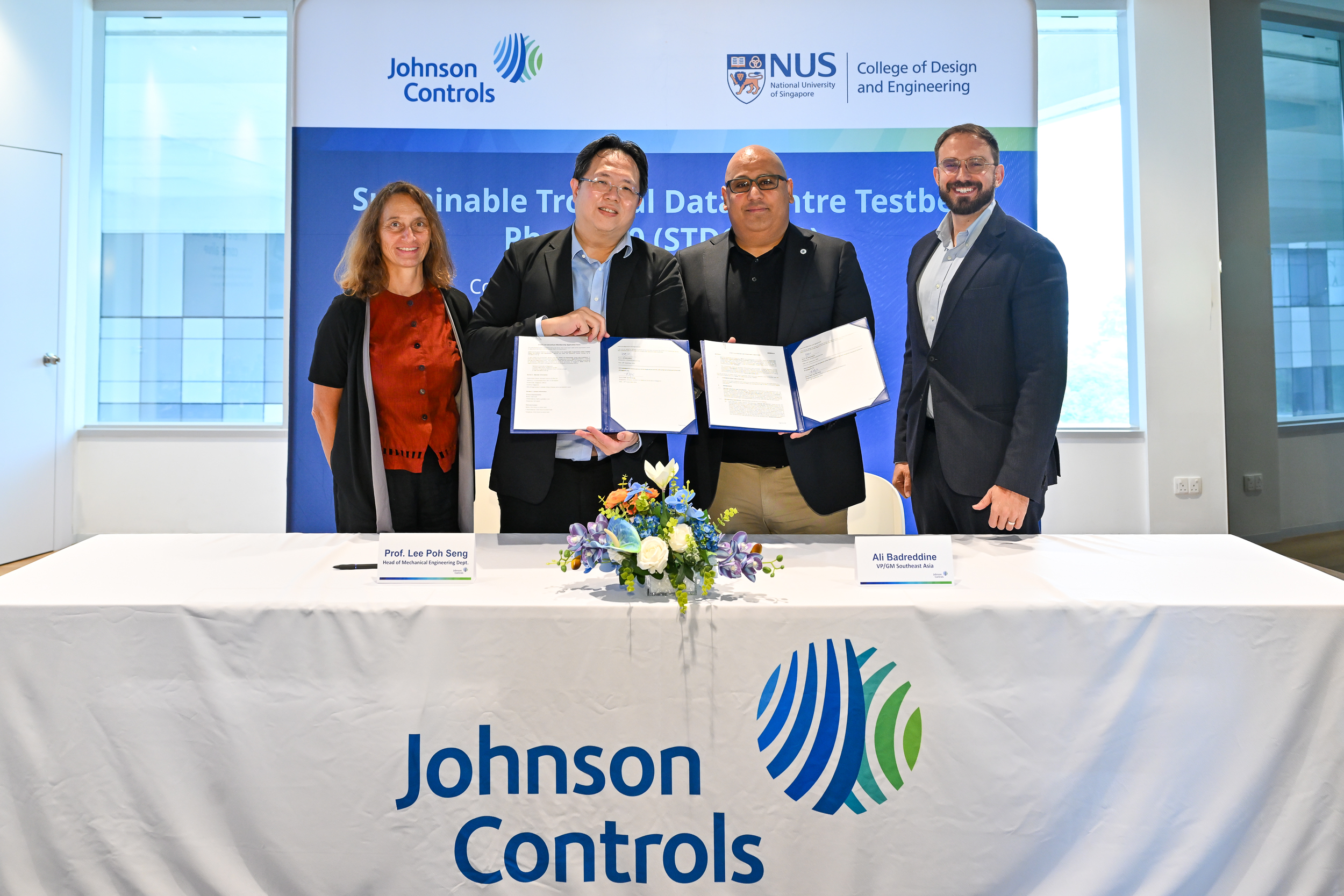
Johnson Controls Joins NUS Tropical AI Data Center Testbed to Cut Cooling Energy by Half
Johnson Controls has joined the National University of Singapore (NUS) tropical artificial intelligence data center testbed to address energy challenges in mission-critical facilities. As high-density AI hardware drives unprecedented power and thermal requirements, facility cooling has become a major operational hurdle, especially in equatorial climates characterized by high ambient temperatures and humidity. According to Johnson Controls, an advanced modeled design developed for this environment has demonstrated the capability to lower non-information-technology energy consumption by up to 50 percent compared to conventional cooling methods. By participating in the NUS testbed, Johnson Controls aims to evaluate and optimize thermal management strategies, validating how modern cooling designs can maintain compute performance while substantially reducing auxiliary electrical overhead in tropical regions.
Key Takeaways
- Strategic Testbed Partnership: Johnson Controls has officially partnered with the National University of Singapore (NUS) to participate in its tropical AI data center testbed.
- Major Energy Reduction: Modeled designs from Johnson Controls show that non-information-technology (non-IT) energy use can be decreased by up to 50% compared to conventional cooling systems.
- Targeting Tropical Climates: The initiative specifically evaluates thermal management and energy performance under challenging ambient conditions common to tropical environments.
- Optimizing AI Workloads: The testing focuses on creating sustainable, high-efficiency operational infrastructure capable of supporting power-dense AI processing demands.
In-Depth Analysis
The Tropical Cooling Challenge for Next-Generation AI Facilities
Artificial intelligence workloads have fundamentally altered the electrical and thermal profiles of modern data centers. High-density server racks running complex machine learning models, neural network training cycles, and large-scale inference operations generate immense heat that must be dissipated continuously to prevent thermal throttling and hardware degradation. In temperate regions, operators often rely on ambient air or economizers to assist in heat dissipation. In tropical regions, however, consistently elevated temperatures and high relative humidity render traditional heat-rejection techniques far less effective.
Consequently, facilities operating in tropical environments face severe efficiency penalties. The energy required to run traditional chillers, water pumps, air-handling units, and environmental controls can inflate a facility's power usage effectiveness (PUE) to undesirable levels. Joining the NUS tropical AI data center testbed allows Johnson Controls to deploy and evaluate advanced engineering models designed to withstand these environmental constraints while keeping the facility thermally stable.
Achieving Up to 50% Reduction in Non-IT Energy Consumption
At the core of Johnson Controls' participation is a modeled design capable of lowering non-information-technology energy use by up to 50% compared with conventional cooling methods. Non-IT power encompasses all auxiliary systems that support computing equipment, including cooling machinery, ventilation, power distribution losses, and lighting, with cooling infrastructure historically making up the overwhelming majority of this overhead.
By targeting non-IT energy consumption, the modeled design addresses the primary source of facility inefficiency. Cutting non-IT power demands in half directly frees up substantial grid capacity that would otherwise be consumed by auxiliary cooling operations. In constrained power markets, this efficiency gain allows operators to direct a larger proportion of available electrical capacity directly to computation, effectively increasing the processing output of the data center without requiring additional utility infrastructure.
Collaborative Validation and Empirical Modeling at NUS
Moving advanced thermal concepts from theoretical models to operational deployment requires empirical validation in representative physical environments. The NUS tropical AI data center testbed provides the real-world operational baseline needed to assess how innovative thermal management designs perform when subjected to continuous tropical climate variables and fluctuating computing loads.
Through this collaboration, the modeled design's projected 50% reduction in non-IT energy will be tested across operational parameters to assess system reliability, heat rejection rates, and control loop dynamics. Validating these models at the NUS facility provides critical real-world data that can help bridge the gap between simulation and full-scale commercial implementation across Southeast Asia and other tropical markets.
Industry Impact
The participation of Johnson Controls in the NUS tropical AI data center testbed carries significant implications for the global data center and AI infrastructure industries:
- Decoupling AI Growth from runaway Energy Demand: As data center operators face stricter environmental regulations and power supply limits, achieving a 50% reduction in non-IT power use provides a pathway to expand AI capacity responsibly.
- Setting Benchmarks for Tropical Deployments: Tropical and subtropical developing markets represent rapidly growing digital hubs. Establishing validated cooling methodologies tailored to warm, humid regions eliminates geographic barriers to deploying cutting-edge AI infrastructure.
- Lowering Operational Overhead: Because cooling accounts for a significant share of ongoing operating expenses, slashing auxiliary energy usage substantially lowers the lifecycle operational cost of operating high-density AI clusters.
- Accelerating Sustainable Facility Architecture: Demonstrating the viability of modeled cooling improvements encourages broader adoption of optimized thermal management systems across enterprise and colocation facilities worldwide.
Frequently Asked Questions
What is the primary focus of Johnson Controls' participation in the NUS testbed?
Johnson Controls is participating in the NUS tropical AI data center testbed to evaluate and validate advanced thermal management designs specifically tailored for high-density AI infrastructure operating under tropical climate conditions.
How significant is the 50% energy reduction cited by Johnson Controls?
A 50% reduction in non-IT energy use represents a substantial operational efficiency gain. Because non-IT energy is largely consumed by cooling equipment, cutting this usage in half enables facilities to minimize auxiliary power overhead and allocate more available electricity directly to compute hardware.
Why are tropical conditions uniquely challenging for AI data center cooling?
Tropical environments present persistent high ambient temperatures combined with high humidity. These conditions limit the effectiveness of conventional evaporative cooling and free-air economization, forcing cooling systems to consume significantly more electricity unless optimized through specialized thermal designs.