
SpaceXAI Grok Bot Analysis: Matching OpenClaw Power with a New Level of Programming Abstraction
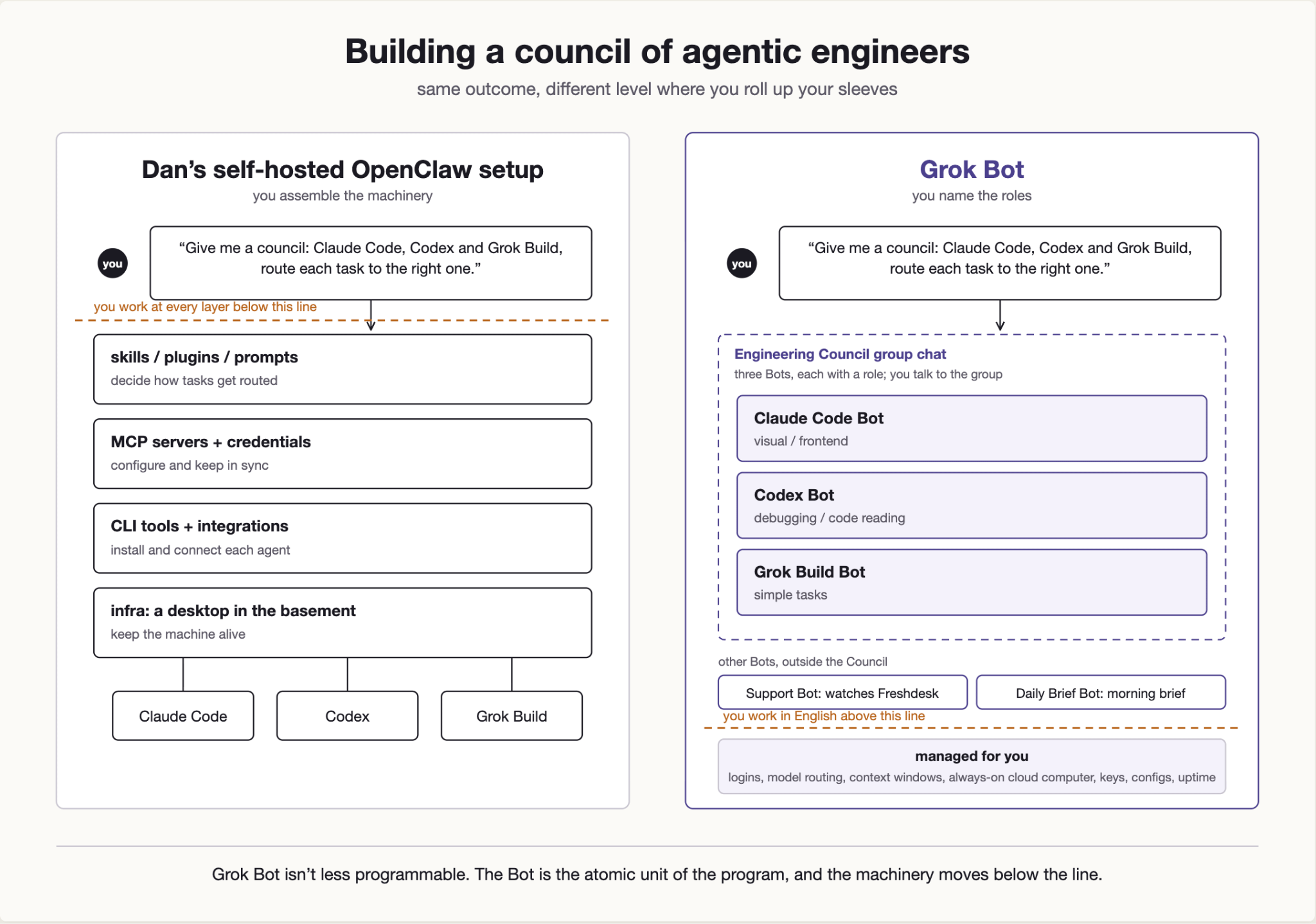
A recent evaluation of SpaceXAI's Grok Bot reveals a significant development in the landscape of AI programming tools. The bot demonstrates a level of programming power that is equivalent to OpenClaw, a notable benchmark in the industry. However, the defining characteristic of Grok Bot is its approach to programmability, which operates at a distinct level of abstraction. By combining high-performance capabilities with a user experience described as having 'MacBook simplicity,' SpaceXAI aims to redefine how developers interact with complex AI systems. This analysis explores the implications of maintaining raw computational power while simplifying the interface through higher abstraction, suggesting a shift toward more accessible yet potent development environments in the artificial intelligence sector.
Key Takeaways
- Power Parity: SpaceXAI’s Grok Bot matches the programming power of OpenClaw, placing it at the top tier of functional AI development tools.
- Abstraction Differentiator: The primary distinction between the two systems lies in the level of abstraction at which they are programmed.
- User Experience Focus: The tool is designed to offer 'MacBook simplicity,' suggesting a focus on streamlined workflows and intuitive design despite its high-level capabilities.
- Strategic Positioning: SpaceXAI is positioning Grok Bot as a high-power alternative that changes the developer's interaction model through its unique programming layer.
In-Depth Analysis
The Parity of Programming Power
The core finding from the initial five-day assessment of SpaceXAI's Grok Bot is its functional equivalence to OpenClaw in terms of raw programming power. In the context of AI development, 'programming power' typically refers to the system's ability to handle complex logic, generate accurate code, and solve multi-step computational problems. By reaching the same level as OpenClaw, Grok Bot establishes itself not as a simplified 'lite' version of existing tools, but as a full-strength peer. This parity suggests that SpaceXAI has successfully optimized its underlying models to compete with established high-performance frameworks, ensuring that users do not have to sacrifice capability for the sake of a new interface.
Redefining Abstraction Levels
While the power remains constant, the 'level of abstraction' serves as the critical pivot point for Grok Bot. In software engineering, a higher level of abstraction generally means that the developer is further removed from the complex, 'under-the-hood' mechanics of the system, instead using more intuitive or generalized commands to achieve results. The report indicates that Grok Bot is programmable at a different level than OpenClaw. This implies a fundamental shift in the developer's workflow. If OpenClaw requires more granular, low-level management, Grok Bot likely utilizes a more declarative or high-level approach. This allows developers to focus on the 'what' rather than the 'how,' potentially reducing the cognitive load required to execute high-power programming tasks.
The 'MacBook Simplicity' Paradigm
The comparison to 'MacBook simplicity' provides insight into the design philosophy behind Grok Bot. This analogy suggests a focus on a seamless, integrated, and 'it just works' user experience. In the realm of AI programming bots, simplicity often translates to better natural language understanding, fewer configuration hurdles, and a more polished interface. By pairing this simplicity with the power of a system like OpenClaw, SpaceXAI is addressing a common pain point in the industry: the trade-off between a tool's capability and its ease of use. Grok Bot appears to be an attempt to bridge this gap, offering a professional-grade engine within a consumer-grade user experience framework.
Industry Impact
The emergence of Grok Bot as a competitor to OpenClaw with a focus on different abstraction levels could signal a broader trend in the AI industry. As AI models become increasingly powerful, the bottleneck for productivity often shifts from the model's capability to the human's ability to interface with it. By providing 'OpenClaw power' through a simpler, more abstracted interface, SpaceXAI may force other players in the industry to re-evaluate their developer experience (DX).
Furthermore, this development suggests that the next phase of competition in AI tools will not just be about who has the most 'power,' but who can make that power the most accessible. If Grok Bot can maintain its performance while lowering the barrier to entry through its unique abstraction level, it could capture a significant portion of the market that requires high-level output but prefers a more streamlined, 'MacBook-like' development environment. This move potentially expands the pool of developers who can effectively utilize high-end AI programming bots, accelerating the pace of AI-driven software development across the board.
Frequently Asked Questions
Question: How does Grok Bot's power compare to OpenClaw?
According to the report, Grok Bot possesses the same level of programming power as OpenClaw, meaning it is capable of performing at a similar high-performance standard for programming tasks.
Question: What is the main difference between Grok Bot and OpenClaw?
The primary difference lies in the level of abstraction. While both are powerful, Grok Bot is programmable at a different level of abstraction, which contributes to its 'MacBook-like' simplicity in user experience.
Question: Who is the developer of Grok Bot?
Grok Bot is developed by SpaceXAI, as part of their suite of artificial intelligence tools designed for high-level programming and task execution.

