Xiaomi Xring O3 CPU Challenges Apple with Massive Multi-Threaded Performance and 44MB Cache
Xiaomi has introduced its latest processor, the Xring O3, marking a significant milestone in mobile computing. According to industry reports, the chip's high-performance C1-Ultra cores match Apple's single-threaded capabilities while delivering a substantial lead in multi-threaded execution. Benchmarks reveal a Geekbench single-core score of 3,945 and a record-breaking multi-core score of 15,221. A standout feature of the Xring O3 is its 44 MB of total cache, which exceeds the capacity found in many contemporary Intel laptop CPUs. Architecturally, the processor is designed for massive parallelism, featuring 21 execution ports and support for advanced extensions like SME2 and SVE2. This development highlights a growing industry trend where transistor budgets are increasingly allocated toward cache and parallel execution units to drive AI and data-intensive performance.
Key Takeaways
- Performance Parity and Leadership: The Xiaomi Xring O3 matches Apple's core performance in single-threaded tasks and significantly outperforms it in multi-threaded scenarios.
- Record-Breaking Benchmarks: The chip achieved a Geekbench single-core score of 3,945 and an unprecedented multi-core score of 15,221.
- Massive Cache Integration: The processor features 44 MB of total cache, a figure higher than many standard Intel-based laptop CPUs.
- Advanced Architecture: The C1-Ultra cores utilize 21 execution ports and support SME2 (Scalable Matrix Extension 2) and SVE2 (Scalable Vector Extension 2) for AI and SIMD acceleration.
- Parallelism Trend: The design reflects a shift toward massively parallel cores with a high density of execution units and arithmetic capabilities.
In-Depth Analysis
Performance Benchmarks and Core Architecture
The Xiaomi Xring O3 represents a major shift in the competitive landscape of mobile processors. According to data shared by industry observers, the processor's primary strength lies in its C1-Ultra cores. These cores have demonstrated the ability to roughly match the single-threaded performance of Apple’s current market-leading cores, which has long been the gold standard for mobile efficiency. However, the Xring O3 distinguishes itself in multi-threaded execution, where it is described as being "much faster."
Quantifiable data from Geekbench supports these claims, with the Xring O3 reaching a single-core score of 3,945. More impressively, its multi-core score of 15,221 sets a new benchmark for mobile performance. While Apple is expected to announce its next generation of processors soon—potentially narrowing or reclaiming this lead—the current performance of the Xring O3 places Xiaomi in a dominant position regarding raw processing power. The C1-Ultra cores are the driving force behind this leap, designed to handle complex workloads with high efficiency.
Cache and Execution Port Density
One of the most striking technical specifications of the Xring O3 is its cache hierarchy. The chip incorporates a total of 44 MB of cache, a volume that is notably higher than what is found in the majority of laptop CPUs, particularly those from Intel. This massive cache is a strategic allocation of transistors, designed to reduce latency and improve data throughput for demanding applications. In modern computing, the ability to keep data close to the execution units is critical for performance, and Xiaomi’s decision to prioritize cache size reflects this necessity.
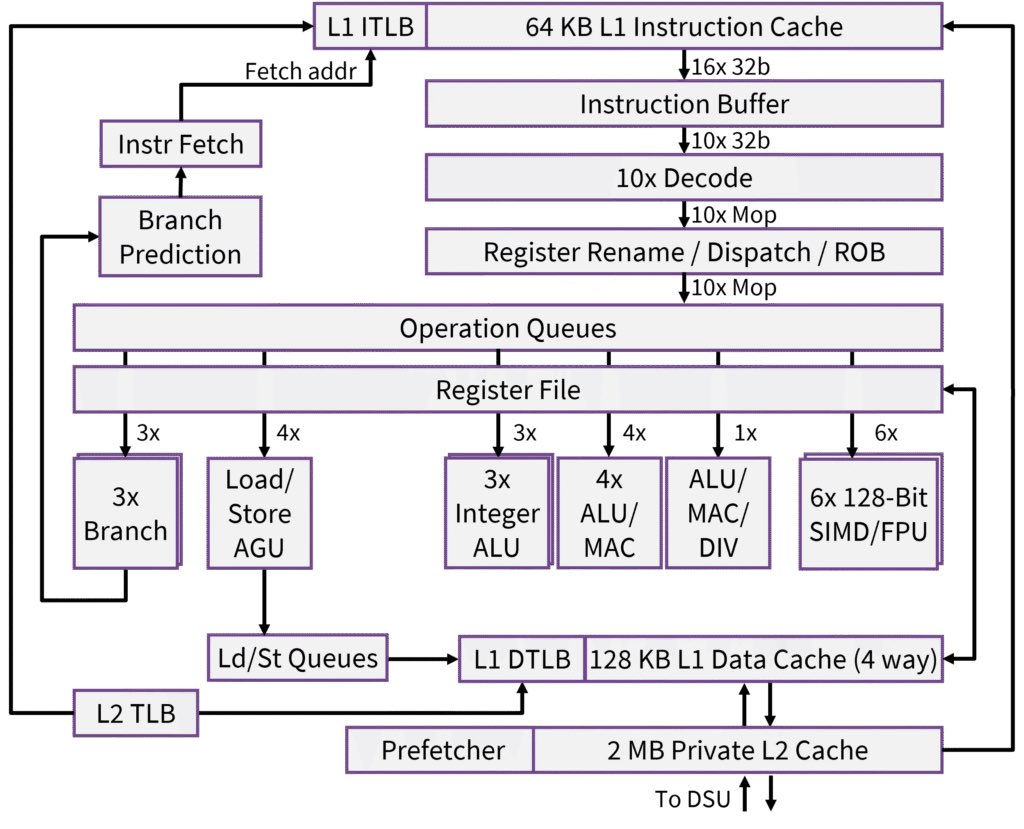
Furthermore, the architecture of the C1-Ultra core is exceptionally "wide." It features 21 execution ports, which is more than what is typically found on high-end Intel or AMD desktop and laptop processors. Out of these 21 ports, six are dedicated to SIMD (Single Instruction, Multiple Data) operations at 128 bits. While AMD’s Zen 5 architecture maintains an advantage in specific vector widths (supporting 4x512-bit), the Xring O3’s 6x128-bit configuration is considered the top tier for ARM-based chips. This high number of execution units allows the processor to perform a vast number of independent additions and multiplications per cycle, facilitating massive parallelism.
Specialized Extensions for AI and Data
To meet the growing demands of modern software, the Xring O3 includes specialized hardware extensions. It supports Scalable Matrix Extension 2 (SME2), which is specifically designed for matrix and AI acceleration. This allows the chip to handle the heavy mathematical requirements of artificial intelligence locally on the device. Additionally, the inclusion of Scalable Vector Extension 2 (SVE2) enhances data parallelism, making the processor more adept at handling diverse data types simultaneously.
These technical choices indicate a clear trend in semiconductor design: the focus is moving away from simple clock speed increases and toward increasing the number of execution units and the size of the cache. By packing more arithmetic units and memory into the silicon, Xiaomi is optimizing for a future where parallel processing and AI-driven tasks are the primary workloads for mobile devices.
Industry Impact
The arrival of the Xring O3 signals a narrowing gap between mobile and traditional laptop computing power. By exceeding the cache and execution port counts of many laptop-grade processors, Xiaomi is challenging the traditional hierarchy of hardware performance. This development forces other major players, including Apple, Intel, and AMD, to reconsider their architectural priorities, particularly regarding cache size and the density of execution ports in mobile-first designs.
Furthermore, the emphasis on SME2 and SVE2 highlights the critical importance of AI acceleration in the next generation of consumer electronics. As mobile devices are increasingly required to run complex AI models locally, the hardware must evolve to support these matrix-heavy operations. Xiaomi’s Xring O3 serves as a blueprint for this transition, demonstrating that the future of mobile silicon lies in massive parallelism and significant on-chip memory resources.
Frequently Asked Questions
Question: How does the Xring O3 compare to Apple's current processors?
The Xring O3 matches Apple's cores in single-threaded tasks but offers significantly faster multi-threaded performance. In Geekbench testing, it achieved a multi-core score of 15,221, which is a substantial leap over previous mobile standards.
Question: Why is the 44 MB cache significant?
A 44 MB cache is unusually large for a mobile processor, even surpassing the cache found in many Intel laptop CPUs. This large cache allows the processor to store more data locally, reducing the need to access slower external memory and thereby increasing overall speed and efficiency.
Question: What are the C1-Ultra cores?
The C1-Ultra cores are the high-performance cores within the Xring O3 processor. They feature an exceptionally wide architecture with 21 execution ports and support advanced technologies like SME2 for AI acceleration and SVE2 for data parallelism.