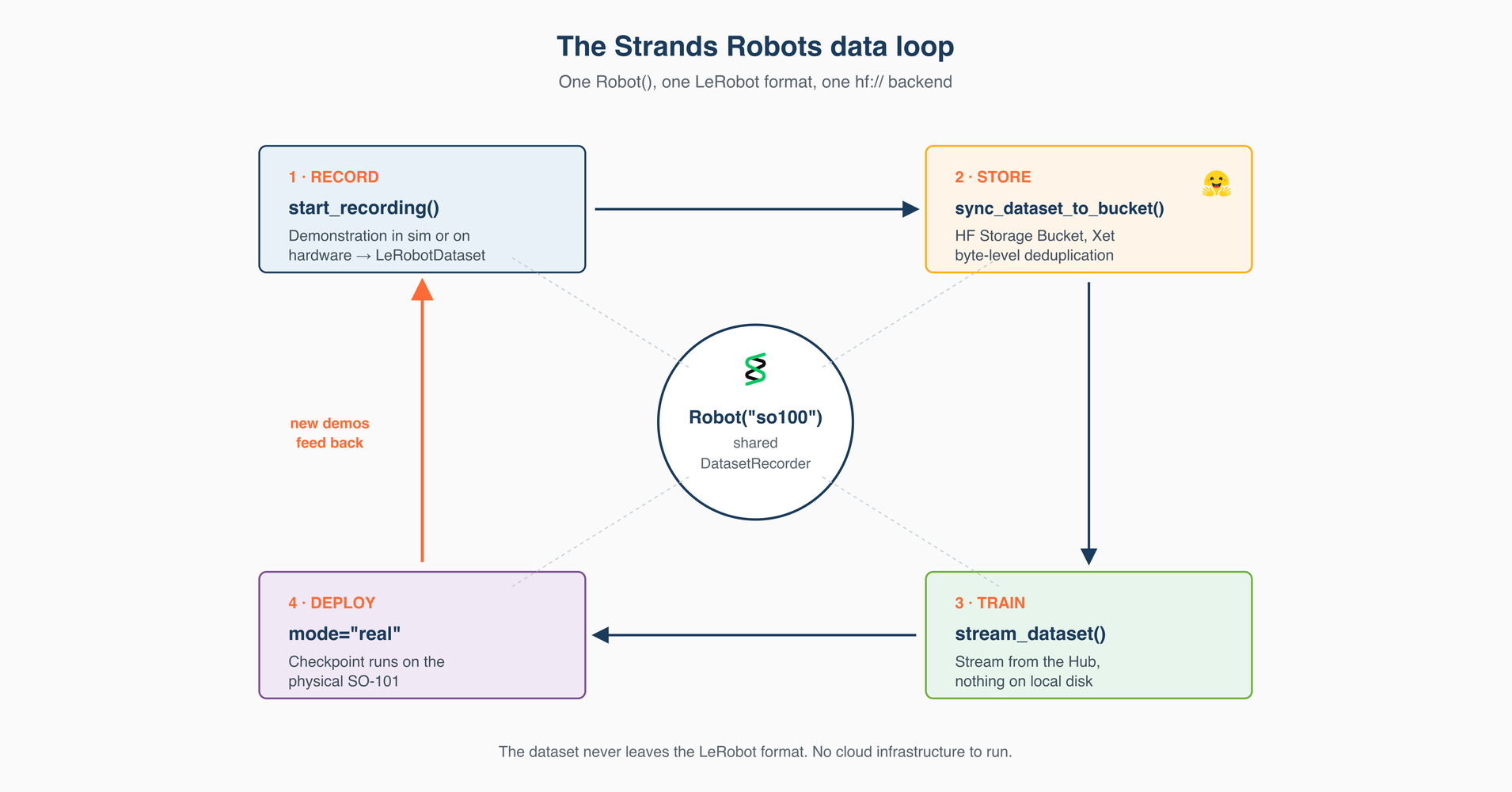
Streamlining Robotics Development: Record, Train, and Deploy with Strands Agents, LeRobot, and Hugging Face Storage Buckets
Hugging Face has announced a unified robotics workflow that integrates Strands Agents, the LeRobot library, and Hugging Face Storage Buckets. This end-to-end solution allows developers to manage the entire lifecycle of embodied AI—from initial data recording to model training and final deployment—within a single ecosystem. By leveraging Strands Agents for interaction, LeRobot for specialized robotics training, and Storage Buckets for scalable data management, Hugging Face aims to simplify the complexities of robotics engineering. This integration represents a significant step toward standardizing the robotics pipeline, providing a cohesive environment for researchers and developers to build and scale intelligent physical agents.
Key Takeaways
- Unified Robotics Lifecycle: A single ecosystem now supports the full pipeline of recording, training, and deploying robotics models.
- Integration of Specialized Tools: The workflow combines Strands Agents and the LeRobot library to bridge the gap between simulation and physical deployment.
- Scalable Data Infrastructure: Hugging Face Storage Buckets provide the backend necessary for handling the massive datasets required for robotics training.
- Simplified Embodied AI: The integration reduces the friction of moving between different platforms and tools during the development process.
In-Depth Analysis
The End-to-End Robotics Loop
The announcement of a unified workflow involving Strands Agents, LeRobot, and Hugging Face Storage Buckets addresses one of the most significant pain points in robotics: fragmentation. Traditionally, robotics developers have had to jump between disparate tools for data collection, model architecture design, and cloud-based deployment. By offering a solution to "record, train, and deploy from one place," Hugging Face is creating a streamlined "loop" for embodied AI.
In this ecosystem, the recording phase likely utilizes Strands Agents to capture high-fidelity interaction data. This is followed by the training phase, where the LeRobot library—specifically designed for robotics—provides the necessary frameworks to turn raw data into actionable intelligence. Finally, the deployment phase is supported by Hugging Face Storage Buckets, ensuring that models and datasets are accessible and version-controlled. This integration suggests a move toward a more software-centric approach to robotics, where the complexity of hardware interaction is abstracted by robust software layers.
Leveraging LeRobot and Strands Agents
LeRobot has emerged as a critical component in the Hugging Face robotics strategy. As an open-source library, it provides tools for data collection, visualization, and training for robotics. The inclusion of Strands Agents into this workflow suggests an expansion of how agents interact within their environments. Strands Agents likely serve as the interface for defining tasks and capturing the teleoperation or autonomous data needed for imitation learning or reinforcement learning.
By combining these with Hugging Face Storage Buckets, the workflow solves the "data gravity" problem. Robotics data, particularly video and sensor logs, is exceptionally heavy. Having a dedicated storage solution integrated directly into the training and deployment pipeline means that developers can manage large-scale datasets without the overhead of manual data transfers or custom infrastructure. This synergy allows for faster iteration cycles, which is crucial for the development of sophisticated embodied AI systems.
Industry Impact
The integration of Strands Agents, LeRobot, and Storage Buckets is poised to lower the barrier to entry for robotics research and development. By providing a standardized path from data capture to deployment, Hugging Face is essentially providing the "DevOps for Robotics." This could lead to an acceleration in the development of general-purpose robots, as smaller teams can now access the same level of infrastructure integration that was previously only available to large-scale labs with custom-built pipelines.
Furthermore, this move strengthens Hugging Face's position as the central hub for all things AI, extending its reach from Large Language Models (LLMs) into the physical world. As embodied AI becomes a primary frontier for the industry, having a unified platform that handles the unique requirements of robotics—such as streaming data and real-time agent deployment—will be a significant competitive advantage.
Frequently Asked Questions
Question: What is the primary benefit of using Hugging Face Storage Buckets in this workflow?
Storage Buckets provide a scalable and integrated way to store the massive amounts of sensor and video data generated during the "record" phase. This ensures that the data is immediately available for training via LeRobot and for versioning during deployment, eliminating the need for external third-party storage solutions.
Question: How does LeRobot contribute to the training phase?
LeRobot is a specialized library designed for robotics. It provides the algorithms and utilities necessary to process robotics-specific data, such as proprioceptive feedback and visual inputs, allowing developers to train models that can effectively control physical hardware.
Question: Can this workflow be used for both simulation and real-world robots?
While the announcement focuses on the unified pipeline, the combination of Strands Agents and LeRobot is typically designed to bridge the gap between simulation and reality, allowing for data recorded in one environment to be used for training models that are eventually deployed on physical robotic systems.