
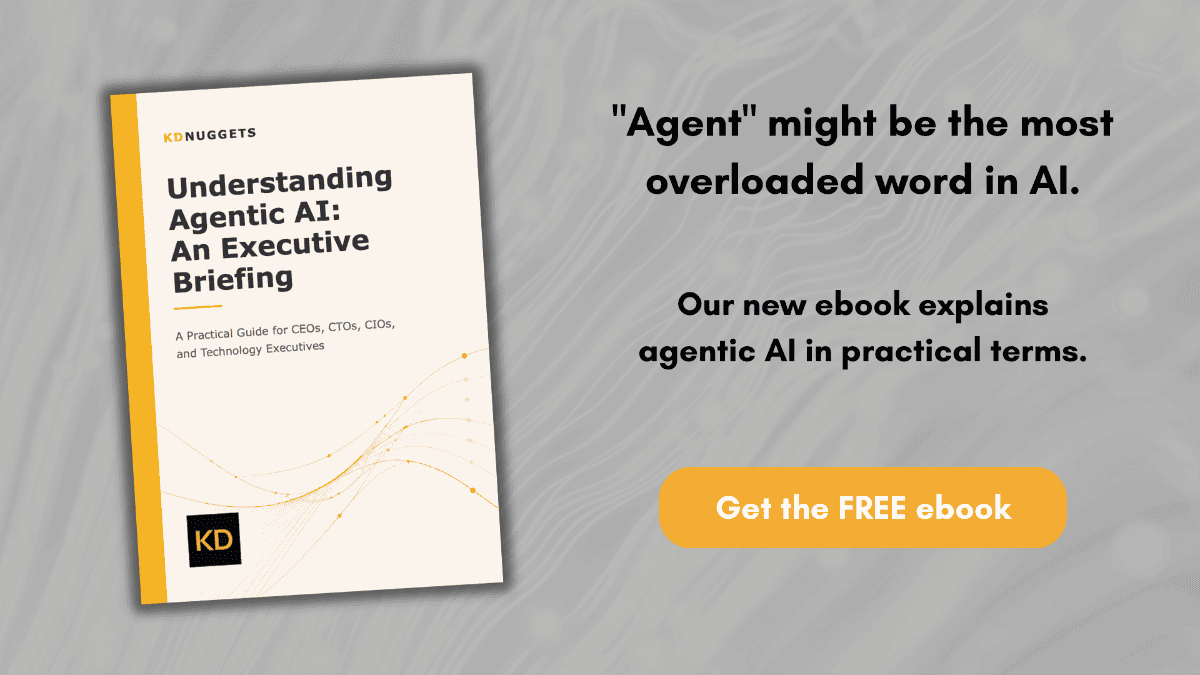
KDnuggets Launches Free eBook 'Understanding Agentic AI' Tailored for Executive Leadership
KDnuggets has announced the release of a new, complimentary eBook titled 'Understanding Agentic AI: An Executive Briefing.' This resource is specifically designed for high-level decision-makers, including CEOs, CTOs, CIOs, and other technology executives. The briefing aims to demystify the complex landscape of agentic AI by walking readers through the essential components required to build functional, real-world agentic systems. By focusing on the structural building blocks of these technologies, the eBook provides a strategic foundation for leaders tasked with navigating the integration of autonomous AI agents into their organizational frameworks.
Key Takeaways
- Targeted Executive Resource: The eBook is specifically authored for C-suite leaders, including CEOs, CTOs, and CIOs, focusing on strategic rather than purely technical oversight.
- Focus on Agentic Architecture: The briefing provides a detailed walkthrough of the fundamental components that constitute a real agentic AI system.
- Educational Accessibility: Released as a free resource by KDnuggets, aiming to broaden the understanding of autonomous AI systems across the technology sector.
- Strategic Decision Support: Designed to help technology executives understand the underlying mechanics of agentic AI to better inform corporate strategy.
In-Depth Analysis
Strategic Guidance for the C-Suite
The release of "Understanding Agentic AI: An Executive Briefing" addresses a critical gap in the current AI discourse: the need for high-level, actionable intelligence for corporate leaders. By explicitly targeting CEOs, CTOs, and CIOs, the publication recognizes that the implementation of agentic AI is not merely a technical challenge but a strategic one. For a CEO, the briefing offers a perspective on how autonomous agents might redefine business models. For CTOs and CIOs, it provides the necessary framework to evaluate the technical feasibility and the structural requirements of agentic systems within their existing technology stacks.
Deconstructing the Components of Agentic Systems
A primary focus of this executive briefing is the exploration of the components from which every real agentic system is built. Rather than treating AI as a "black box," the eBook breaks down the architecture into understandable segments. This component-based approach is vital for executives who must manage the lifecycle of AI deployment. By understanding the building blocks—ranging from the core logic to the interaction layers—technology leaders can better assess the maturity of agentic solutions and ensure that their organizations are investing in robust, scalable systems rather than experimental prototypes.
Bridging the Gap Between Theory and Implementation
The briefing serves as a bridge between the theoretical potential of agentic AI and the practical realities of system construction. For technology executives, the ability to distinguish between a standard AI model and a truly agentic system is crucial. The eBook's emphasis on "real agentic systems" suggests a focus on functional, deployed technology. This helps CIOs and CTOs set realistic expectations for what agentic AI can achieve and what infrastructure is required to support it, ensuring that the transition to more autonomous AI operations is grounded in technical reality.
Industry Impact
The introduction of this briefing by KDnuggets signifies a shift in the AI industry toward the professionalization and standardization of agentic AI knowledge. As organizations move beyond simple generative AI toward more complex, autonomous agents, the demand for executive-level education increases. By providing a clear breakdown of the components of agentic systems, this resource helps standardize the vocabulary and conceptual framework used by decision-makers. This, in turn, can lead to more informed procurement processes, better-aligned internal development goals, and a more structured approach to AI governance across the industry.
Frequently Asked Questions
Question: Who is the primary audience for the 'Understanding Agentic AI' eBook?
The eBook is specifically written for high-level technology executives and decision-makers, including CEOs, CTOs, CIOs, and other leaders responsible for organizational technology strategy.
Question: What is the main focus of the briefing?
The briefing focuses on explaining the essential components that make up a real agentic AI system, providing a structured overview of how these systems are built and how they function at an executive level.
Question: Is there a cost associated with this resource?
No, the eBook "Understanding Agentic AI: An Executive Briefing" is offered as a free resource by KDnuggets.


