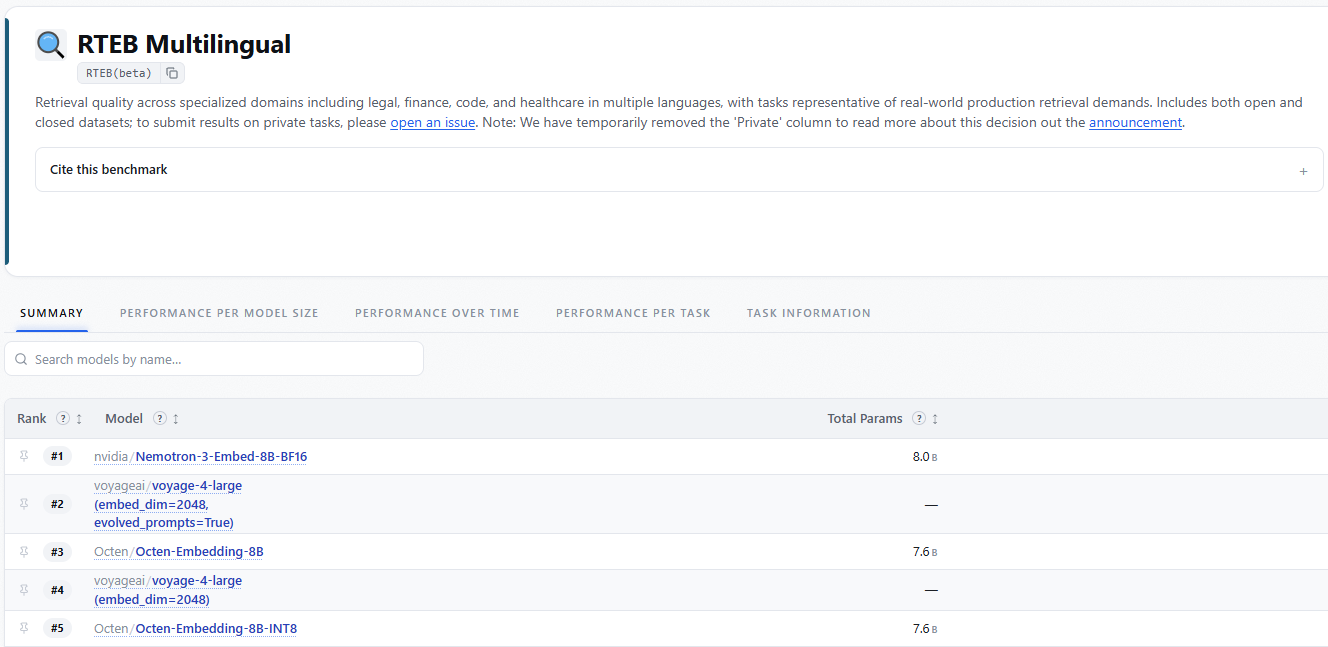
NVIDIA Nemotron 3 Embed Achieves Top Ranking on RTEB Benchmark to Advance Agentic Retrieval
NVIDIA's Nemotron 3 Embed model has secured the number one position on the RTEB (Retrieval-Task-Enhanced Benchmark), marking a significant milestone in the field of agentic retrieval. This achievement highlights the model's superior performance in processing and retrieving information for AI agents. The ranking underscores NVIDIA's continued leadership in developing high-performance embedding models that facilitate more efficient and accurate AI-driven search and retrieval tasks. By leading the RTEB rankings, NVIDIA demonstrates the efficacy of its latest embedding technology in enhancing the accuracy and speed of retrieval tasks, which are essential for the next generation of autonomous AI systems and Retrieval-Augmented Generation (RAG) applications.
Key Takeaways
- NVIDIA Nemotron 3 Embed has reached the #1 overall position on the RTEB benchmark.
- The model is specifically optimized for agentic retrieval tasks, enhancing AI autonomy.
- This achievement signifies a leap forward in how AI agents interact with and retrieve complex data.
- The RTEB benchmark serves as a critical metric for evaluating embedding models in task-oriented scenarios.
- NVIDIA's success reinforces its position as a leader in both AI hardware and specialized software models.
In-Depth Analysis
The Significance of the RTEB Benchmark
The achievement of the #1 ranking on the RTEB (Retrieval-Task-Enhanced Benchmark) by NVIDIA's Nemotron 3 Embed highlights a shift in the evaluation of AI models. Unlike traditional benchmarks that may focus on general language understanding or simple semantic similarity, RTEB emphasizes the practical application of retrieval in task-oriented environments. This benchmark is designed to test how well an embedding model can support the complex needs of modern AI workflows, particularly those involving multiple steps and specific goals. NVIDIA's success in this arena suggests that Nemotron 3 Embed is uniquely capable of handling the nuances required for high-precision data fetching, which is the backbone of any effective AI system.
Advancing Agentic Retrieval Capabilities
Agentic retrieval represents the next frontier in AI interaction. It refers to the ability of AI agents to autonomously determine what information is needed and how to retrieve it to complete a specific task. Unlike standard search, where a user provides a query and receives a list of results, agentic retrieval involves an AI model acting as an 'agent' that navigates through data to find the exact context required for its next action. Nemotron 3 Embed provides the foundational embedding technology that allows these agents to map queries to the most relevant data points with high fidelity. By ranking first on the RTEB, NVIDIA's model proves its robustness in supporting the complex decision-making processes inherent in agentic workflows, ensuring that agents have the most accurate information at their disposal.
Technical Excellence in Embedding Models
Embedding models are the unsung heroes of the AI world, converting text into numerical vectors that machines can understand and compare. The performance of Nemotron 3 Embed on the RTEB benchmark indicates a high level of technical refinement in how NVIDIA constructs these vector spaces. A top ranking suggests that the model has a superior ability to maintain semantic relationships even in large and diverse datasets. This is particularly important for enterprise applications where data can be fragmented and highly technical. By providing a model that ranks #1 overall, NVIDIA is offering a tool that can significantly reduce the 'noise' in data retrieval, leading to more reliable and contextually aware AI outputs.
Industry Impact
Setting a New Standard for RAG Systems
The rise of NVIDIA Nemotron 3 Embed to the top of the RTEB leaderboard has significant implications for the AI industry, particularly for Retrieval-Augmented Generation (RAG). RAG has become the standard for reducing hallucinations in Large Language Models (LLMs) by providing them with external context. However, the quality of the RAG system is entirely dependent on the quality of the retrieval. NVIDIA's achievement sets a new performance standard, likely prompting competitors to refine their retrieval-focused architectures. For developers, this means access to more reliable tools for building RAG systems, potentially ensuring that the most relevant context is always provided to the LLM, thereby increasing the overall trust in AI-generated content.
Empowering the Next Generation of AI Agents
As the industry moves toward more autonomous AI agents—systems that can plan, use tools, and execute tasks—the demand for high-performance retrieval will only grow. NVIDIA's focus on 'agentic retrieval' positions Nemotron 3 Embed as a critical component for developers building these advanced systems. This milestone reinforces NVIDIA's position not just as a hardware provider, but as a dominant force in the software and model architecture space. It signals to the market that NVIDIA is committed to solving the 'retrieval bottleneck' that currently limits the effectiveness of many autonomous AI applications.
Frequently Asked Questions
Question: What is the RTEB benchmark?
The RTEB (Retrieval-Task-Enhanced Benchmark) is a specialized evaluation framework designed to measure the performance of embedding models specifically in the context of retrieval tasks. It focuses on how well these models support AI agents in finding and utilizing information to complete specific, goal-oriented tasks.
Question: How does Nemotron 3 Embed improve AI performance?
Nemotron 3 Embed improves AI performance by providing more accurate vector representations of data. This allows AI systems to retrieve the most relevant information more quickly and precisely, which is essential for reducing errors in AI responses and enabling agents to perform complex, multi-step operations autonomously.
Question: Why is NVIDIA's ranking on RTEB important for developers?
For developers, this ranking serves as a validation of the model's effectiveness. It indicates that Nemotron 3 Embed is currently one of the best tools available for building high-quality retrieval systems, particularly for applications like RAG and autonomous AI agents where accuracy and contextual relevance are paramount.