Meituan LongCat Team Open-Sources WBench: A Systematic Multi-Round Evaluation Benchmark for Interactive Video World Models
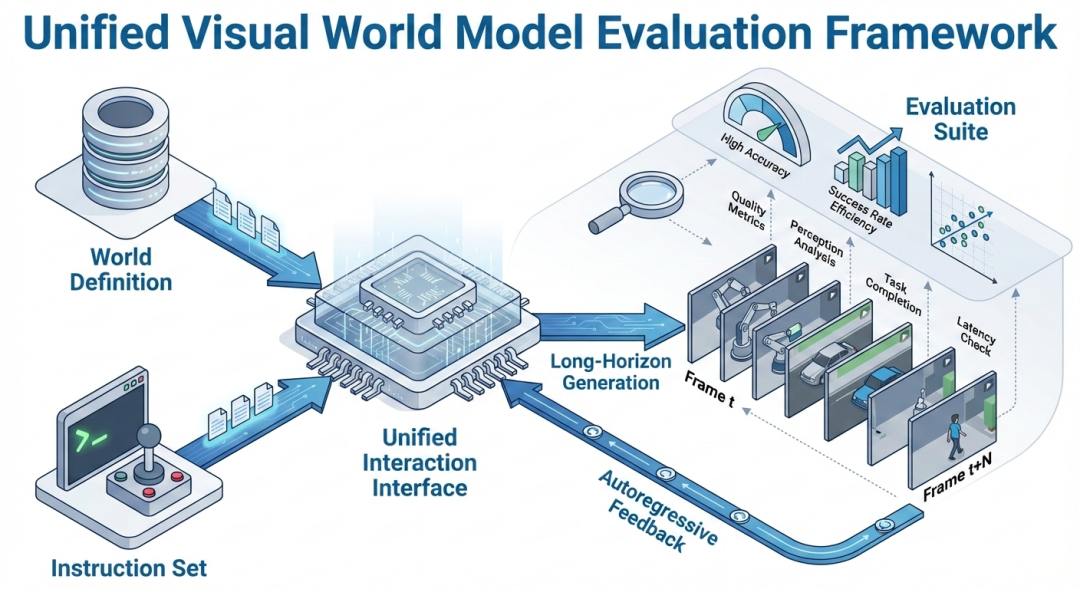
The Meituan LongCat technology team has announced the release and open-sourcing of WBench, the first systematic multi-round evaluation benchmark specifically designed for interactive video world models. As the industry shifts from passive video generation to active, interactive environments, WBench serves as a critical diagnostic tool—described by the team as a "CT scanner"—to identify exactly where current models struggle. By evaluating performance across diverse scenarios ranging from lunar walks to cybernetic cities, WBench aims to pinpoint the technical bottlenecks that prevent world models from achieving seamless interaction. This open-source initiative provides a structured framework for the AI community to measure and improve the interactive capabilities of next-generation world models, moving beyond simple observation to complex, multi-stage engagement.
Key Takeaways
- Pioneering Benchmark: WBench is the first systematic, multi-round evaluation framework dedicated to interactive video world models.
- Diagnostic Precision: The tool acts as a "CT scanner" for AI, identifying specific failure points in the transition from passive viewing to active interaction.
- Open-Source Contribution: Developed by Meituan's LongCat team, the benchmark is open-sourced to facilitate industry-wide progress in world model development.
- Focus on Interaction: Unlike traditional benchmarks that focus on static or single-turn video generation, WBench emphasizes multi-round, interactive capabilities.
In-Depth Analysis
From Passive Observation to Active Interaction
The evolution of video generation models has reached a critical juncture where "passive viewing" is no longer the ultimate goal. The Meituan LongCat team identifies a significant gap in the current landscape: the ability of world models to handle "active interaction." While existing models can generate visually stunning sequences, their ability to maintain consistency and logic across multiple rounds of interaction remains a challenge. WBench is designed to address this by providing a systematic way to test how these models respond to sequential inputs and environmental changes. By moving the focus to multi-round evaluation, the benchmark forces models to demonstrate a deeper understanding of cause-and-effect within their generated worlds, whether those worlds are realistic lunar landscapes or complex cybernetic urban environments.
The "CT Scanner" for World Model Bottlenecks
One of the most significant contributions of WBench is its role as a diagnostic instrument. The LongCat team describes the benchmark as a "CT scanner," a metaphor that highlights its ability to look beneath the surface of model outputs. In the development of world models, it is often difficult to determine why a model fails to maintain coherence during an interaction. WBench provides the structured data and evaluation metrics necessary to "pinpoint" these specific bottlenecks. By testing models across a variety of scenarios—from the low-gravity physics of a moonwalk to the dense, high-activity settings of a futuristic city—WBench reveals the limits of a model's spatial reasoning, temporal consistency, and interactive logic. This level of granular analysis is essential for researchers looking to move past the current limitations of generative AI.
Industry Impact
The introduction of WBench by Meituan's LongCat team marks a significant milestone for the AI research community. As world models become increasingly central to fields like autonomous driving, robotics, and immersive simulation, the need for standardized, rigorous evaluation becomes paramount. By open-sourcing WBench, Meituan is providing a common language for developers to assess "interactive" performance, which has historically been much harder to quantify than simple image or video quality. This benchmark is likely to accelerate the development of more robust world models by highlighting the specific areas where current architectures fall short, thereby guiding future research toward solving the most critical hurdles in AI interaction.
Frequently Asked Questions
Question: What makes WBench different from existing video generation benchmarks?
Unlike traditional benchmarks that evaluate a model's ability to generate a single, passive video clip based on a prompt, WBench focuses on multi-round interaction. It evaluates how a world model maintains consistency and responds to changes over several stages of interaction, simulating a more realistic and "active" environment.
Question: Who can benefit from using the WBench benchmark?
WBench is designed for AI researchers and developers working on world models, interactive simulations, and advanced generative AI. By using this open-source tool, teams can diagnose specific weaknesses in their models' interactive logic and temporal coherence, helping them refine their architectures for better performance in complex, multi-turn scenarios.