Meituan LongCat Team Launches WBench: The First Systematic Multi-Round Benchmark for Interactive Video World Models
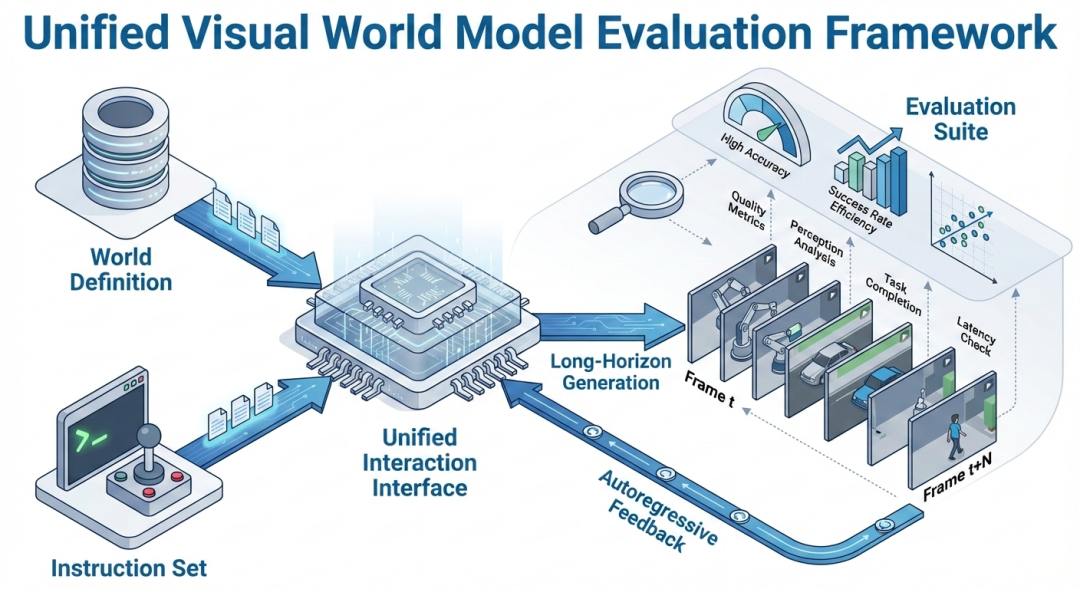
The Meituan LongCat team has officially introduced and open-sourced WBench, a groundbreaking evaluation framework designed to measure the capabilities of interactive video world models. As the first systematic multi-round benchmark in this field, WBench serves as a diagnostic tool—likened to a 'CT scanner'—to identify the specific limitations AI models encounter when transitioning from passive observation to active interaction. By focusing on the boundaries of how AI simulates and responds to dynamic environments, WBench provides a structured approach to understanding the current state of world models. This initiative marks a significant step in the evolution of AI evaluation, moving beyond simple video generation to assess how models handle complex, multi-stage interactive scenarios.
Key Takeaways
- Introduction of WBench: Meituan's LongCat team has developed and open-sourced WBench, the first systematic benchmark for interactive video world models.
- Multi-Round Evaluation: Unlike traditional benchmarks, WBench focuses on multi-round interactions, providing a more comprehensive assessment of AI performance over time.
- Diagnostic Capabilities: The tool is described as a 'CT scanner' for AI, capable of precisely locating technical bottlenecks in model development.
- Shift to Active Interaction: WBench is specifically designed to evaluate the transition of world models from 'passive viewing' to 'active interaction.'
- Open-Source Contribution: By open-sourcing the benchmark, the LongCat team provides the broader AI community with a tool to measure the boundaries of world model technology.
In-Depth Analysis
The Transition from Passive Viewing to Active Interaction
The development of WBench by the Meituan LongCat team addresses a critical juncture in the evolution of artificial intelligence: the shift from models that merely observe and generate content to those that can interact with a simulated environment. In the original report, this is described as the move from "passive viewing" to "active interaction."
Passive viewing refers to the traditional capability of video models to generate or interpret visual data without the need for responsive feedback. In contrast, active interaction requires a world model to understand the consequences of specific actions within a digital or simulated space. WBench is positioned as the primary tool to measure this transition. By establishing a systematic framework, it allows researchers to see where a model fails to maintain consistency or logic when it is required to do more than just 'watch.' The benchmark explores the boundaries of these models, testing how well they can simulate a 'world' that responds to inputs, which is a fundamental requirement for advanced AI applications in robotics, gaming, and autonomous systems.
WBench as a Diagnostic 'CT Scanner' for World Models
One of the most striking aspects of the LongCat team's announcement is the comparison of WBench to a 'CT scanner.' This metaphor highlights the benchmark's role as a high-precision diagnostic instrument rather than a simple leaderboard. In the context of AI development, a 'CT scanner' implies the ability to look beneath the surface of a model's output to identify internal structural weaknesses.
Specifically, WBench is designed to pinpoint exactly where a world model 'gets stuck' during the interactive process. Because it utilizes a multi-round evaluation system, it can track the degradation of logic or visual fidelity across multiple stages of interaction. This is a significant departure from single-turn evaluations, which might not capture the cumulative errors that occur in a dynamic, multi-step environment. By providing this level of granular feedback, WBench enables developers to identify whether a model's failure is due to a lack of temporal consistency, a misunderstanding of physical laws, or an inability to process complex interactive commands. This systematic approach is essential for pushing the boundaries of what world models can achieve, moving them closer to realistic and reliable simulations of the physical or digital world.
Industry Impact
The release of WBench has significant implications for the AI industry, particularly for teams working on generative video and world models. First, it establishes a new standard for evaluation. As the first systematic multi-round benchmark for interactive video, it fills a gap in the current research landscape where most evaluations are static or limited to single-action responses.
Second, the open-source nature of WBench encourages transparency and collaborative improvement across the industry. By providing a common 'measuring stick,' the LongCat team allows different organizations to compare their progress in a standardized way. This could accelerate the development of more sophisticated world models by highlighting universal challenges that the community needs to solve.
Finally, the focus on 'active interaction' signals a shift in industry priorities. As AI moves toward more agentic behavior—where models are expected to act and react—benchmarks like WBench will be crucial in ensuring these interactions are safe, logical, and technically sound. The ability to 'scan' a model for its interactive boundaries will likely become a standard part of the AI development lifecycle.
Frequently Asked Questions
Question: What is the primary purpose of WBench?
WBench is designed to be a systematic multi-round evaluation benchmark for interactive video world models. Its primary purpose is to measure the boundaries of these models and identify exactly where they struggle when moving from passive observation to active interaction within a simulated environment.
Question: Who developed WBench and is it available to the public?
WBench was developed by the Meituan LongCat team. According to the original announcement, the benchmark has been open-sourced, making it available for the broader technical community to use and integrate into their AI evaluation workflows.
Question: Why is the 'multi-round' aspect of WBench important?
The multi-round aspect is crucial because it simulates real-world interactions which are rarely single-step events. By evaluating a model over multiple rounds, WBench can detect how well a model maintains consistency and handles the complexities of ongoing interaction, providing a much deeper analysis than traditional, single-turn benchmarks.