Meituan Launches LongCat-2.0: A Trillion-Parameter Model Trained on 50,000-Card Domestic Computing Clusters
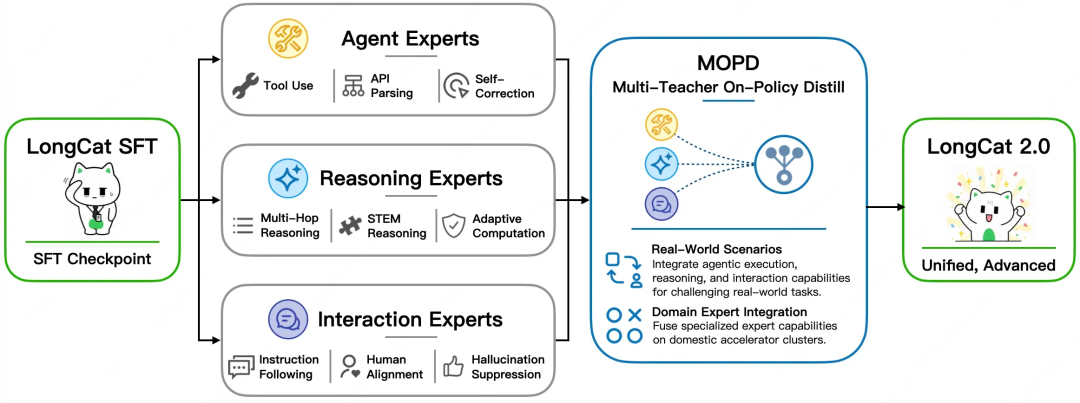
Meituan's technology team has officially announced the release of LongCat-2.0, a pioneering trillion-parameter model. This release marks a significant milestone as the industry's first model to complete its entire training and inference lifecycle on a domestic computing cluster consisting of 50,000 cards. LongCat-2.0 features a total of 1.6 trillion parameters with a dynamic activation range between 33B and 56B, averaging 48B. Built from scratch, the model natively supports an ultra-long context window of 1 million tokens. Its architecture is specifically designed to optimize Agentic Coding tasks, aiming to provide high efficiency and stability in code understanding, generation, and execution. This development highlights a major step forward for domestic hardware capabilities in supporting massive-scale artificial intelligence models.
Key Takeaways
- Massive Scale: LongCat-2.0 is a trillion-parameter model with a total of 1.6T parameters, utilizing a dynamic activation mechanism (33B to 56B parameters) to balance performance and efficiency.
- Domestic Infrastructure Milestone: It is the first model of its scale to complete full-process training and inference on a domestic computing cluster featuring 50,000 cards.
- Ultra-Long Context: The model natively supports a 1M (one million) token context window, allowing for the processing of massive codebases and complex documents.
- Specialized for Coding: The architecture is purpose-built for Agentic Coding, focusing on the stability and efficiency of code understanding, generation, and execution.
In-Depth Analysis
Breakthrough in Domestic Computing Clusters
The release of LongCat-2.0 by the Meituan technology team represents a landmark achievement for the domestic AI industry. By successfully training and running inference for a 1.6-trillion-parameter model on a 50,000-card domestic computing cluster, Meituan has demonstrated that large-scale AI development is increasingly viable on localized hardware infrastructure. This feat covers the entire lifecycle of the model, from initial pre-training from scratch to final inference. The ability to manage a cluster of this magnitude—50,000 cards—indicates significant advancements in distributed training stability, interconnect efficiency, and software-hardware co-optimization within the domestic ecosystem. This transition reduces reliance on external hardware providers and proves that trillion-parameter scales are achievable through domestic technological integration.
Architectural Innovation for Agentic Coding
LongCat-2.0 is not just defined by its size but by its specialized architectural goals. With a total parameter count of 1.6T and an average activation of approximately 48B, the model employs a dynamic range of 33B to 56B. This suggests a sophisticated Mixture-of-Experts (MoE) or a similar conditional computation approach that allows the model to remain efficient despite its massive total capacity. A core differentiator is its native support for a 1M ultra-long context window. In the realm of Agentic Coding, this capability is critical. It allows the model to "see" and understand entire repositories of code simultaneously, rather than processing fragmented snippets. By focusing on the stability of code generation and execution, Meituan aims to move beyond simple code completion toward a more autonomous "agentic" model that can manage complex, multi-step programming tasks with high reliability.
Optimization for Real-World Execution
The design philosophy behind LongCat-2.0 centers on the practical requirements of modern software development. The Meituan team has prioritized the model's ability to perform in "Agentic Coding" scenarios, where the AI acts as an agent capable of not only writing code but understanding the broader context of its execution. The 1M context support ensures that the model can maintain coherence across long-range dependencies in software architecture. Furthermore, the emphasis on "efficiency and stability" suggests that the model has been tuned to minimize errors during the generation-to-execution pipeline, a common hurdle for large language models in technical domains. By pre-training from scratch with these goals in mind, LongCat-2.0 is positioned as a specialized tool for high-end engineering tasks.
Industry Impact
The introduction of LongCat-2.0 has profound implications for the AI industry, particularly in the sectors of hardware sovereignty and specialized LLM applications. First, it serves as a proof-of-concept for the scalability of domestic computing power, showing that trillion-parameter models are no longer the exclusive domain of global hardware giants. This could accelerate the adoption of domestic chips in other high-performance computing sectors. Second, by focusing specifically on Agentic Coding and ultra-long context, Meituan is pushing the industry toward more functional, task-oriented AI. As models move from general-purpose assistants to specialized agents capable of handling 1M tokens of context, the potential for automating complex software engineering workflows increases significantly. This release sets a new benchmark for what is expected from coding-centric large language models in terms of both scale and specialized capability.
Frequently Asked Questions
Question: What are the specific parameter details of LongCat-2.0?
LongCat-2.0 features a total of 1.6 trillion (1.6T) parameters. During operation, it uses a dynamic activation strategy where the active parameters range from 33B to 56B, with an average activation of approximately 48B parameters.
Question: What makes LongCat-2.0 unique compared to other coding models?
LongCat-2.0 is unique because it was trained from scratch on a 50,000-card domestic computing cluster and natively supports an ultra-long context window of 1 million tokens. It is specifically optimized for "Agentic Coding," focusing on the stability of code understanding and execution in real-world tasks.
Question: What hardware was used to train LongCat-2.0?
The model was trained and tested for inference on a domestic computing cluster consisting of 50,000 cards, marking the first time a trillion-parameter model has completed the full process on such an infrastructure.