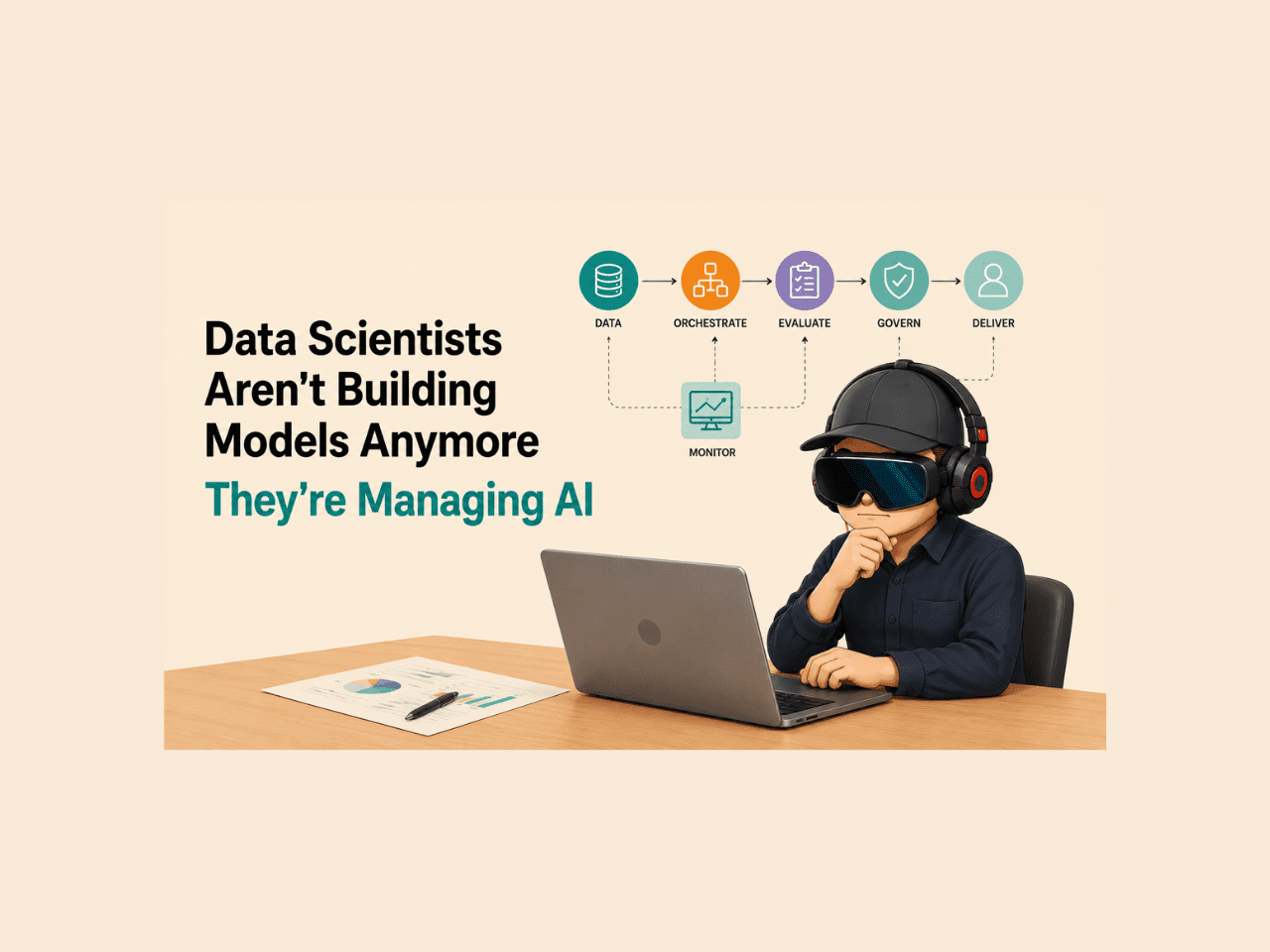
Data Scientists Are Becoming AI Managers, Not Model Builders: A Strategic Shift in Professional Roles
The data science profession is undergoing a fundamental transformation, shifting its primary focus from the construction of models to their ongoing management. According to insights from KDnuggets, the role of the data scientist is evolving to meet the demands of a maturing industry where the oversight of AI systems is becoming more critical than their initial development. This transition signifies a move away from the 'builder' archetype—characterized by manual algorithm selection and feature engineering—toward an 'AI Manager' role that prioritizes the lifecycle, performance, and strategic alignment of existing models. This shift reflects broader changes in how organizations deploy and maintain artificial intelligence, emphasizing long-term stability and operational oversight over the creation of new architectures.
Key Takeaways
- The primary responsibility of data scientists is transitioning from building models to managing them.
- The industry is moving away from a focus on the initial construction phase of AI development.
- Professional value is increasingly found in the oversight and maintenance of AI systems rather than manual model creation.
- This shift suggests a maturation of the AI field, prioritizing operational stability and long-term management.
In-Depth Analysis
The Transition from Construction to Management
The core evolution within the data science field, as identified by Nate Rosidi, marks a significant pivot in the professional landscape. For years, the hallmark of a data scientist was the ability to build complex models from the ground up. This involved a heavy emphasis on the 'builder' aspect: selecting specific algorithms, performing intricate feature engineering, and manually tuning hyperparameters to achieve optimal results. However, the current trend indicates that this 'building' phase is no longer the central pillar of the role. Instead, the focus has moved toward "managing them."
This shift implies that the technical barriers to model creation may be lowering, or that the industry has reached a point where the management of existing assets is more valuable than the creation of new ones. As an AI Manager, the data scientist is less concerned with the 'how' of initial construction and more focused on the 'how' of sustained performance. This involves a transition from a project-based mindset—where the goal is a finished model—to a process-based mindset, where the goal is the continuous health and accuracy of the AI system within a production environment.
The New Managerial Paradigm in Data Science
Becoming an "AI Manager" rather than a "Model Builder" requires a different set of priorities and skills. While building is often a solitary or highly technical task, management is inherently strategic and operational. The management of models encompasses the entire lifecycle of the AI, including its deployment, the monitoring of its outputs, and the adjustment of its parameters to account for changing data environments.
In this new paradigm, the data scientist acts as a steward of the model's integrity. The shift suggests that the industry is placing a higher premium on professionals who can ensure that AI systems remain reliable, ethical, and aligned with organizational goals over time. The role now demands a focus on governance and optimization. Rather than starting with a blank slate to create a new model, the modern data scientist is tasked with overseeing a suite of models, ensuring they function correctly as part of a larger business ecosystem. This change highlights a move toward the operationalization of AI, where the maintenance of the system is the primary driver of value.
Industry Impact
The shift from building to managing models has profound implications for the AI industry at large. Firstly, it suggests a change in the demand for specific skill sets. Educational programs and professional development may need to pivot from teaching pure model architecture to focusing on model operations (MLOps), governance, and strategic management. Organizations may begin to look for candidates who demonstrate an ability to oversee complex systems rather than those who only possess deep technical knowledge of algorithm construction.
Furthermore, this transition indicates a maturation of the AI market. As pre-built models and automated tools become more sophisticated, the need for manual construction diminishes, allowing human experts to focus on high-level oversight. This could lead to more stable and reliable AI deployments across various sectors, as the emphasis shifts toward long-term performance and risk management. The rise of the "AI Manager" marks the beginning of an era where the sustainability of artificial intelligence is prioritized over its novelty.
Frequently Asked Questions
Question: What does it mean for a data scientist to be an "AI Manager"?
It means the role is shifting from the manual construction and tuning of models to the ongoing oversight, maintenance, and strategic management of those models within a production environment.
Question: Why is the focus moving away from building models?
The shift suggests that the industry is maturing, with a greater emphasis being placed on the long-term performance, reliability, and operational stability of AI systems rather than just their initial creation.
Question: Does this change the skills required for data scientists?
Yes, the shift implies that skills in model operations, governance, and lifecycle management are becoming increasingly important compared to the traditional focus on manual algorithm development and model building.