Meituan Releases LongCat-Next: A Native Multimodal Model Designed to Perceive and Interact with the Physical World
Meituan's technical team has officially announced the release and open-sourcing of LongCat-Next, a native multimodal model that represents a major step toward physical-world AI. By integrating vision and speech as native modalities—essentially the AI's "mother tongue"—LongCat-Next is designed to bridge the gap between digital processing and real-world interaction. Alongside the model, Meituan has open-sourced its discrete tokenizer, providing the developer community with the core tools needed to build systems that can perceive, understand, and act within the physical environment. This initiative underscores Meituan's commitment to advancing AI capabilities beyond text-based interfaces, focusing on the practical application of intelligence in complex, real-world scenarios through an open-source research philosophy.
Key Takeaways
- Native Multimodal Integration: LongCat-Next treats vision and speech as primary, native languages for AI, rather than secondary additions.
- Open Source Commitment: Meituan has open-sourced both the LongCat-Next model and its specialized discrete tokenizer to the global developer community.
- Physical World Focus: The model is specifically designed to explore the path toward AI that can perceive and interact with the physical world.
- Empowering Developers: The release aims to provide a foundation for building AI systems capable of understanding and acting upon real-world environments.
In-Depth Analysis
The Vision of Native Multimodality in Physical AI
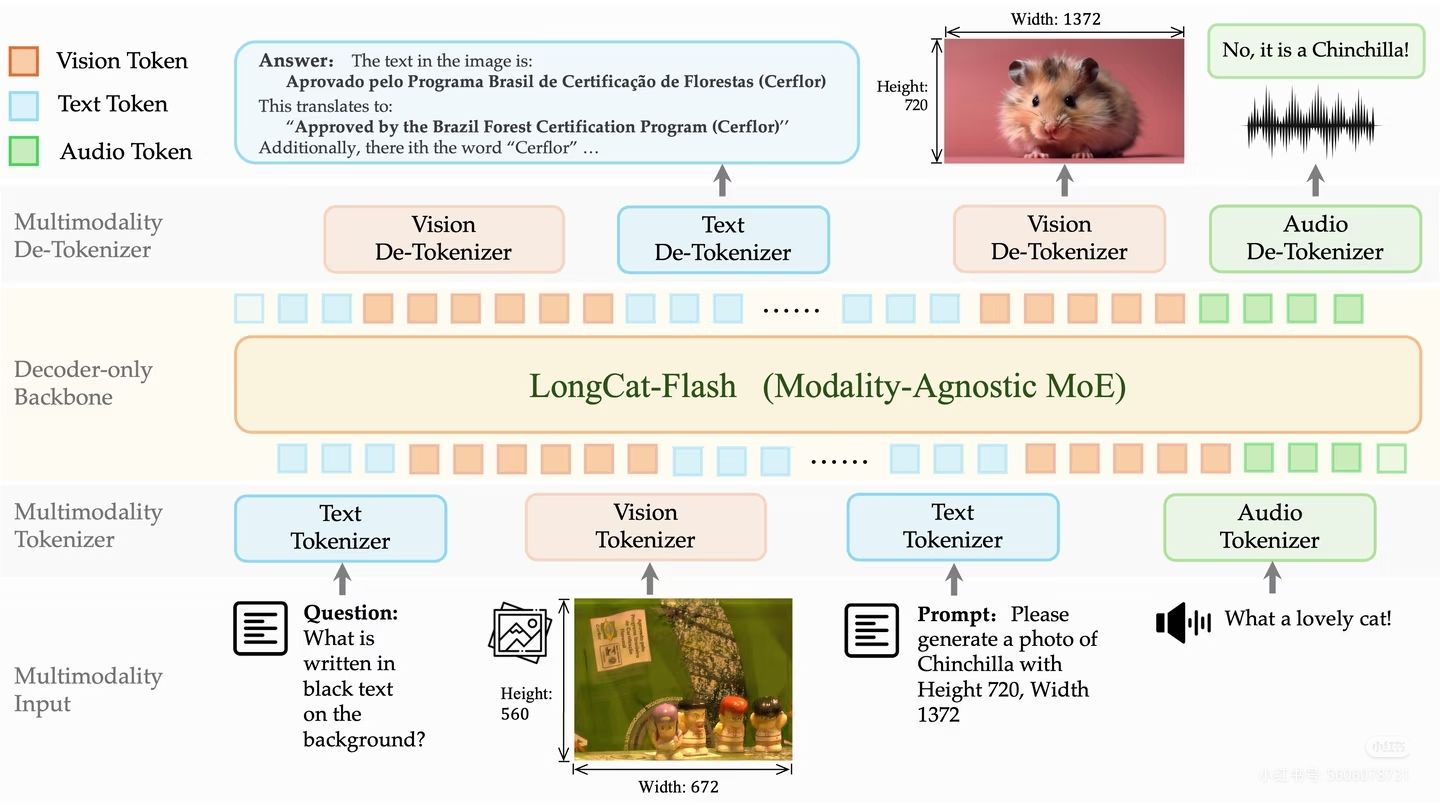
Meituan's introduction of LongCat-Next signifies a strategic shift toward "native multimodality." In the context of this release, vision and speech are not merely treated as external data types to be converted into text; instead, they are positioned as the AI's "mother tongue." This approach is central to Meituan's exploration of AI in the physical world. By developing a model that processes visual and auditory information natively, the goal is to create a more seamless and intuitive understanding of the environment. This is a critical requirement for AI systems that are intended to operate outside of purely digital or text-based realms, where the ability to perceive nuances in the physical surroundings is paramount.
According to the Meituan technical team, LongCat-Next is an exploration into how AI can truly inhabit and function within the real world. The emphasis on "perceiving, understanding, and acting" suggests a model architecture that is not just passive but is designed for interaction. This move reflects a broader trend in the industry where the focus is moving from Large Language Models (LLMs) toward Large Multimodal Models (LMMs) that can serve as the "brain" for robotics or other physical-world applications.
Open Sourcing the Core Research Infrastructure
One of the most significant aspects of this announcement is the decision to open-source the core components of the research. Meituan has released both the LongCat-Next model and its discrete tokenizer. The tokenizer is a vital component in multimodal systems, as it is responsible for converting complex visual and speech signals into a format that the model can process. By making these tools available, Meituan is lowering the barrier to entry for other developers and researchers who are looking to build sophisticated, real-world AI applications.
This open-source strategy is intended to foster a collaborative ecosystem. The Meituan technical team expressed their hope that by sharing their research ideas and core tools, more developers will be able to build upon this foundation. This collaborative approach is essential for solving the complex challenges associated with physical-world AI, which requires high levels of reliability, real-time processing, and environmental awareness. The release of the discrete tokenizer, in particular, provides a technical window into how Meituan handles the discretization of continuous signals like speech and video, which is a key technical hurdle in native multimodal development.
Industry Impact
The release of LongCat-Next has several implications for the AI industry, particularly in the field of multimodal research and physical-world applications. First, it highlights the growing importance of "native" multimodality. As AI moves closer to integration with hardware and robotics, the ability to process vision and speech without heavy reliance on text-based intermediaries becomes a competitive advantage. Meituan’s focus on these modalities as "mother tongues" sets a benchmark for how future models might be structured to handle real-world data.
Second, the open-sourcing of these tools by a major industry player like Meituan accelerates the democratization of advanced multimodal AI. By providing the model and the tokenizer, Meituan is enabling smaller teams and independent researchers to experiment with physical-world AI concepts that were previously restricted to large organizations with massive computational and research resources. This could lead to a surge in innovation for applications in logistics, autonomous delivery, and environmental monitoring, where Meituan itself has significant operational interests.
Frequently Asked Questions
Question: What is LongCat-Next?
LongCat-Next is a native multimodal model developed and open-sourced by Meituan. It is designed to treat vision and speech as primary inputs to help AI better perceive, understand, and interact with the physical world.
Question: What specific components did Meituan open-source?
Meituan has open-sourced the LongCat-Next model itself along with its core discrete tokenizer, which is used to process multimodal data.
Question: What is the primary goal of the LongCat-Next project?
The primary goal is to explore the path toward physical-world AI, providing a foundation for developers to create systems that can function effectively in real-world environments rather than just digital ones.