Meituan Open Sources LongCat-Next: A Native Multimodal Model Integrating Vision and Voice for Physical World AI
Meituan's technical team has officially announced the release and open-sourcing of LongCat-Next, a groundbreaking native multimodal model. Designed to treat vision and voice as fundamental "native languages," LongCat-Next represents a strategic shift toward AI that can seamlessly perceive and interact with the physical world. Alongside the model, Meituan has released its discrete tokenizer to the global developer community. This initiative aims to provide the necessary tools for creators to build AI systems capable of understanding and acting within real-world environments. By open-sourcing these core components, Meituan seeks to foster a collaborative ecosystem focused on the next generation of embodied AI and multimodal integration, moving beyond traditional text-centric models to a more holistic sensory approach.
Key Takeaways
- Native Multimodality: LongCat-Next integrates vision and voice as core, native components rather than secondary plugins, allowing for more fluid cross-modal understanding.
- Open Source Commitment: Meituan has released both the LongCat-Next model and its specialized discrete tokenizer to the public, encouraging community-driven innovation.
- Physical World Focus: The model is specifically designed to bridge the gap between digital intelligence and physical world perception, understanding, and action.
- Developer Empowerment: By providing the core research architecture, Meituan aims to enable developers to build applications that can interact with the real world more effectively.
In-Depth Analysis
The Evolution of Native Multimodality
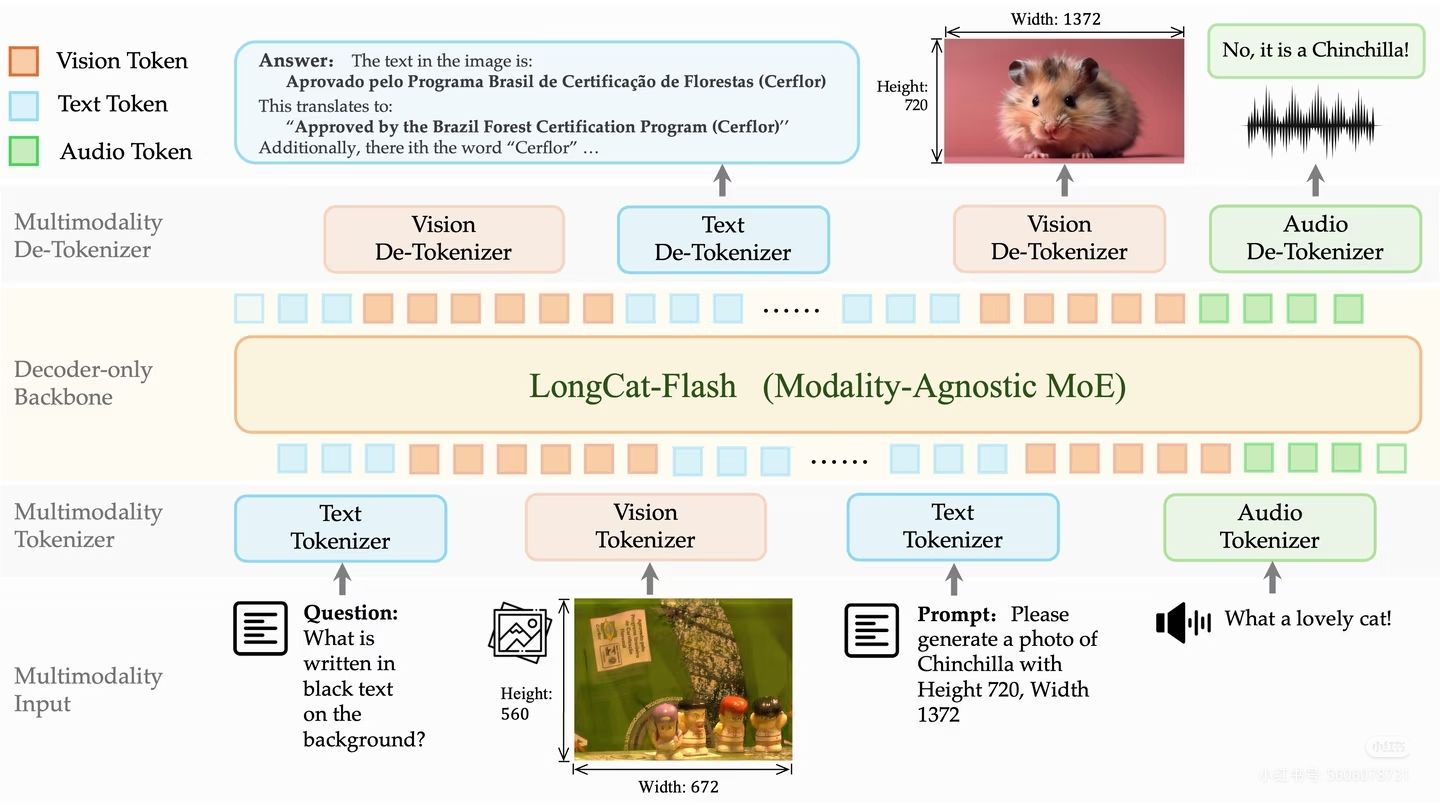
The release of LongCat-Next marks a significant milestone in the evolution of multimodal artificial intelligence. Traditionally, many AI systems have treated non-text inputs—such as images and audio—as peripheral data that must be translated or adapted into a format the primary language model can understand. Meituan’s approach with LongCat-Next challenges this paradigm by establishing vision and voice as "native languages" of the model.
This native integration implies that the model's architecture is designed from the ground up to process visual and auditory signals with the same level of depth and nuance as text. By doing so, LongCat-Next can potentially avoid the information loss that often occurs during the translation between different modalities. This structural choice is essential for tasks that require high-fidelity perception, such as navigating complex physical environments or interpreting subtle vocal cues in human-robot interaction. The focus on "native" capabilities suggests a more unified representation space where different senses inform and enhance one another directly.
Open Sourcing the Discrete Tokenizer
A critical component of the LongCat-Next announcement is the open-sourcing of its discrete tokenizer. In the context of multimodal AI, a tokenizer is responsible for breaking down continuous data—like a stream of audio or a high-resolution image—into discrete units that the neural network can process. The efficiency and accuracy of this tokenizer are often the bottleneck for multimodal performance.
By sharing this technology, Meituan is providing the developer community with a foundational tool that is often kept proprietary by large tech firms. This move allows researchers to examine how Meituan handles the complex task of discretizing visual and auditory information, potentially setting a new standard for how multimodal data is prepared for large-scale models. For developers, this lowers the barrier to entry for creating sophisticated AI that can "see" and "hear" with the same proficiency as current models "read."
Toward AI in the Physical World
Meituan describes LongCat-Next as an exploration into "AI for the physical world." This vision moves beyond the confines of chatbots and digital assistants, aiming instead for embodied AI—intelligence that can perceive, understand, and act within a three-dimensional space. The ability to act is the final and most challenging piece of this puzzle.
For AI to function effectively in the physical world—whether in logistics, delivery, or robotics—it must possess a real-time understanding of its surroundings. LongCat-Next’s emphasis on vision and voice suggests a model that is being prepared for environments where text is secondary to sensory input. By open-sourcing the model, Meituan is inviting the global community to test these capabilities in diverse real-world scenarios, accelerating the transition from theoretical AI to practical, physical-world applications.
Industry Impact
The introduction of LongCat-Next has several profound implications for the AI industry. First, it accelerates the trend toward open-source multimodal foundations. As more companies release high-quality multimodal models, the industry moves away from a text-only focus, pushing the boundaries of what "General Intelligence" actually means.
Second, Meituan’s focus on the physical world aligns with the growing interest in embodied AI. By providing a model that treats vision and voice as native, Meituan is positioning itself as a key contributor to the infrastructure required for advanced robotics and automated systems. This could lead to a surge in specialized applications in sectors like autonomous delivery, smart manufacturing, and interactive service robots, where sensory perception is paramount.
Finally, the release of the discrete tokenizer may influence how other organizations approach the technical challenges of multimodal data processing. If the community adopts Meituan’s standards, it could lead to greater interoperability between different AI systems and tools, further maturing the ecosystem for multimodal development.
Frequently Asked Questions
Question: What makes LongCat-Next different from traditional multimodal models?
Unlike models that use external encoders to translate vision or voice into a format for a language model, LongCat-Next is designed with these modalities as "native languages." This means the model is built to process and understand visual and auditory information directly within its core architecture, potentially leading to more accurate and integrated perception.
Question: Why did Meituan choose to open-source the discrete tokenizer?
The discrete tokenizer is a vital tool for converting complex sensory data into a format the AI can process. By open-sourcing it, Meituan enables developers to build upon their specific methodology for handling vision and voice, fostering innovation and allowing the community to create AI that can better interact with the real world.
Question: What are the primary intended applications for LongCat-Next?
LongCat-Next is intended for "Physical World AI." This includes any application where an AI needs to perceive, understand, and act in a real-world environment. Examples could include robotics, autonomous systems, and advanced sensory-based interfaces that require a deep understanding of visual and auditory context.