Meituan LongCat Team Unveils LongCat-AudioDiT: Advancing Zero-Shot TTS Voice Cloning via Waveform Latent Space
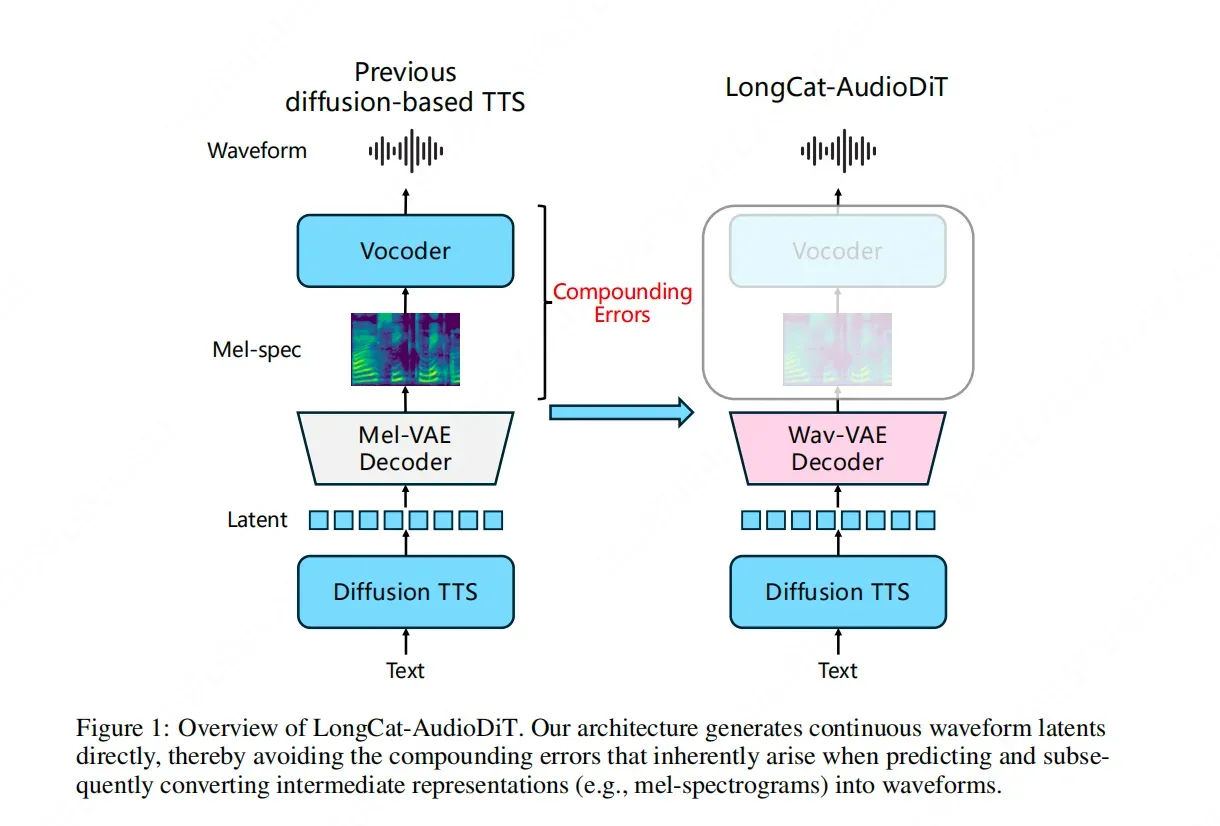
The Meituan LongCat team has officially released LongCat-AudioDiT, a specialized model designed to push the boundaries of zero-shot Text-to-Speech (TTS) voice cloning. By fundamentally redesigning the audio generation pipeline, the model abandons traditional intermediate representations like Mel-spectrograms. Instead, it utilizes a diffusion-based approach operating directly within the waveform latent space. This strategic shift is intended to eliminate cascade errors that typically arise during multi-stage data conversion processes. By allowing the AI to learn the inherent patterns of sound directly from the source, LongCat-AudioDiT aims to overcome existing technical bottlenecks in voice synthesis, providing a more streamlined and high-fidelity solution for cloning voices without the need for extensive training on specific target speakers.
Key Takeaways
- Innovative Architecture: LongCat-AudioDiT moves away from traditional TTS pipelines by completely discarding intermediate representations such as Mel-spectrograms.
- Direct Waveform Processing: The model operates within the waveform latent space, utilizing diffusion models to synthesize speech directly.
- Error Reduction: By bypassing intermediate steps, the system effectively blocks cascade errors that often degrade audio quality during data conversion.
- Zero-Shot Breakthrough: The technology is specifically designed to enhance the 'upper limit' of zero-shot voice cloning, allowing for more accurate mimicry of voices with minimal data.
- Technical Origin: Developed by the Meituan LongCat team to address long-standing bottlenecks in the field of audio generation.
In-Depth Analysis
Moving Beyond Mel-Spectrograms
For years, the standard approach to Text-to-Speech (TTS) has relied on a two-stage process: first converting text into an intermediate visual representation of sound known as a Mel-spectrogram, and then using a vocoder to turn that spectrogram back into audible waveforms. While effective, this process introduces a significant technical hurdle. The Meituan LongCat team identified that these intermediate stages act as a bottleneck, often losing nuanced acoustic information during the transformation.
LongCat-AudioDiT represents a paradigm shift by "skipping the middleman." By abandoning Mel-spectrograms, the model attempts to let the AI learn the laws of sound itself. This direct approach ensures that the unique characteristics of a voice—the subtle textures and timbres that define a person's speech—are preserved more effectively. The removal of these intermediate layers simplifies the architecture and focuses the model's learning capacity on the raw essence of the audio signal.
Solving Cascade Errors via Waveform Latent Space
A primary challenge in traditional audio synthesis is the accumulation of "cascade errors." When data is converted from text to a spectrogram and then to a waveform, small inaccuracies at each stage can compound, leading to a final output that sounds robotic or distorted. LongCat-AudioDiT addresses this by operating directly in the waveform latent space using a diffusion-based model.
Diffusion models have shown immense promise in image generation, and the LongCat team has applied this logic to audio. By working in the latent space of the waveform, the model can generate high-fidelity sound while maintaining the structural integrity of the audio. This method "blocks the cascade error at the source," as the model does not have to reconcile discrepancies between different data formats. The result is a more robust system for zero-shot voice cloning, where the AI can replicate a voice it has never encountered before with higher precision and fewer artifacts.
Industry Impact
The release of LongCat-AudioDiT by Meituan marks a significant milestone in the evolution of generative AI for audio. By challenging the necessity of Mel-spectrograms, this research opens new doors for how high-fidelity speech can be synthesized. For the AI industry, this suggests a move toward more integrated, end-to-end models that reduce the complexity of the audio production pipeline.
Furthermore, the focus on zero-shot voice cloning has profound implications for personalized AI assistants, content creation, and accessibility tools. If the "upper limit" of cloning quality can be pushed higher without requiring massive amounts of data from a specific speaker, the barrier to creating realistic digital voices will drop significantly. This technology positions Meituan at the forefront of audio research, demonstrating how fundamental changes in model architecture can solve persistent engineering challenges like data conversion errors.
Frequently Asked Questions
Question: What makes LongCat-AudioDiT different from traditional TTS models?
Traditional TTS models usually convert text into a Mel-spectrogram before generating sound. LongCat-AudioDiT discards this intermediate step and generates speech directly in the waveform latent space using a diffusion model to avoid data loss and errors.
Question: What are "cascade errors" in the context of voice cloning?
Cascade errors occur when inaccuracies from one stage of a process (like generating a spectrogram) are passed on and amplified in the next stage (like turning that spectrogram into sound). LongCat-AudioDiT eliminates these by using a more direct, single-path generation method.
Question: Why is "zero-shot" cloning important?
Zero-shot cloning allows an AI to mimic a person's voice using only a very short sample of their speech, without needing to be specifically trained on that person's voice for hours. LongCat-AudioDiT aims to make this process more accurate and lifelike.