
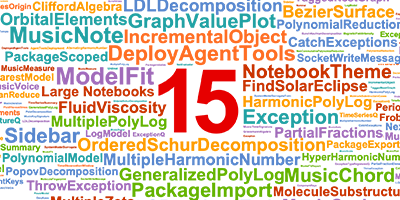
Wolfram Language and Mathematica Version 15: A New Era of AI Integration and Symbolic Computation
Wolfram Research has officially launched Version 15 of the Wolfram Language and Mathematica, introducing a transformative suite of features led by built-in AI assistants and symbolic music capabilities. This major release focuses on 'useful AI' integration, placing an AI assistant in every notebook and allowing seamless interaction between the Wolfram environment and external AI ecosystems. Beyond AI, the update delivers significant core functionality, including the new ModelFit superfunction, expanded categorical data computation, and massive improvements to time series analysis. Technical depth is further enhanced with new support for Grassmann and Clifford algebras, curvilinear PDEs, and reinforcement learning for control systems. With UI upgrades like notebook sidebars and real-time search, Version 15 represents a comprehensive evolution for scientists, engineers, and data researchers.
Key Takeaways
- Integrated AI Assistants: Version 15 introduces a built-in AI assistant in every notebook, facilitating a more interactive and guided computational experience.
- Symbolic Music and Advanced Modeling: The release debuts 'Symbolic Music' as a core feature and introduces the ModelFit superfunction for streamlined data modeling.
- Expanded Mathematical Frameworks: New support for Grassmann, Clifford, and Weyl algebras, alongside multivariate Zetas and Polylogs, strengthens the platform's physics and math capabilities.
- Enhanced Data and Engineering Tools: Significant updates to Time Series, Categorical Data, and Reinforcement Learning for control systems, plus GPU optimization via CUDA kernels.
- Modernized User Interface: Notebooks now support sidebars, visual themes, and gigabyte-sized files with real-time search functionality.
In-Depth Analysis
The Integration of 'Useful AI' and User Experience
The headline feature of Wolfram Language and Mathematica Version 15 is the deep integration of artificial intelligence. Rather than treating AI as an external add-on, this version embeds an AI assistant directly into every notebook environment. This allows users to leverage the power of the Wolfram Language from within their preferred AI environments and vice versa. The release emphasizes 'useful AI,' focusing on practical applications such as the Wolfram Foundation Tool in LLM functions and AI-assisted methods for solving complex DSolve problems.
User experience has also seen a significant overhaul. For the first time, notebooks feature sidebars, providing a more structured way to navigate large-scale projects. The platform now supports gigabyte-sized notebooks with real-time 'Find' capabilities, ensuring that performance remains fluid even when handling massive datasets. Visual themes have been introduced to allow for personalized workspace aesthetics, including a 'Going Dark in the Light' mode for improved visual comfort. These UI updates are complemented by the 'Monitor' function's new one-argument form and the ability to hold subvalues, offering developers more granular control over computation visibility.
Advancements in Symbolic Representation and Data Science
Version 15 introduces 'Symbolic Music,' a major addition that brings the platform's symbolic power to the realm of auditory composition and analysis. This is paired with the 'ModelFit' superfunction, designed to simplify and automate the process of fitting complex models to data. Data handling capabilities have been expanded to include categorical data computation and a 'Big' update to Time Series and Event Series, allowing for more robust analysis of temporal data.
Tabular data visualization and connectivity have also been prioritized. The release includes richer connectivity for tabular data, multipanel visualization tuneups, and the ability to handle larger datasets more efficiently. For developers working on large codebases, Version 15 introduces a structured package format and improved exceptions and error handling, making the language more resilient and scalable for enterprise-level applications. The introduction of ready-to-use incremental data structures further optimizes how data is managed during iterative computations.
Scientific, Engineering, and Mathematical Breakthroughs
In the realm of pure and applied mathematics, Version 15 is a powerhouse. It introduces support for Grassmann, Clifford, and Weyl algebras, which are essential for advanced physics and geometry. The platform's handling of multivariate Zetas, Polylogs, and Harmonic numbers has been expanded, and partial fraction decomposition has been streamlined. For differential equations, DSolve now benefits from AI-assisted methods, and PDEs have been updated to support curvilinear coordinates and derived quantities in solutions.
Engineering and physical sciences see major updates with the introduction of reinforcement learning for control systems and tools for approximating systems engineering models. The release also includes specialized features for geospatial and astronomical calculations, such as plotting over graphs, placing ticks on maps of the Earth, and predicting solar eclipses or orbital trajectories. To support these intensive computations, Wolfram has continued its 'GPUification' efforts, allowing CUDA kernels to be used as external functions and providing GPU access through Wolfram Compute Services. This ensures that the platform can handle the latest high-performance computing requirements, including real-time connections via Web Sockets and enhanced UX for integrating Python within notebooks.
Industry Impact
The release of Version 15 signifies a major shift in how symbolic computation platforms interact with the burgeoning AI industry. By embedding AI assistants and providing tools to bridge the gap between Large Language Models (LLMs) and structured symbolic logic, Wolfram Research is positioning itself as a critical layer in the AI stack. The ability to verify AI-generated code or use AI to solve complex symbolic equations addresses one of the primary weaknesses of current LLMs: their lack of precise mathematical reasoning.
Furthermore, the introduction of symbolic music and advanced physics frameworks like Clifford algebras ensures that Mathematica remains the gold standard for specialized scientific research. The focus on 'Big' data structures and GPU optimization also indicates a move toward competing more directly with high-performance data science environments, offering a unique blend of symbolic flexibility and raw computational power. This release sets a high bar for integrated development environments (IDEs) in the scientific community, emphasizing that the future of research lies in the synergy between human intuition, symbolic logic, and artificial intelligence.
Frequently Asked Questions
Question: What are the primary AI features introduced in Version 15?
Version 15 introduces a built-in AI assistant in every notebook, the Wolfram Foundation Tool for LLM functions, and AI-assisted methods for solving specific mathematical problems in DSolve. It also allows users to interact with Wolfram Language from external AI environments.
Question: What is 'Symbolic Music' in the context of this release?
Symbolic Music is a new core functionality in Version 15 that allows for the symbolic representation, manipulation, and analysis of musical structures within the Wolfram Language, similar to how it handles mathematical expressions or chemical structures.
Question: How does Version 15 improve performance for large-scale data?
Performance is enhanced through 'Big' Time Series support, the ability to handle gigabyte-sized notebooks with real-time search, and continued GPUification, including the use of CUDA kernels as external functions and GPU-backed compute services.

