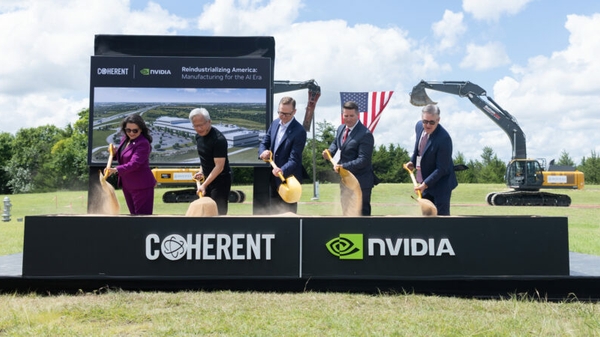
Coherent Breaks Ground on Expanded Texas Facility to Scale the Optical Backbone of Artificial Intelligence
Coherent has officially commenced the expansion of its manufacturing facility in Sherman, Texas, a strategic move designed to bolster the physical infrastructure supporting global artificial intelligence. The company, a leader in high-tech materials and components, specializes in the production of lasers, optical components, and compound semiconductors that serve as the essential connectivity layer for AI systems. Central to this expansion is the facility's role in operating the world’s first 6-inch indium phosphide (InP) manufacturing line. As AI processing demands continue to surge, Coherent’s investment in Texas highlights the critical importance of light-based technologies in maintaining the speed and efficiency of data transmission within AI clusters. This expansion marks a significant step in scaling the optical backbone necessary for the next generation of computational power.
Key Takeaways
- Strategic Expansion: Coherent has broken ground on an expanded manufacturing building in Sherman, Texas, to scale production for AI infrastructure.
- Critical Components: The facility focuses on producing lasers, optical components, and compound semiconductors that "wire" AI systems together.
- Technological Milestone: The site is home to the world’s first 6-inch indium phosphide (InP) manufacturing capability.
- Speed of Light Connectivity: The expansion addresses the growing need for optical solutions to facilitate high-speed AI data processing.
In-Depth Analysis
Scaling the Optical Backbone in Texas
The expansion of Coherent’s Sherman facility represents a pivotal moment for the hardware side of the artificial intelligence industry. While much of the public focus remains on software and GPU performance, the physical connectivity—the "optical backbone"—is what enables these systems to function at scale. Coherent’s decision to grow its Texas footprint underscores the state's emerging role as a hub for high-tech manufacturing. By producing lasers and optical components locally, Coherent is positioning itself to meet the immediate needs of AI developers who require high-bandwidth, low-latency connections to link massive arrays of processors.
The Significance of 6-Inch Indium Phosphide
A core element of Coherent's competitive advantage at the Sherman site is its work with compound semiconductors, specifically indium phosphide (InP). The company operates what it identifies as the world’s first 6-inch indium phosphide line. In the realm of photonics and high-speed data transmission, the transition to 6-inch wafers is a major industrial milestone, allowing for greater scale and efficiency in production compared to smaller wafer sizes. Indium phosphide is a critical material for the lasers and sensors that drive optical networking, making it an indispensable part of the infrastructure that allows AI to run "at the speed of light."
Wiring the Future of AI Systems
As AI models grow in complexity, the challenge of moving data between nodes becomes increasingly difficult. Coherent’s products act as the literal wiring for these systems. By expanding the production of compound semiconductors and optical components, Coherent is addressing a potential bottleneck in AI scaling. The ability to manufacture these components at scale ensures that as computational power increases, the optical pathways used to transmit that power do not lag behind. This expansion is not just about increasing floor space; it is about scaling the specialized technology required to keep pace with the rapid evolution of AI hardware.
Industry Impact
The expansion of the Sherman facility has broad implications for the AI industry supply chain. By increasing the availability of high-end optical components and pioneering 6-inch indium phosphide production, Coherent is helping to stabilize the hardware pipeline for AI data centers. This move reinforces the trend of domestic semiconductor and component manufacturing, providing a reliable source of the specialized hardware needed for high-speed optical communication. Furthermore, it highlights the shift toward light-based technologies as the primary medium for data transfer in high-performance computing environments, ensuring that the physical infrastructure can support the next decade of AI innovation.
Frequently Asked Questions
Question: What specific products will the expanded Coherent facility produce?
Answer: The facility in Sherman, Texas, is dedicated to manufacturing lasers, optical components, and compound semiconductors. These parts are used to connect and integrate various AI systems, forming the optical backbone of modern data infrastructure.
Question: Why is the 6-inch indium phosphide line significant?
Answer: Coherent’s 6-inch indium phosphide (InP) line is the first of its kind in the world. This material is essential for high-speed optical communications, and the 6-inch format allows for more efficient, large-scale production of the semiconductors required for AI connectivity.
Question: How does Coherent’s expansion affect the AI industry?
Answer: The expansion helps scale the production of critical hardware that allows AI systems to communicate at high speeds. By increasing the supply of optical components, Coherent supports the industry's need for faster data transmission and more robust physical infrastructure.