
Meituan Technical Team Open-Sources LongCat-Flash-Prover for Rigorous Mathematical Theorem Proving and Formalization
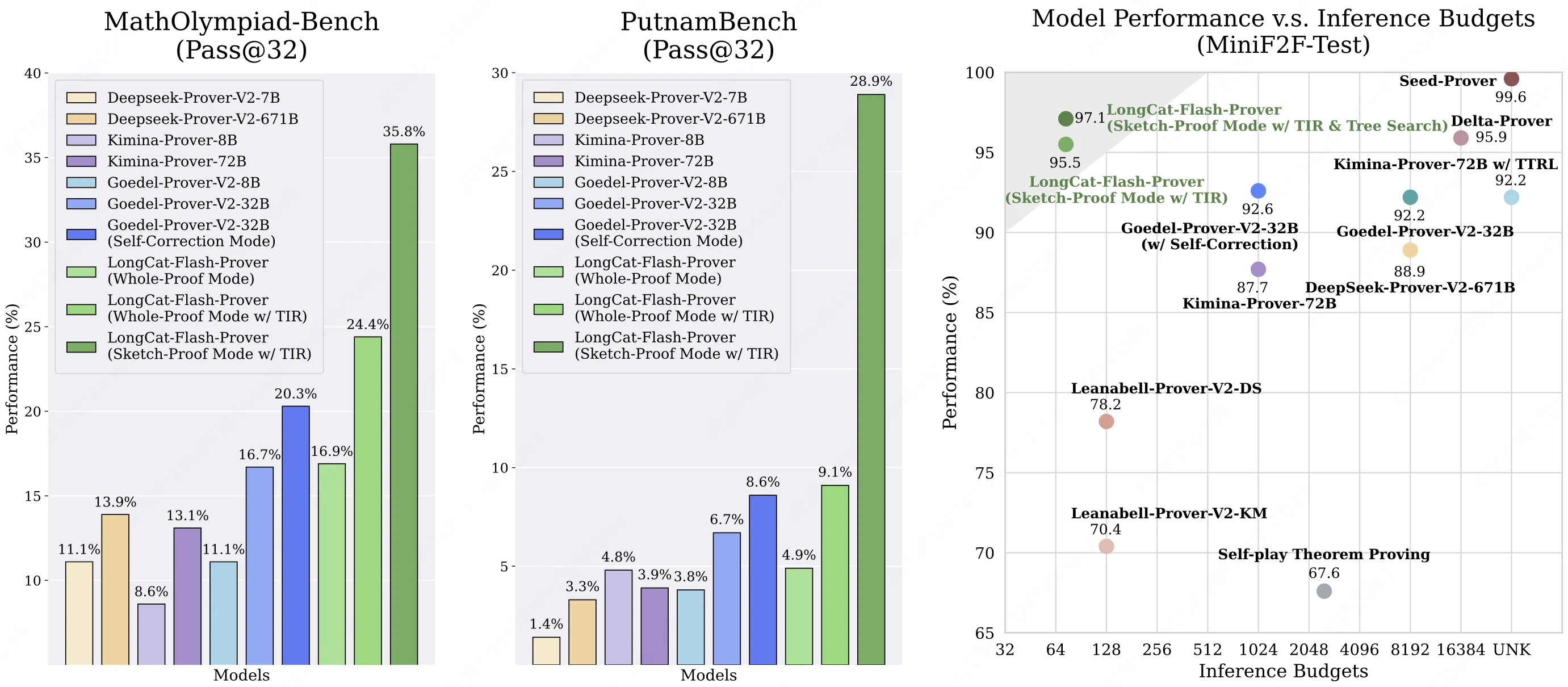
The Meituan Technical Team has announced the open-source release of LongCat-Flash-Prover, a specialized AI model designed to tackle the complexities of mathematical formalization and theorem proving. Unlike conventional AI models that prioritize reaching a correct final numerical value, LongCat-Flash-Prover focuses on the construction of rigorous logical chains. The model addresses a critical challenge in AI reasoning: the tendency for natural language ambiguity to undermine the validity of a proof. By shifting the focus from "guessing answers" to "rigorous proof," this initiative aims to enhance the capabilities of AI in handling complex reasoning tasks where precision and formal logic are paramount. The release marks a significant contribution to the field of automated reasoning and formal verification.
Key Takeaways
- Open-Source Release: Meituan has made LongCat-Flash-Prover available to the public, focusing on mathematical theorem proving.
- Rigorous Logic: The model moves beyond simple numerical accuracy to ensure every step of a mathematical proof is logically sound.
- Addressing Ambiguity: It specifically targets the issue of natural language ambiguity which often leads to the failure of AI-generated proofs.
- Formalization Focus: The tool is designed for mathematical formalization, a process that requires extreme precision compared to standard problem-solving.
- Complex Reasoning: LongCat-Flash-Prover represents a step forward in transitioning AI from intuitive guessing to structured, verifiable reasoning.
In-Depth Analysis
From Numerical Accuracy to Logical Rigor
In the current landscape of artificial intelligence, many models are evaluated based on their ability to provide the correct final answer to a mathematical problem. However, the Meituan Technical Team identifies a significant gap between "calculating correctly" and "proving rigorously." In standard mathematical tasks, a model might arrive at the correct numerical value through heuristic patterns or "guessing," but this does not suffice for theorem proving.
Theorem proving requires a strict logical chain where each statement must follow undeniably from the previous ones. LongCat-Flash-Prover is engineered to address this specific requirement. By focusing on the process of formalization, the model ensures that the reasoning path is as important as the conclusion. This shift is crucial for complex reasoning tasks where the validity of the entire structure depends on the integrity of every individual link in the logical chain.
Overcoming the Pitfalls of Natural Language
One of the primary obstacles in AI-driven theorem proving is the inherent ambiguity of natural language. As noted by the Meituan Technical Team, even a slight ambiguity in phrasing can lead to the collapse of an entire mathematical proof. Natural language often lacks the precision required for formal logic, leading models to produce arguments that may seem plausible but are fundamentally flawed upon closer inspection.
LongCat-Flash-Prover is designed to mitigate these risks by emphasizing formalization. By translating mathematical concepts into a formal framework, the model reduces the reliance on ambiguous natural language descriptions. This approach allows the AI to maintain a level of strictness that prevents logical gaps. The goal is to move the AI away from the "guesswork" associated with large language models and toward a more disciplined, formal approach to mathematical truth.
The Challenge of Complex Reasoning
Complex reasoning remains one of the most challenging frontiers for AI. The development of LongCat-Flash-Prover is a direct response to the difficulty of making AI models perform reliably in high-stakes logical environments. Theorem proving serves as a perfect test case for this, as it leaves no room for error.
The Meituan Technical Team's decision to open-source this model suggests a commitment to advancing the collective understanding of how AI can be trained for formal verification. By providing a specialized tool for mathematical formalization, they are addressing the core issues of consistency and verification that currently limit the application of AI in advanced scientific and mathematical research. The model's design reflects a deep understanding that for AI to be truly useful in these fields, it must be able to prove its work through a verifiable and rigorous process.
Industry Impact
The release of LongCat-Flash-Prover has significant implications for the AI industry, particularly in the sectors of automated reasoning and formal verification. By open-sourcing a model specifically tuned for theorem proving, Meituan is providing a foundation for other researchers to build upon, potentially accelerating the development of AI that can assist in scientific discovery and software verification.
Furthermore, this move highlights a growing trend in the industry toward specialized models. While general-purpose LLMs are versatile, specialized models like LongCat-Flash-Prover are necessary for tasks that require absolute logical precision. This release may encourage other tech giants to share specialized tools that address the "hallucination" or "guessing" problems inherent in current AI architectures, leading to more reliable and transparent AI systems in the future.
Frequently Asked Questions
Question: What makes LongCat-Flash-Prover different from other math-solving AI?
Unlike models that focus on finding the correct final numerical answer, LongCat-Flash-Prover is designed for formal theorem proving, which requires a strict, step-by-step logical chain and formalization to ensure the entire proof is rigorous and verifiable.
Question: Why is natural language a problem for AI in mathematical proofs?
Natural language is often ambiguous. In the context of a formal mathematical proof, any ambiguity can lead to a logical failure. LongCat-Flash-Prover aims to solve this by focusing on formalization, which removes the vagueness associated with standard language.
Question: Is LongCat-Flash-Prover available for public use?
Yes, the Meituan Technical Team has open-sourced LongCat-Flash-Prover, making it available for the community to use and develop further for mathematical formalization and theorem proving tasks.