Meituan LongCat Team Open-Sources WBench: The First Systematic Multi-Round Benchmark for Interactive Video World Models
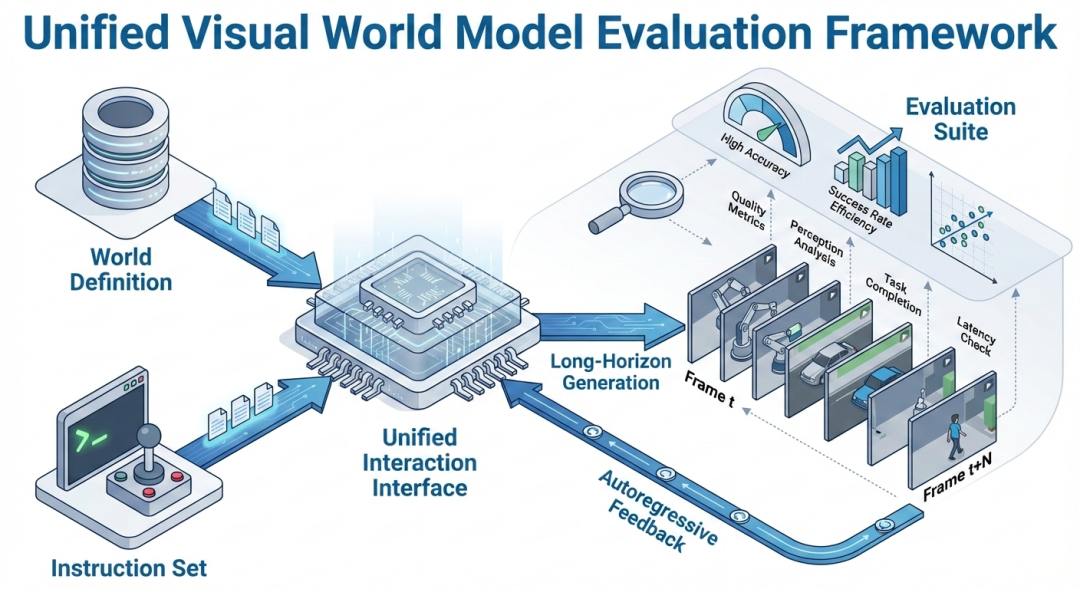
The Meituan LongCat team has officially introduced and open-sourced WBench, a pioneering evaluation framework designed to test the limits of interactive video world models. Positioned as the first systematic multi-round benchmark in its category, WBench functions as a diagnostic tool—likened to a "CT scanner"—to identify specific technical hurdles as AI transitions from passive video generation to active, interactive environmental simulation. By focusing on the boundaries between "passive viewing" and "active interaction," WBench provides a rigorous methodology for assessing how models maintain consistency across complex, multi-step scenarios. This open-source contribution aims to standardize the evaluation of world models, offering insights into their performance in diverse settings ranging from lunar landscapes to futuristic urban environments.
Key Takeaways
- Pioneering Framework: WBench is the first systematic multi-round evaluation benchmark specifically designed for interactive video world models.
- Diagnostic Precision: The Meituan LongCat team describes the tool as a "CT scanner" capable of pinpointing exactly where world models fail during interaction.
- Focus on Interaction: The benchmark targets the critical transition phase where AI moves from "passive viewing" to "active interaction."
- Open Source Contribution: By open-sourcing WBench, Meituan provides the global AI community with a standardized tool to measure and push the boundaries of world model capabilities.
In-Depth Analysis
The Shift from Passive Observation to Active Interaction
In the current landscape of artificial intelligence, the development of "world models" represents a significant leap toward creating systems that understand and simulate physical reality. However, a primary challenge identified by the Meituan LongCat team is the gap between a model's ability to generate or observe video (passive viewing) and its ability to respond logically to user inputs within that video (active interaction).
WBench is specifically engineered to address this gap. While many existing models can produce visually stunning sequences, they often struggle when a user attempts to interact with the environment. These failures in "active interaction" can manifest as logical inconsistencies, loss of spatial awareness, or the breaking of physical laws. WBench provides a structured environment to test these interactions across multiple rounds, ensuring that the model doesn't just perform well in a single instance but maintains a coherent world state over a sustained period of engagement.
WBench as a Diagnostic "CT Scanner" for AI
The metaphor of a "CT scanner" used by the LongCat team highlights the diagnostic nature of WBench. In medical imaging, a CT scanner allows doctors to see internal structures and identify specific points of failure or disease. Similarly, WBench is designed to look "under the hood" of a world model. Instead of providing a simple pass/fail grade, it aims to identify the specific "bottlenecks"—the exact moments and conditions under which a model's simulation of reality begins to degrade.
This systematic approach is crucial for iterative development. By identifying whether a model fails during a "moonwalk" simulation due to gravity logic or in a "cyber city" due to complex architectural rendering and navigation, researchers can apply targeted fixes. The "multi-round" aspect of the benchmark is particularly vital here; it tests the cumulative error of a model. In interactive settings, a small error in round one can lead to a total collapse of the world model by round five. WBench captures this progression, providing a clear map of the model's operational boundaries.
Establishing a Systematic Multi-Round Standard
Before the introduction of WBench, the evaluation of interactive world models lacked a unified, systematic framework. Most assessments were either qualitative or limited to single-turn interactions. Meituan's LongCat team has filled this void by establishing a benchmark that emphasizes "multi-round" evaluation. This means the AI is tested on its ability to process a sequence of actions and maintain a consistent environment throughout the entire chain of events.
This systematic nature ensures that the evaluation is repeatable and objective. By covering diverse scenarios—from the low-gravity environment of a moonwalk to the high-density complexity of a cybernetic metropolis—WBench challenges models to demonstrate a generalized understanding of different physical and logical rules. This variety is essential for determining if a world model has truly learned the underlying principles of an environment or is simply mimicking patterns found in its training data.
Industry Impact
The release of WBench is poised to have a significant impact on the AI industry by providing a much-needed yardstick for the next generation of generative models. As the industry moves beyond simple text-to-video generation toward fully interactive simulations, the ability to measure progress accurately becomes paramount.
By open-sourcing this tool, Meituan is fostering a more transparent and collaborative research environment. Standardized benchmarks like WBench allow different teams to compare their models' interactive capabilities on a level playing field, which typically accelerates the pace of innovation. Furthermore, the focus on "active interaction" aligns with the broader industry goal of developing AI for robotics, autonomous driving, and immersive virtual reality, where a model's understanding of interaction is a matter of safety and functional utility.
Frequently Asked Questions
What is the primary purpose of WBench?
WBench is designed to serve as a systematic multi-round evaluation benchmark for interactive video world models. Its goal is to identify the technical limits of these models as they transition from simply generating video to allowing active user interaction within a simulated environment.
Why does the Meituan LongCat team refer to WBench as a "CT scanner"?
The team uses this metaphor because WBench is designed to provide a deep, diagnostic look at a model's performance. It doesn't just evaluate the output but helps researchers pinpoint exactly where and why a model fails to maintain a consistent interactive world.
What does "multi-round evaluation" mean in the context of WBench?
Multi-round evaluation refers to testing the AI model over a series of sequential interactions rather than a single action. This tests the model's ability to maintain logical and physical consistency over time, which is a much higher bar for world models than single-turn generation.