Managing AI Coding with Agent Evaluation Logic: Lessons from a 310,000-Line AI Refactoring Project
As AI-generated code accounts for over 90% of system development, the primary challenge has shifted from production speed to the effective constraint of AI capabilities. Without unified standards, AI risks exponentially increasing system chaos. This analysis explores the practice of the Meituan technical team in refactoring 310,000 lines of code by applying Agent evaluation logic to AI coding management. By implementing a structured framework consisting of technical debt sorting, rule construction, Refactoring Standard Operating Procedures (SOPs), and Pre-PR mechanisms, the team successfully transformed high-cost refactoring into a continuous, iterative daily process. This approach ensures that AI-driven development remains orderly and sustainable, preventing the accumulation of unmanaged technical debt while maintaining high code quality across large-scale systems.
Key Takeaways
- Shift in Focus: In an environment where 90% of code is AI-generated, the priority shifts from coding speed to the ability to constrain and govern AI outputs.
- Agent Evaluation Logic: Managing AI coding requires a framework similar to Agent evaluation, focusing on systematic oversight rather than manual line-by-line review.
- Four Pillars of Management: Successful AI refactoring at scale (310,000 lines) relies on technical debt sorting, rule construction, Refactoring SOPs, and Pre-PR mechanisms.
- Operational Efficiency: These mechanisms transition refactoring from a high-cost, specialized project into a routine, iterative action integrated into daily development.
In-Depth Analysis
The Challenge of AI-Generated Chaos
The advent of AI in software engineering has enabled a reality where the vast majority of code—often exceeding 90%—is generated by artificial intelligence. However, this surge in productivity brings a significant risk: the amplification of chaos. The Meituan technical team identifies that without a unified set of specifications and constraints, AI does not inherently produce better systems; instead, it can accelerate the accumulation of technical debt and architectural inconsistency. The core issue is no longer how fast code can be written, but how effectively the AI's capabilities can be constrained to align with organizational standards and system integrity.
Implementing the Agent Evaluation Framework
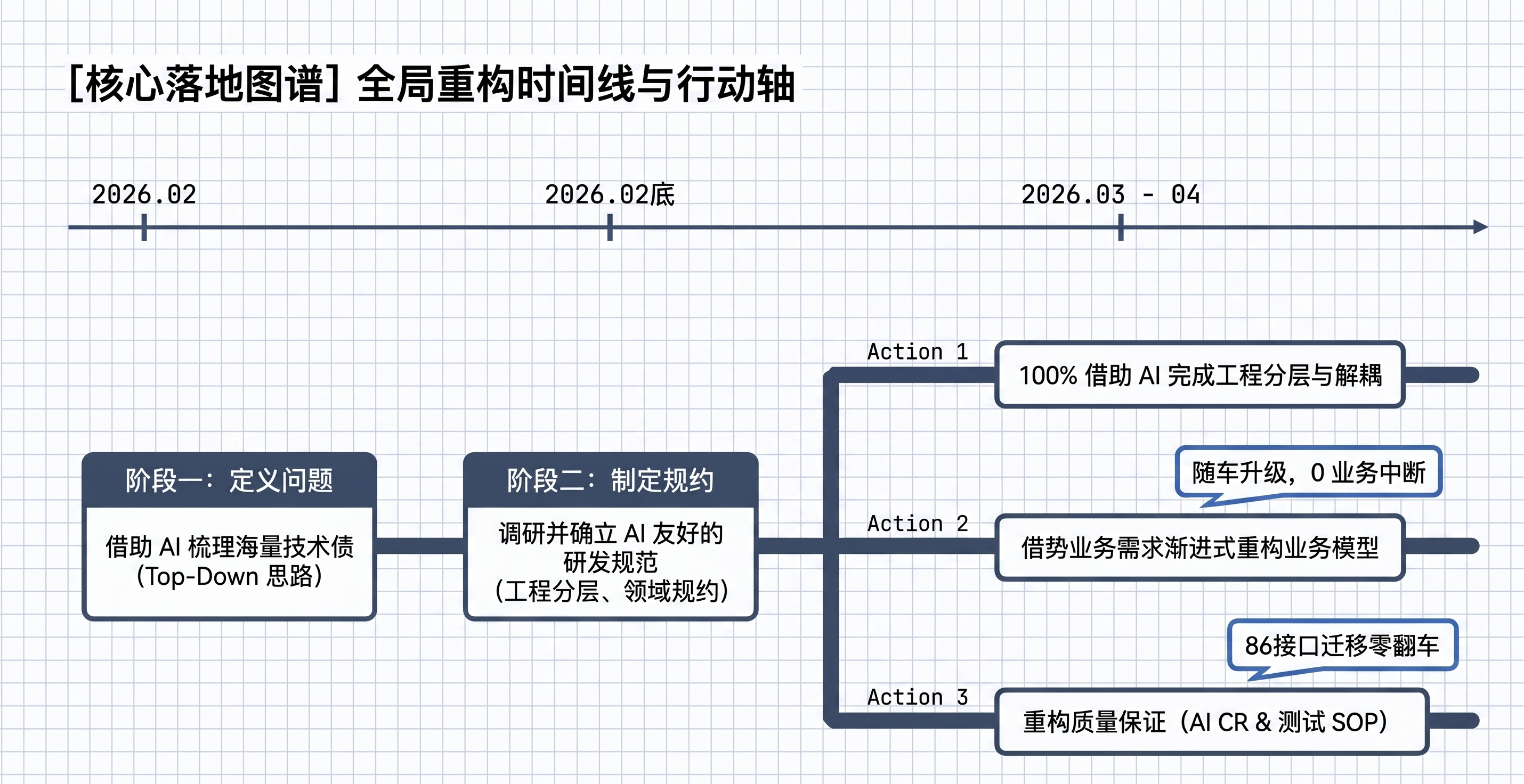
To address the complexities of managing AI-driven development, the team adopted an "Agent evaluation" mindset. This approach treats the AI as an autonomous agent that must be managed through rigorous evaluation and structured workflows. The practice, applied to a massive 310,000-line code refactoring project, centers on several critical components:
- Technical Debt Sorting: Identifying and categorizing existing issues to provide the AI with a clear roadmap of what needs improvement.
- Rule Construction: Establishing explicit rules that the AI must follow, ensuring that generated code adheres to specific architectural and stylistic requirements.
- Refactoring SOP (Standard Operating Procedure): Creating a standardized process for how refactoring tasks are assigned to and executed by the AI, reducing variability in output quality.
- Pre-PR Mechanism: Implementing a validation layer before a Pull Request (PR) is even created. This mechanism acts as a gatekeeper, ensuring that AI-generated refactors meet all predefined rules and standards before they enter the human review or integration phase.
From Special Projects to Daily Iteration
One of the most significant outcomes of this methodology is the transformation of the refactoring process itself. Traditionally, large-scale refactoring (such as a 310,000-line project) is viewed as a high-cost, specialized "special project" that requires dedicated time and resources. By leveraging AI under the Agent evaluation framework, the Meituan team has successfully integrated these tasks into the daily development cycle. The combination of automated rules and SOPs allows for continuous improvement of the codebase, making refactoring a "daily action" that occurs alongside regular feature iterations rather than a disruptive, periodic necessity.
Industry Impact
Redefining the Role of the Developer
As AI takes over the bulk of code generation, the developer's role is evolving into that of a "System Architect" and "AI Manager." The focus is moving toward defining the constraints, rules, and evaluation metrics that govern AI agents. This shift suggests that future software engineering excellence will be defined by the quality of an organization's AI governance frameworks rather than the manual coding skills of its staff.
Scalability of Technical Debt Management
The ability to refactor 310,000 lines of code through a continuous, AI-managed process sets a new benchmark for technical debt management. For the broader industry, this demonstrates that legacy systems can be modernized more efficiently if the right oversight mechanisms—like Pre-PR gates and SOPs—are in place. It offers a blueprint for maintaining long-term code health in the age of rapid AI expansion.
Frequently Asked Questions
Question: Why is "Agent evaluation logic" used for AI coding?
Because AI-generated code can quickly become unmanageable at scale, treating the AI as an Agent allows teams to apply systematic evaluation and constraint mechanisms. This ensures the AI's output is consistent with system requirements and prevents the "amplification of chaos" that occurs when AI operates without strict oversight.
Question: What is the purpose of the Pre-PR mechanism in this context?
The Pre-PR mechanism serves as an automated quality gate. It checks AI-generated code against established rules and SOPs before a Pull Request is submitted. This reduces the burden on human reviewers and ensures that only code meeting high-quality standards reaches the final stages of the development pipeline.
Question: How does this approach change the cost of code refactoring?
By using AI guided by SOPs and automated rules, refactoring is no longer a high-cost, one-time specialized project. It becomes a low-friction, continuous process that happens during daily iterations, significantly reducing the long-term cost and effort required to maintain a healthy codebase.